As more power producers embark on integrating new systems to decarbonize – such as hydrogen production, storage, and usage – many are unsure how to proceed.
Do they dip their toes in the water with a small demonstration project or take a larger leap with a more comprehensive investment? How do they adapt existing assets for hydrogen utilization? How do they manage the complexity of hydrogen infrastructure that comes with new systems and supply chains?
New technologies related to the usage of hydrogen create a paradox. Driven by the critical importance of economies of scale for commercial viability, there is need for standardization of design and system configuration. But there is also need for flexibility so a solution can be adapted or customized for a given customer’s unique needs, geography, and resources.
At this point in the energy transition, Mitsubishi Power is seeing progress across the board in the development of hydrogen infrastructure – from advances in hydrogen production technology to the execution of a large hydrogen hub in Utah – that is revolutionizing production and storage. Collaboration and a continued push on both technology and infrastructure is needed to spur progress.
Our examination of the challenges and opportunities facing our industry includes:
• Dealing with diverse customers
• Addressing the need for standardization of hydrogen infrastructure
• Developing a utility-scale green hydrogen hub
One size does not fit all
Let’s start with the need for customization. Power producers come in all shapes and sizes, and many regard hydrogen as an unproven frontier. That is understandable since a negligible amount of all U.S. electricity generation in 2022 was fueled by hydrogen.
Meanwhile, natural gas made up nearly 40% share of U.S. power generation and many producers continue to invest substantial capital in gas-fired assets. These new assets range from large combined cycle plants with planned high capacity factors to peaking units designed for rapid response.
As a result, there are vastly different anticipated needs for hydrogen infrastructure. Some customers, leveraging incentives from the public sector, need hundreds of electrolyzers to ramp up utility-scale production from renewables. Others that want green hydrogen at smaller scale need significantly fewer units. And still others, merely looking to pilot demonstration of hydrogen integration, may select an alternative to traditional green hydrogen production and select an alternative technology such as methane pyrolysis.
If the goal is to decarbonize existing assets – today or tomorrow – a one-size-fits-all policy won’t work. Supporting all ends of the demand will be challenging, but solutions can be found by building the right technology partnerships and working closely with customers to meet their needs.
Toe in the water
For power producers looking to dip their toe in the water, a clean-slate approach isn’t the right answer. Producers have invested significant capital into fleets of gas turbines that require decades to recoup; they’re understandably wary of stranding those assets. That’s where a blended fuel approach makes the most sense, modifying existing turbines to integrate some hydrogen with traditional hydrocarbons – and starting with a proof-of-concept pilot project. Here, the source of hydrogen is less important than the need to see its viability within current infrastructure.
We at Mitsubishi Power did just that in 2022, working with Georgia Power and the Electric Power Research Institute to validate North America’s first 20% hydrogen blend for an advanced-class gas turbine. On an M501G turbine at Georgia Power’s Plant McDonough-Atkinson in Smyrna, Ga. (Figure 1) the 20% blend reduced carbon emissions by roughly 7% compared to fully fired on natural gas. (See “M501G hydrogen demo a significant first step towards decarbonization,” GTW December 2022).

Standardization is key
At the other end of the spectrum are the customers ready to go all-in; developers starting greenfield projects to leverage emissions-free hydrogen at a larger scale.
Not all are power producers – some want to export clean ammonia, for example – but they recognize the true potential of hydrogen as a vehicle for energy storage. To get there, at scale, standardization is key. Partners must pre-engineer, standardize, duplicate, and scale as much as possible, driving down costs as the path is forged.
That’s what we are doing at the Advanced Clean Energy Storage (ACES Delta) hub in Delta, Utah, which will supply clean hydrogen to the Intermountain Power Project (IPP) Renewed J-class combined cycle plant now under construction .
In mid-2023, two M501JAC advanced-class 453MW gas turbines were delivered to IPP Renewed, each capable of up to a 30%(v) hydrogen fuel blend upon startup in 2025. These turbines are targeted to reach 100% hydrogen by 2045 or sooner, all part of a total site redevelopment that transitions the original IPP plant from 1,800MW of coal-fired generation to 840 MW of 100% carbon-free hydrogen-fueled combined cycle power.
Providing future-proof solutions today ensures that customers can transition their assets over time and feel confident in making long-term investment decisions.
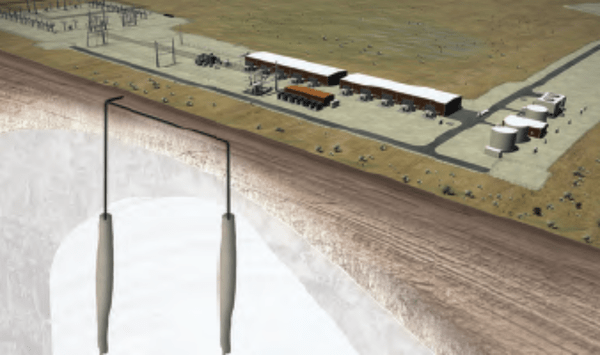
The ACES Delta Hub
The ACES Delta Hub, now under construction and scheduled to start operation in 2025, will be one of the world’s largest clean hydrogen hubs; it will use excess renewable energy and a 220MW (40 x 5.5MW) bank of electrolyzers to produce carbon free hydrogen. The hydrogen will be pumped into two massive salt caverns capable of storing up to 300 gigawatt-hours of energy available for future dispatchable power (Figure 2).
In June 2022, the Department of Energy issued a $504.4 million loan guarantee to help finance the project, and progress continues as you read this. Engineering, procurement, and construction (EPC) continues around the clock, with undergrounds and foundations largely in place. Transformers are on site, as is the first shipment of electrolyzers, and rectifiers and gas separators are in transit.
By 2025, ACES Delta and IPP Renewed will form something truly remarkable in hydrogen infrastructure: a facility capable of producing and storing 100 metric tons of hydrogen per day, with much of it fueling a new high-efficiency combined cycle plant to generate energy at a fraction of the net emissions emitted by the coal-fired plant it is replacing (Figure 3).

Building on confidence
There is a virtual loop in the way projects like ACES Delta and IPP Renewed build confidence in the technology; even enough to attract new stakeholders, with Chevron New Energies announced as a major partner in ACES Delta (see Editorial Box at end of article).
But on a broader scale, as more projects get developed and built, there is a continual learning process across the industry, even at small- and medium-scale projects. In Norway, for example, Mitsubishi Power partnered with HydrogenPro to construct and validate one of the world’s largest single stack high-pressure alkaline electrolyzer systems. And in Japan, Mitsubishi is investing in a permanent installation to advance hydrogen production through electrolysis and other technologies.
As we adopt new technologies and efficiencies in these hydrogen infrastructure projects, we can apply these lessons going forward. That experience can help those at the trailhead of their hydrogen journey, most of whom have questions related to hydrogen use in gas turbines. There are legitimate concerns – and good field validation is pivotal. Research is important, but nothing builds confidence in a technology investment like real-world experience.
Choosing right partner does matter
From custom pilot projects to standardized large-scale hydrogen delivery, it is important for power producers to choose partners with experience on both sides. The ideal hydrogen partner has the flexibility to support one-off smaller installations and the know-how to scale mega hydrogen infrastructure projects. These are symbiotic elements in the broader puzzle.
From our HydrogenPro validation unit in Norway, we learned of small design and manufacturing improvements that could be incorporated – and applied them to the electrolyzers shipped to our Takasago Hydrogen Park, Mitsubishi Power’s end-to-end verification center in Japan and the 220 MWs of electrolyzers for ACES Delta Hub in Utah. (See “Hydrogen Park to support validation of hydrogen gas turbine technologies, Gas Turbine World, June, 2022).
See Figure 4 for the photo of a fully assembled HydrogenPro 5.5MW single-stack pressurized alkaline electrolyzer. Permanent installation of such a unit has been completed at the Hydrogen Park and it now operates at full load and in real-world conditions as long-term validation testing begins.

At the same time, at our Takasago R&D center, we are pressing ahead on combustion technology improvements for both our H-25 (41 MW) and M501JAC (453 MW) gas turbines, using self-produced hydrogen. Over the next 18 months, we will validate the hydrogen capabilities on both models, with increasing hydrogen co-firing on units installed at our facility.
Across Japan, at Mitsubishi Heavy Industries’ Carbon Neutral Park in Nagasaki, we are developing solid oxide electrolyzers and methane pyrolysis as alternative processes for hydrogen production. Those technologies are mutually beneficial as they will similarly be installed at our Takasago facility for long term validation in a commercial-scale deployment. Mitsubishi Power’s philosophy on validation ensures the hydrogen partner, not the customer, works through the learning process on ‘serial number one’.
For integrating the technologies and pre-designing the hydrogen production equipment, Mitsubishi Power has developed the Hydaptive package which incorporates all of the elements of a standardized hydrogen-enabled combined cycle plant (Figure 5). By having a standard design configuration, cycle time and costs can be reduced for the overall project. Using this approach, we can partner with the project’s EPC contractor to provide our respective scopes of supply where we add the most value and make each project as competitive as possible.

Meeting customers where they are
While the energy sector has yet to realize a hydrogen economy, it is clearly in the early stages of getting there, and it is important for technology providers to stay ahead of power producers’ needs. As an example, the hydrogen co-firing capability needs to stay ahead of the available hydrogen supply. And the electrolyzer manufacturing supply chain needs to expand to support the anticipated demand. Most of today’s projects are smaller scale, but a near future of giga-watt-sized projects is conceivable.
Leveraging hydrogen to decarbonize power generation requires partners who meet customer needs in real time, whether it is an all-in approach that needs scalable green hydrogen or a toe-in-the-water position to see what hydrogen integration looks like. Collaboration is vital to project success and producers at either end benefit from partners with experience across the board – those who cultivate a standardized approach to scale up when the moment is right, even as they deliver custom solutions for producers at the start of their hydrogen journey.
The paradox between standardization and customization is real, but the best partners can embrace both.
Chevron buys majority stake as ACES Delta Hub approaches commercialization
As viability approaches for the Advanced Clean Energy Storage (ACES Delta) hub in Delta, Utah, the first-of-its-kind hydrogen facility has attracted new partners and additional expertise. In September of this year, Chevron New Energies Company, via acquisition of Salt Lake City based Magnum Development, acquired a majority stake in ACES Delta LLC, the owner and developer of the project.
It’s an example of major energy players bringing their expertise to the table to operationalize the revolutionary hub, which will produce and store green hydrogen, and dispatch 100% hydrogen power in the years to come. Here, it combines Chevron’s long experience in the fuels industry, Mitsubishi Power’s expertise in creating solutions and services around clean-energy technology, and Magnum’s know-how in large-scale underground storage development.
With the goal to use excess electricity from intermittent renewables to produce hydrogen, then store it in two underground salt caverns – each the size of the Empire State Building – ACES Delta will facilitate dispatchable zero-emissions hydrogen that can be used weeks or months after the initial offtake of renewable energy. That shift, capable of preserving surplus power for entire seasons, is not economically possible with conventional batteries.
Customers like the Intermountain Power Agency’s IPP Renewed (a redeveloped coal-fired plant project) expected to transition to 100% hydrogen fuel by 2045, will use hydrogen from ACES Delta to produce 840 MW of carbon-free power. With Chevron aboard this hydrogen infrastructure project, ACES Delta should see ongoing development on the path toward commercial operations beginning in 2025 with the ability to produce and store up to 100 metric tons of hydrogen per day.
Editor’s Note:
Mitsubishi Power sub-recipient in Clean Hydrogen Hub awards
Mitsubishi Power Americas has achieved another major milestone in its contributions toward the development of at-scale hydrogen hubs in the U.S.
In response to the U.S. DOE request for hydrogen-based decarbonization solutions, two hydrogen-hub projects in which Mitsubishi Power will participate have been selected to begin award negotiations: (1) the Pacific Northwest Hydrogen Hub; and, (2) the HyVelocity Hub in the Texas Gulf Coast region.
“The selection of these two hydrogen hub projects for award negotiations is indicative of how the hydrogen economy is quickly developing and garnering support from both the public and private sectors”, says Michael Ducker, Mitsubishi Power’s Sr. VP, Hydrogen Infrastructure. “Mitsubishi Power stands ready to support these and other projects for a cleaner, carbon-free future”.