The Tennessee Valley Authority (TVA) was created as part of Roosevelt’s New Deal in 1933.
As the largest public utility in the country, it comprises dozens of hydroelectric, coal and nuclear generation facilities. But its 35 GW portfolio is aging, so the agency is switching out and replacing its coal plants with natural gas generation.
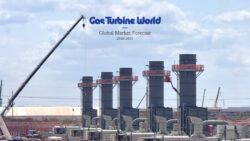
Case in point: the 1.3 GW Kingston Fossil Plant, once the largest coal plant in the world, will be retired in 2027 to be replaced by a 1.5 GW complex. To consist of a combined cycle plant powered by GE Vernova LM600 PF+ gas turbines, 100 MW of onsite battery storage, and 4 MW of solar generation.
Kingston’s demise as a coal generator has come with a decline in capacity. While it used to generate 1.7 GW, it is now down to 1.3 GW. Further, the demand for more frequent starts and stops is causing regular maintenance issues.
According to an official statement, Kingston “was not designed for these types of operations, which present reliability challenges that are difficult to anticipate and expensive to mitigate.”
The replacement plant will make use of 16 dual-fueled aeroderivative gas turbines to provide the bulk of its power output. The Ridgeline Pipeline, being expanded to bring enough natural gas fuel to the plant, should be in service by the fall of 2026.
“Many of TVA’s new gas turbines are replacing older, less efficient units,” said Jamie Cook, TVA’s General Manager of Major Projects. “Natural gas units are cleaner than coal-fired generation. We can also operate them when other sources of generation, like solar, aren’t available. They supplement those sources with reliable power when we need it most.”
TVA is also sensitive to the need for grid stability and voltage support on its network. Planning for the site includes the fact that it “must continue to maintain reserve margins and provide transmission system voltage support needed to maintain overall system stability and reliability.”
The company has ordered synchronous clutches from SSS Clutch Co. for each LM6000 PF+ gas turbine. These clutches are built into a load gear since the gas turbines operate at a speed higher than the generator at 3,600 rpm. The gear is needed to create synchronization with the grid.
“By enabling these LM6000s to run as synchronous condensers, the TVA is ensuring it has enough inertia, system stability and reactive power support,” said Morgan Hendry, President of SSS Clutch.
Grid support is urgently needed as TVA is in an aggressive program to add 1 GW of wind turbines and solar PV in Tennessee. Grids suffer when they close rotating generation plants and replace them with wind and solar. The grid needs rotating inertia as well as the reactive power and system stability benefits that come from traditional power plants.
“Regulators and utilities are starting to realize the folly of retiring natural gas generation assets when they are vitally needed for peaking power and for grid stability,” said Hendry.
For insight into what gas turbine equipment has been purchased to meet specific applications (Simple Cycle, Combined Cycle, pipeline expansion, peaking capacity, chemical plant, etc), our annual Handbook offers a section covering these types of Orders and Installations.
If you’re evaluating new equipment: you can use this to double-check what you’re selecting, or even crowd-source decision-making, by seeing who bought what, for what purpose! The annual Gas Turbine World Handbook is the only guide you’ll ever need for new equipment purchases. ORDER HERE