Fact: Gas Turbine filters help generate more power by preventing turbine degradation – reducing fouling, pressure drop (including spikes) and downtime for offline washes, and other maintenance.
That’s the good news about gas turbine filters. The bad news is there are many types of filters that offer different benefits. Added to this, different suppliers have created confusion about how to measure and compare one filter to the next.
Luckily, there is a way to compare: ISO 29461-1:2021 standard is the first and only international test standard developed specifically for turbomachinery filters, which provides an accurate rating for efficiency and dust holding capacity for the entire range of air intake filters for gas turbines, compressors, and other turbomachinery applications.
ISO T-ratings for gas turbine filters
Previous standards did not meet the needs of the turbomachinery industry, which faces more severe challenges like higher dust concentrations, higher airflows, high pressure drop, heavy snow, high humidity, rain and fog, etc. ISO 29461-1 addresses these needs, ensuring operators have the necessary information to make the best decision for their application. Click here to read the white paper.
Filter efficiencies according to the ISO standard are measured from T2 to T13. This ISO-T rating (T for turbine) is the only accepted standard, and their values should not to be compared to MERV, EN, or ASHRAE.
Why you need air filters
Dirty air can foul turbine and compressor blades, degrade components, and reduce power capacity, causing unscheduled downtime and lost revenue. You can recapture that revenue with the right filtration solution. Despite the central role of air filters in gas turbine performance and operational costs, plant operators often overlook their importance or find themselves at a point of confusion when selecting the right filtration solution.
Filter solutions and performance can vary widely, each with associated cost trade-offs. When they are carefully matched with a plant’s profile, filter costs will be justified by additional power output or equipment protection.
It’s wise to periodically evaluate whether the filters on your system remain optimal for the plant goals ― especially if your operation has changed since the original filter installation.
To determine filtration needs, ask three key questions:
■ What is my plant’s primary need or challenge?
■ What filter solution best meets this challenge?
■ What cost trade-offs are involved in realizing an ROI?
Each plant will need to apply its own ROI equation, but the steps and factors to consider are presented here. If you are interested in the best filter option for your location and operational needs, contact us for a free ROI / Life Cycle analysis (CLICK HERE).
- Identify primary need
Establish your primary need relating to your operational demands and environmental conditions:
Operational considerations: The type of power plant, i.e. base load, peak load, or intermediate load, is the first determinant of your filtration selection. In base load plants, it’s essential that filters can maintain a steady level of clean, dry air over sustained durations, even if it means compromising a minor initial output loss for reliable power with minimal downtime. By contrast, filters in peaking plants need to deliver a high volume of clean, dry air to maximize power output during shorter cycles.
Environmental considerations: The environment gas turbines operate in can vary dramatically based on geography, local activity and seasonal changes. These factors contribute to the differences and changes in the amount, size distribution and type of contaminants ― all of which pose unique challenges for the turbine.
Depending on the conditions at a given site and their operation/maintenance targets, the filtration system can be optimized in terms of the type of filters, efficiency (T-rating), and number of stages.

- Understand filter properties
Filters differ not only in their materials, but also in how they are constructed. Each filter type is designed for specific contaminants and applications.
There are three primary criteria to compare filters: efficiency, water handling, and filter integrity.
Efficiency: This is the most widely recognized performance factor. Not to be confused with cost efficiency, filtration efficiency refers to the proportion of inlet air contaminants removed by the filter, measured by particulate matter concentrations upstream and downstream from the element.
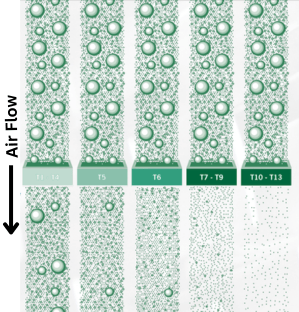
When selecting filters, it is important to ensure that the filter efficiency is tested and rated per ISO 29461-1:2021. Before this standard was implemented, filtration companies referred to a large range of standards that couldn’t easily be compared.
Hydrophobicity: Whether a filter allows water to pass through the filter is another key attribute. In humid or coastal locations, it can be a top priority. In humid conditions, contaminants such as salt and other soluble contaminants, may dissolve in water. If the filter is not hydrophobic and lets this water through to the clean air side, these contaminants will make their way to the turbine when the water evaporates. Any contaminants carried over by water will lead to hot-end corrosion, fouling of the compressor and plugging of cooling channels. A non-hydrophobic filter defeats the purpose of a high efficiency filter, as it will inevitably lead to contaminant bypass.
Hydrophobic properties of a filter will also impact the reliability of your operations by avoiding pressure drop spikes that can lead to unwanted shutdowns or trips for filter changes. To prevent this, filters must be designed with features that enable a low and stable pressure drop. Make sure your filters are rated per ISO 29461-2 hydrophobicity test to ensure the filters are capable of handling water and pressure spikes.
Filter integrity: A filter may have good efficiency and hydrophobicity, but how will it perform overtime, or when challenged with harsh weather conditions? ISO 29461-3 assesses the long-term durability and structural integrity by testing its burst pressure under wet and humid conditions. A filter that passes this test with at least 6250 Pa will ensure that your filters can handle continuous or cyclical loads without failure. During the life of a filter, the filter should remain intact, without any loose pieces to prevent Foreign object damage (FOD) risk, pressure drop should remain low and stable to prevent massive media tears leading to bypass, and efficiency should remain as it was first rated to also prevent bypass.
- Calculate costs and ROI
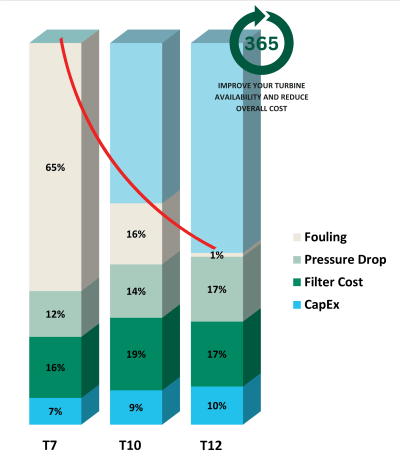
As described in previous sections, there are several trade-offs to consider when selecting a filtration system. To realize a good ROI, the operator needs to balance the capital expenditure (CapEx) and operational expenditure (OpEx) for their setup. A Life Cycle Cost (LCC) analysis eliminates the guesswork related to this, helping operators compare different filter for their assets.
An in-depth LCC analysis considers variables such as:
- Environment and air pollutants
- Impact on filter pressure drop and life
- Filter cost, including installation and disposal
- Fouling impact on compressor degradation and heat rate
- Engine type, configuration, and duty cycle
- Availability requirements and economic value
Request a free Life Cycle Cost analysis (see sample here) to ensure you are making the most cost-effective decision for your turbomachinery applications. Click here to contact us.
Useful links: