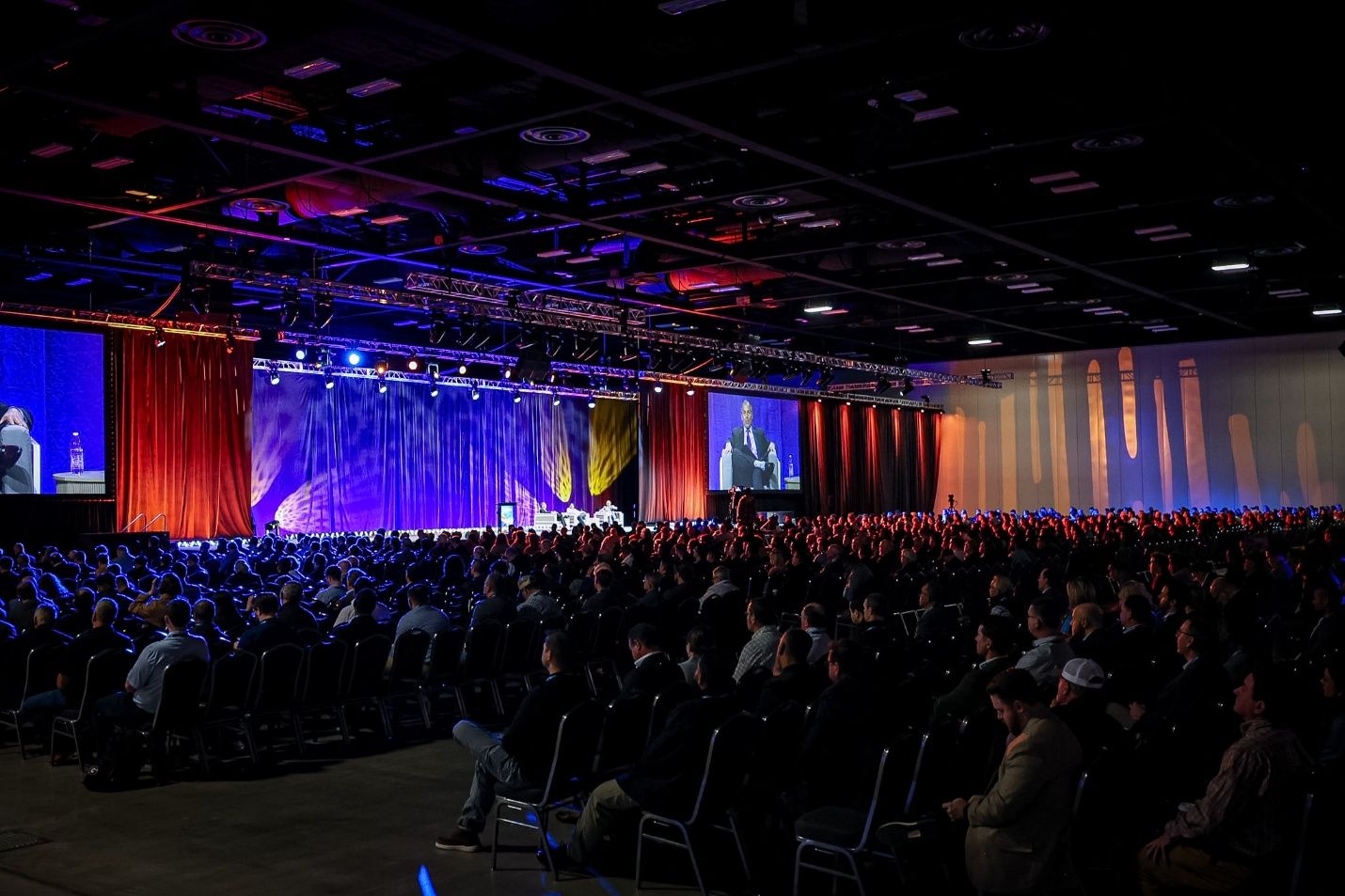
About 8,100 people showed up for the PowerGen 2026 show in Texas.
The annual PowerGen International conference took place earlier in 2026 in San Antonio, Texas. This year’s event was dominated by the data center boom. As well as an entire data center track, the organizers arranged a data center pavilion inside the exhibit hall. Data centers cropped up in almost every conversation.
Attendance was up at this year’s show (from 7,200 in 2025 to 8,100), edging ever closer to its pre-COVID level of 10,000. The event began with a keynote from Texas utility CPS Energy and Sargent & Lundy. Rudy Garza, President and CEO of CPS Energy, discussed the impact of growing demand from data center developers. His company is evaluating many large-load opportunities that might be able to cope with the energy intensity of AI applications.
“Resource requirements are changing the power industry at a faster pace than we ever expected,” said Garza. “Hyperscalers are asking a lot from us, but infrastructure construction might take years.”
Sargent & Lundy has also been impacted by surging data center demand. This is driving greater interest in combined-cycle generation projects though the supply chain is unable to keep up with the speed-to-power expected by developers and hyperscalers. Transmission, turbomachinery, generators, components – all have lengthening lead times.
“Three years ago, we worked on one or two combined cycle projects and now we have at least 15 or happening,” said Victor Suchodolski, Chairman, President & Chief Executive Officer at Sargent & Lundy. “Everyone is disappointed with lead times but there is no magic switch.”
Where are the Turbines?
With so much interest in gas turbines on all fronts, it was unfortunate that the major gas turbine vendors conceded the floor to the gas engine community. Dozens of reciprocating engine companies operated booths and prominently displayed their engines. In stark contrast, no gas turbine OEM booths were to be found and not a single gas turbine could be seen on display anywhere at the conference. Yes, Siemens Energy sponsored the data center pavilion and organized a press dinner. They, as well as GE Vernova and Mitsubishi Power, had speaking slots at the conference. Nevertheless, there appears to be a complacency about the need for high visibility at the industry’s leading event.
As I walked the floor, companies like Central Power Systems and Services caught my attention. They just received an order for 32 of its 420 kW genset packages for a Kentucky data center, arranged to run in parallel. Their lead time is said to be one week. Their facility can produce up to 800 units per year.
Volvo Penta made a big splash with its G17 gas engine aimed at the data center market. This 17-liter, 6-cylinder, spark-ignited model operates on both conventional natural gas and renewable natural gas. The flexible design allows operators to connect directly to existing gas infrastructure, simplifying installation and eliminating the need for additional fuel-conditioning systems. It delivers 450 kW at 1800 rpm, and once again it is being sold in large volume into the data center market. Recent announcements from Wartsila also showcased recip plants providing 200 MW and another from CAT said its recips would provide more than 1.5 GW. Such an incursion from rival technology surely merits more attention from the gas turbine community.
Texas Data Center Storm
Texas has long been known for its oil and gas booms. While it continues to be rich in both commodities, it is now in the midst of a data center boom, as was covered in depth during the PowerGen conference.
“Texas has eclipsed North Virginia as the hot spot for data centers,” said Elaina Ball, Chief Strategy Officer for CPS Energy. CPS can supply 85 GW of power production during peak hours. However, there is another 230 GW of planned capacity in the queue trying to get onto the grid.
Relief may come in the form of the recently approved Senate Bill 6. It provides new rules to speed the interconnection process. Instead of each individual interconnect request being considered independently, the state is now processing requests in larger batches. This could triple the speed of approval. Data centers, too, will be required to pay for upgrades to the grid that are needed for their facilities as a way to protect consumers from rising electricity rates.
“Texas Senate Bill 6 standardizes interconnect fees and apportions transmission costs fairly so data centers pay their share better,” said Ball.
In response to its demand forecast more than doubling, CPS Energy has acquired a series of gas turbine plants as well as more solar, wind and batteries to boost its overall capacity.
“A couple of years ago, the focus was on decarbonization, but the dialogue has changed and now it is all about time to power,” said Ball. “It is all about speed to market.”
Data center operator CyrusOne revealed that a key strategy is to position its data centers beside new or existing power resources so they can share a point of interconnection and avoid joining an interconnect queue. Part of the reason for this approach is that the scale of projects has risen sharply. From 100 MW to 300 MW range in 2024, new projects are often a GW or more.
“You have to plan long term along many channels, which includes co-development of new facilities, and behind the meter power (BTM) rather than waiting on grid availability,” said Gene Alessandrini, Senior Vice President of Energy and Location Strategy at CyrusOne. “New power will largely be BTM but most will then become connected to the grid later.
He noted that the company’s 2030 carbon neutral goal has become more difficult to achieve due to the necessity of adding more natural gas to satisfy so many interconnect requests.
“We will be building more gas plants over the next few years as they can be done rapidly and the price of gas is unlikely to rise much as there is so much of it around,” he said.
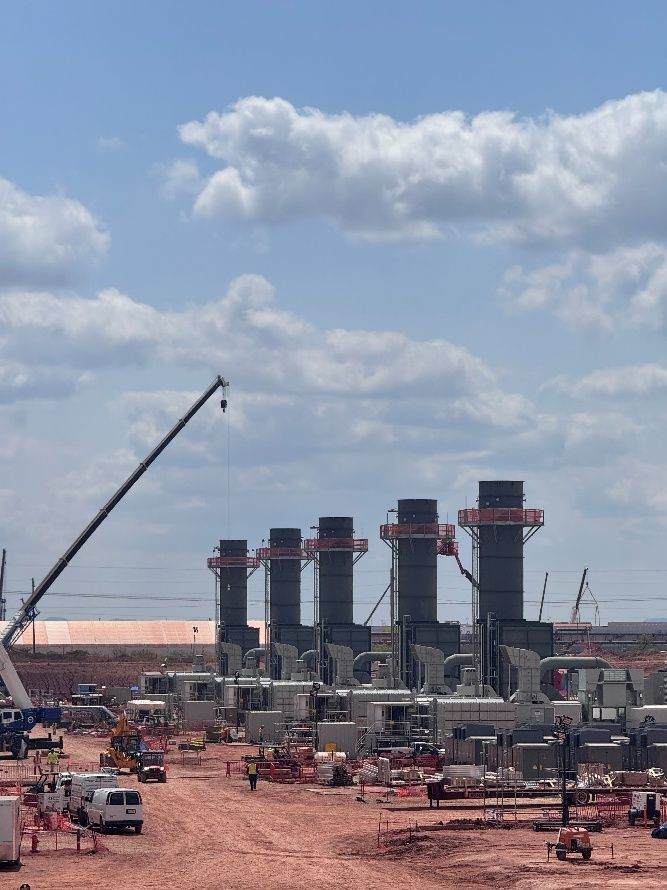
turbines to run a huge AI factory in Texas.