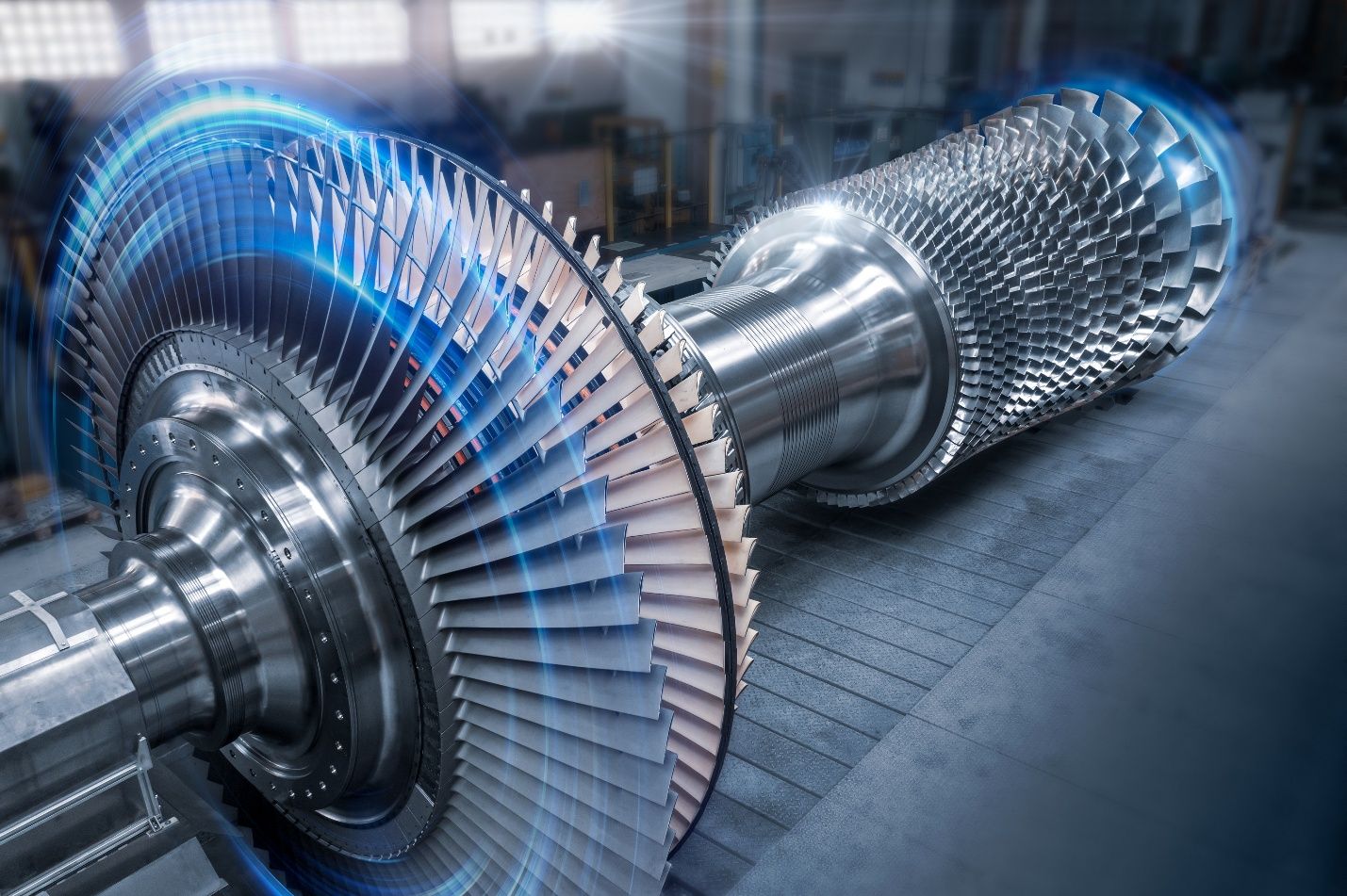
The Ansaldo Energia GT36 rotor.
Gas Turbine World visited the Ansaldo Energia factory in Genoa Italy. After a tour of its massive facilities, we sat down with executives from the company for an update on its various gas turbine offerings. These include the H-Class GT36, and the F-Class GT26 and AE94.3A.
Ansaldo as a corporate entity dates back to 1853. It has been in the gas turbine business since 1960. Its Genoa facility, where all manufacturing is done, spans 220,000 square meters.
A smaller facility (around 10,000 square meters) a couple of kilometers away is situated beside the harbor. As some turbines are too large to transport from the main site to the harbor by road, they are taken in sections and assembled at the harbor site to be shipped around the world.
The main site is where all turbines are made, milled, welded, machined, tested, and repaired. A few functions such as casting and thermal barrier coating (TBC) application are done by partners.
The company is expanding its manufacturing capabilities. Two large milling machines have been introduced to alleviate a bottleneck on GT36 rotor production.
This expansion is being driven by increased orders from all areas outside the Americas, according to Stefani Gianatti, Executive Vice President of Thermal New Units at Ansaldo Energia.
Data center interest is strong in Europe, Middle East and within Italy. Also, there has been a surge in the need for traditional power generation to support the build \out of renewables.
“Five years ago, there was little investment in gas turbines but now it is completely different,” said Gianatti. “The grid needs both gas turbines and renewables.”
He believes the thermal power sector will show several years of strong growth above expectations and will then stabilize. In support of this trend, Ansaldo Energia invested 80 million Euros in 2025 and is continuing to invest.
As well as ramping up manufacturing, it has been strengthening its supply chain in areas such as casting where it competes against the aerospace and military sectors.
Ansaldo is also increasing its production of generators and synchronous condensers (with flywheels). Gianatti said that the company recently sold 10 synchronous condensing units to the Italian grid, and another to the UK grid.
GT36
Alstom originally conceived the GT36 as a 60 Hz machine. At the time Ansaldo Energia acquired Alstom, a prototype existed. The company switched the focus to 50 Hz and pushed the development through to completion by 2020.
Since then, extensive testing and validation, as well as initial models in the field, have provided confidence that this turbine is ready for broad market adoption.
Like the GT26, the GT36 features sequential combustion with an important difference. The GT26 has two stages built into the gas turbine, but the GT36 has confined the stages to within the combustion system itself. This makes the GT36 less complex.
However, many 3D printed parts are needed within the GT36 combustion section to help with all stages.
Features include a 15-stage axial compressor with four variable guide vanes, a four-stage, air cooled turbine, a cold-end generator driven, a cannular sequential combustor chamber and a solid welded rotor. Maintenance intervals are 33,000 hours for hot gas path inspections.
The GT36 can run down to loads of only 15%. Emissions levels are 25 ppm NOx and 10 ppm CO. (NOx level can go below 15 ppm in dry gas mode). The GT36 also has a 70% hydrogen capability, fast start and fast ramp-up of 100 MW per minute ramp, high part load efficiency, and high turndown capability with low fuel consumption, providing high reserve power.
The current GT36 fleet has over 60,000 EOH. Gianatti said the company has reservation agreements for 4 units in Europe, two of which are in Germany plus another 3 in advanced development in the Middle East.
Why is the Ansaldo Energia H-class superior to other H-class machines? Bonzani stressed its operational flexibility (startup time, ramp time, load down to 15% load), and its 70% hydrogen capability.
“If the combined cycle plant runs at base load, we are not the best choice in terms of overall power and efficiency,” said Bonzani. “But as many combined cycle plants now have cycling operation, our flexibility, ramp rate and partial load efficiency make us the best bet.”
You can read the full article about our visit in the next print edition of Gas Turbine World. This article includes details of the rest of the Ansaldo Energia fleet, the company’s market expectations, what it is doing to ramp up manufacturing output, and its plans to achieve 100% hydrogen in all its machines.