2025 was a very good year for gas turbine orders.
Every year at the Western Turbine Users Inc. (WTUI) show, Anthony (Tony) Brough, Principal Consultant at Dora Partners and Company, presents the latest sales trends and predictions related to gas turbines. At WTUI 2026 in Long Beach, California, he noted extremely high demand for industrial gas turbines.
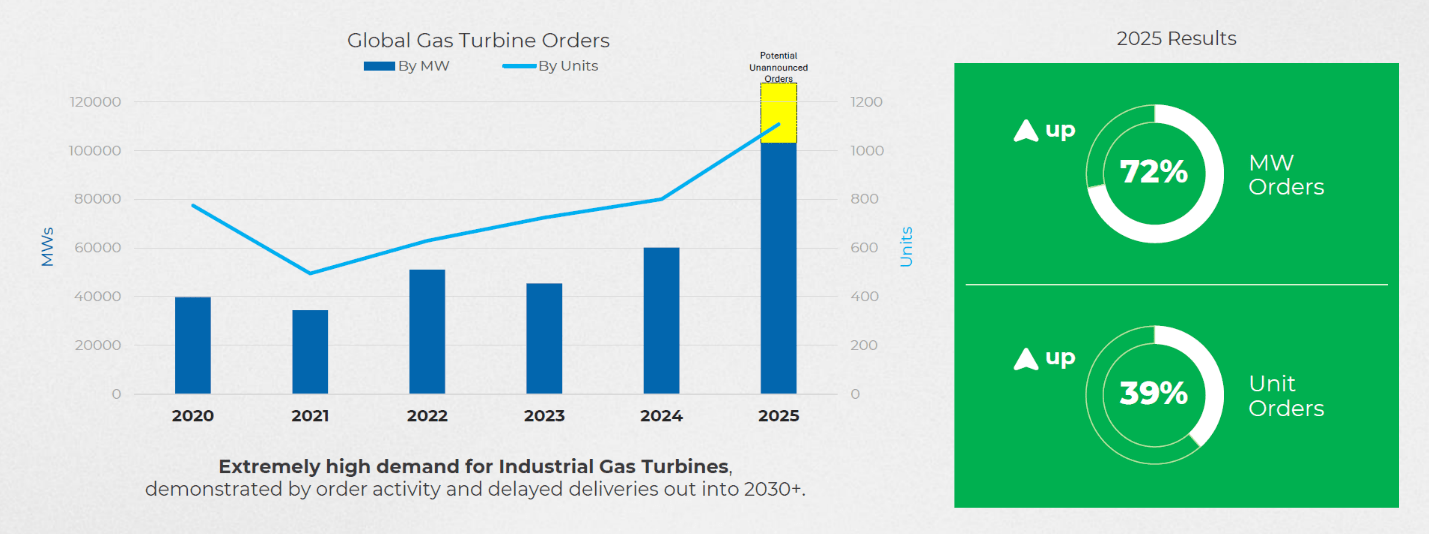
“MW orders in 2025 are 72% up on 2024 and unit orders are up 39%,” said Brough.
MW capacity orders increased from 60 GW in 2024 to more than 100 GW in 2025. In addition, there were close to 25 GW of unannounced orders or slot reservations with the big drivers being AI demand, the energy transition, and global supply chain stability.
Data Center Demand
Perhaps the biggest shift, though, was in data center demand. Brough reported an increase of about 20 times in GT capacity orders from data center developers and related distributed power construction compared to 2024.
Gas turbines in the 150 – 300 MW+ range are likely to remain strong until 2028, though a downturn is possible by 2029. Models between 1 MW and 100 MW should also enjoy good sales for the next couple of years. Heavy frame and light industrial units dominate the power sector, particularly F-, H- and J-class units.
“The 300+ MW range is the fastest growing range in the industrial gas turbine market with GE Vernova, Siemens Energy, and MHI in a tight battle for business,” said Brough.
In the aeroderivative sector, the GE Vernova/Baker Hughes LM2500+ gobbled up almost half of overall MW capacity orders in 2025. The LM6000 was next with almost 20%. In terms of fleets, the LM2500/LM2500+ fleet has now exceeded 2,700 worldwide and the LM6000 has surpassed 1,200.
“North American aeroderivative shares are very strong, primarily driven by mobile gensets and data center power,” said Brough.
While turbine sales in power generation are spectacular, those in the oil & gas sector are down across the past seven years compared to the previous seven. This primarily affects small machines ranging from 1 MW to 30 MWs due to trends such as electrification and competition from gas engines.
Who dominates in small machines?
Brough pointed to light industrial units from Solar Turbines and Siemens Energy as the leaders under 20 MW.
Solar Turbines continues to record steady orders for its Taurus, Mars, and Titan 130/250 models. More recently, the Titan 350 has begun to gain traction.
The Siemens Energy SGT-400 is also increasing in popularity. But a new player is gaining ground in oil & gas. Baker Hughes is doing well in selling its 16 MW NovaLT16.
For the LNG and pipeline markets, gas turbines in the 30 – 150 MWs remain decent sellers. With so much LNG development in North America, it accounts for the bulk of the business. In terms of capacity orders for oil & gas, the top selling aeroderivative gas turbine is the LM2500+ by far, followed by the LM6000.
“Aeroderivatives remain a very strong player in the oil & gas sector,” said Brough. “Some light industrials are also strong.”
Five Year Predictions
How will things pan out over the next five years? Dora Partners expects Siemens Energy to win on gas turbine value share for power generation by a small margin, followed by GE Vernova. Brough forecasts that the Siemens Energy SGT-800s is likely to account for about a third of the company’s gas turbine sales, but its E-, F, and H-class machines will do well, too. For GE Vernova, Frame 7HA models should account for more than half of GE Vernova sales in the power sector.
In oil & gas, Baker Hughes is forecast to record the most turbine revenue followed by Siemens Energy. Baker Hughes is steadily ramping up production and adding more packaging partners.
But predictions are often a risky game. Geopolitical pressure has intensified of late. It could change the scene suddenly. Similarly, there is growing competition in the form of small modular reactors (SMR), gas engines, batteries, and utility-scale solar photovoltaics. Coal plant retirements being postponed or cancelled could also hurt gas turbine sales.
In addition, the AI bubble could burst quickly. Some predict that the AI boom will continue until the end of the decade while others are concerned that it could evaporate. For 2026 and perhaps into 2027 at least, there are no signs that the AI boom is ending.
“Time will tell if the ongoing gas turbine sales boom will continue until the end of the decade,” said Brough. “For the next couple of years at least, we predict strong turbine orders in both power and O&G.”
You can access an in-depth report of gas turbine sales and trends by reading the Gas Turbine Market Forecast 2026-2035 available here: