Bad news for manufacturers of gas turbines: sales continue to decline, and gas turbine prices are expected to drop by 5-10% in 2021-2022. Here’s what’s driving a decrease in gas turbine prices:
The global pandemic has trampled all near-term energy forecasts and market projections for power-generating equipment, and the future depends on the rate of recovery. In a slow recovery, according to the International Energy Agency (IEA), the pandemic could leave the world facing the weakest decade of energy demand since the 1930s.
Also negative for the gas turbine market, particularly in the large-capacity end of the power segment, is the continued exponential growth in renewables. The cost of solar photovoltaic energy, being dubbed the new “king of electricity supply”, keeps falling. The IEA outlook sees a massive expansion in solar, as renewables overall are forecast to meet 80 percent of the world growth in electricity through 2030.
For gas turbine OEMs, this foretells of heightened and aggressive competition for market share in a continuing depressed market. The result: further downward pressure on pricing, particularly for large utility gas turbines over 200MW rating. Moreover, with the increase in average size of new units sold, and with growing percentage of “jumbo” gas turbines over 300MW in the mix, industry’s total unit orders continues to fall and impact factory utilization.
On the brighter side, the growth of intermittent renewable sources is increasing demand for smaller frame and aeroderivative gas turbines to provide flexible and rapid-response grid protection, giving a boost to gas turbine sales and pricing support in those sectors of the market.
Also, in major market areas where there is growing demand for pipeline gas and LNG, most notably China and Southeast Asia, demand for utility-size gas turbines is expected to be strong.
Demand, and price support, is also expected to be bolstered by the sustained steady stream of coal-plant retirements in North America, where natural gas prices are still near historic lows, and in Europe, although the latter is strongly committed to replacing coal with renewable energy sources.
After a short-lived sharp dive early last year, the price of oil has recovered and appears to be holding around the $50+ per barrel mark. However, there remains a concern for the Oil & Gas sector of the market, where investment in new and expanded gas turbine projects is very sensitive to world oil price levels and demand. The IEA and other industry sources see, at best, a near-term plateauing of oil demand. At worst, there are forecasts for a sharp decline.
Significant over-capacity of manufacturing space for large units continues to drive all major gas turbine OEMs to strategic corrective measures including shutdowns and repurposing or selling their factories. This is on top of resorting to increasingly aggressive pricing of new units and other marketing tactics, such as discounts on long-term service contracts and extended warranties.
Although there will always be exceptions, as observed from several field reports, GTW expects that gas turbine prices for the larger utility power generation units in the 2021-2022 time frame will slide by 5-10 percent from 2020 levels. The pricing of smaller industrial and aeroderivative units is expected to be unchanged or slightly higher.
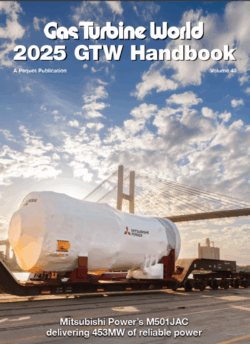
Are you looking to compare base unit prices and generating costs per kW/h? Gas turbine prices and model specifications can be reviewed in our annual Gas Turbine World Handbook. We offer coverage of the following companies: GE Power, GE Aviation, Siemens Energy, Mitsubishi Power, PW Power Systems (PWPS), Ansaldo Energia, IHI Power Systems, Kawasaki Heavy Industries, Solar, MAN Turbo, Capstone, Bharat Heavy Electricals, Zorya Mashproekt, UEC-Aviavigatel, UEC Gas Turbines, Magellan, Baker Hughes, Ethos Energy, Centrax, OPRA, Mapna, Dresser Rand, Hitachi Zosen, and Vericor.
To order your copy, please use the following link: CLICK HERE.