GE Vernova has set its corporate path towards decarbonization considering both near- and long-term goals by: (1) deploying diverse generating technology today to make progress in lowering both emissions and carbon intensity, while (2) investing in the breakthrough technologies of tomorrow to ultimately achieve net-zero.
According to this pathway, near-term reductions will depend on investing in a wide-ranging portfolio that combines continued and accelerated growth of renewable energy (wind and solar) with deployment of efficient gas power and advanced nuclear to reduce emissions while meeting the growing demand.
Given the continued and growing need for gas power, particularly the increased need for grid protection, the long-recognized advantages of aeroderivative gas turbines for power generation are seen today to be of increasing importance. These include:
- Modular Configuration. Can be quickly installed in two weeks with a small crew of 20 people.
- Operational Flexibility. 5-minute cold starts, for peaking and fast response to protect grid from intermittent renewable energy
- Fuel Flexibility. Can operate over a wide spectrum of fuels from gas and distillate to hydrogen blends
The vital role of gas power
Due to its lower carbon intensity, deploying gas power instead of high-carbon fuels such as coal is seen as the fastest way to reduce CO2 emissions while enabling a strong foundation for building renewables and other low-carbon generation assets. This is supported by data from both the US and Europe where reductions in CO2 emissions from the power sector due to coal retirements have been dramatic and are ongoing.
Beyond the immediate reductions afforded by replacing coal, gas turbines offer a pathway to decarbonization of power generation with technologies, both pre-combustion, by use of clean (green or blue) hydrogen fuel, and post-combustion, with addition of carbon capture and sequestration.
Increasing demand for reliable and cleaner energy worldwide has been a key driver behind the growth of gas turbine power generation. With growing population and rapid urbanization, the need for affordable and flexible solutions has never been greater.
In addition to their potential contribution to direct decarbonization by way of their inherently lower carbon intensity, deployment of gas turbines is of growing importance due to their long-recognized peaking capability, cogeneration functionality and role in grid balancing.
Today, the soaring growth of intermittent wind and solar renewable energy sources brings with it parallel growth in the need for quick-starting and flexible backup power to ensure grid stability and reliability. According to the IEA, in 2023, worldwide renewable power capacity increased by over 100GW, or by about a third, to 440GW.
Advantages of aeroderivative gas turbines
Given this continued and growing need for gas power and particularly the increased need for grid protection, aeroderivative gas turbines offer several advantages over other turbine technologies, such as faster start-up time, higher simple cycle efficiency, and compact modular packaging that enables quick installation and deployment.
These factors have led to increasing adoption of aeroderivative-based gensets for power generation as many electric utilities and energy-intensive industries across the globe are seeking generation technologies that can best complement the addition of renewable energy while also charting a more sustainable path forward.
We are also witnessing growth in aeroderivative power plant solutions driven by the rising demand for decentralized power systems in remote areas, and off-grid locations.
Aeroderivative features enhance popularity
The popularity of aeroderivative gas turbines (derived from aircraft jet engines) is largely due to three main features:
- Compact modular configuration.
Aeroderivatives are relatively compact and lightweight, facilitating easier transportation and installation. Their modular configuration allows power to be brought online quickly compared to other technology choices such as reciprocating engines.
A good example of this is GE Vernova’s LM2500XPRESS power plant (Figure 1) nominally rated at 37MW (model G5 DLE), built using proven LM2500 aeroderivative gas turbine technology. It is 95% factory-assembled into simplified modules for quick and easy site installation. Where power is needed quickly, the plant can be installed in as little as two weeks with a relatively small crew of 20 people.

Following up on that success, GE developed a new 57MW LM6000VELOX package, recently adopted at a customer site in North America. Here, the objective was to shorten the installation and commissioning schedule of standard LM6000 package by up to 40%. Find out how they saved 4,000 man-hours of labor.
- Operational flexibility and responsiveness.
The rapidly progressing energy transition presents energy suppliers and system operators with the increasingly difficult challenge of ensuring grid reliability and stability.
The characteristic light weight of aeroderivative gas turbines allows faster cold start times compared to reciprocating engines (and other flexible generation solutions) making aero units highly adaptable to varying power demands.
Besides their traditional role in peak shaving, grid balancing, and emergency power generation, aeroderivative gas turbines are ideal for meeting the quick response needed for grid protection in the face of fluctuations in intermittent renewable energy supplies.
- Fuel flexibility for more sustainable path. .
Fuel flexibility is another major advantage of aeroderivative gas turbines.
They can operate on wide spectrum of fuels, from natural gas, LNG, hydrogen blends, distillates, and less common fuels such as low-Btu syngas and coke oven gas.
This enables operators to switch from one fuel to another, “on the fly” without having to shut down, depending on cost and availability, improving supply security by sourcing fuel from a diversity of sources.
GE Vernova’s aeroderivative portfolio can operate on a wide range of hydrogen and natural gas fuel blends — the specific limit depending on the combustion system configuration. Work is ongoing to expand their capability to burn 100% hydrogen on selected models over the next decade, providing operators a path to zero CO2 stack emissions.
Global market trends
According to our recent Market Forecast, North America and Europe will continue to lead the demand for aeroderivative gas turbines.
This is due to well-established power generation infrastructures, stringent emissions regulations, and strong commitment to renewable energy.
GE Vernova is working with utilities and energy providers across the globe to help solve needs for fast, flexible, and more sustainable power. We expect to witness substantial growth in the application of aeroderivatives throughout the world and increasing global investment in infrastructure development.
Following are recent examples of such projects, covering diverse parts of the globe, to benefit from the advantages of aeroderivative gas turbines.
Power projects across Europe
In Europe, GE Vernova expects to supply over 1.1GW of reserve and peaking power with aeroderivative gas turbines. Several recently completed and current projects include:
- RWE 300MW simple cycle power station in Biblis, Germany, comprising eleven LM2500XPRESS modular packaged units (Figure 2).
- Switzerland Federal Office of Energy 250MW simple cycle power station at GE’s Manufacturing Center at Birr comprising eight trailer-mounted TM2500 mobile gensets.

- Two nominal 200MW peaking/reserve power projects for Ireland’s Electricity Supply Board at the Shannonbridge and Northwall power plants, each powered by six LM2500XPRESS aeroderivative units and a 150MW plant at the Tarbert site powered by three LM6000 units.
- A TM2500 plant, deployed on the remote Greek island of Kos to increase its electricity supply, and an emergency mobile TM2500 genset in Ukraine Supporting coal-to-gas switch
Taiwan’s energy mix has been rapidly changing with reduction of coal use with addition of renewable energy sources. Taiwan Power Company has ordered six (6) LM2500XPRESS units to add 175MW of capacity to help balance the power grid and meet future demand.
Unit selection was largely based on their compact and modular configuration allowing for quick installation while also providing flexible operational capability to complement increased wind power in the region.
Capturing flared gas using aeroderivative gas turbines
Yemen is working toward ending routine flaring at oil production sites. This will reduce greenhouse gas emissions and conserve the gas for electric power generation in areas which rely on less-sustainable fuels like diesel oil for their energy needs.
Many oil field operators who flare associated gas (natural gas found mixed with crude oil within a reservoir) have committed to making the investments to reduce flaring and supply clean fuel gas. The electricity produced is not only consumed for captive power needs in the oil fields, but will also support the needs of surrounding communities while reducing their required investment in grid infrastructure.
An example is Yemen’s Masila Petroleum Exploration and Production Company (PetroMasila) which aimed to transition from diesel power generation to natural gas from crude oil production to reduce flaring and lower related emissions.
The company sought a fast approach to bring much-needed power to Yemen, where the distribution and transmission system was severely damaged in an 8-year-long civil war. For a solution, they turned to GE Vernova for the supply of trailer mounted TM2500 aeroderivative units (Figure 3).

This model is especially attractive to developing countries like Iraq, Yemen, Nigeria, Angola, and Libya with significant electricity shortfall and where flaring is common.
For more, see GE Vernova white paper, “Capturing Flared Gas For Use in GE Vernova’s Aeroderivative Gas Turbines”
Hydrogen-ready projects
Active hydrogen-ready power projects are proof that the future of electricity generation is already happening with aeroderivative gas turbines.
Last year, an LM6000 aeroderivative gas turbine supplied by GE Vernova successfully operated on blends of up to 44% (vol) green hydrogen in a pilot project at the New York Power Authority’s Brentwood Power Station on Long Island. (Figure 4).
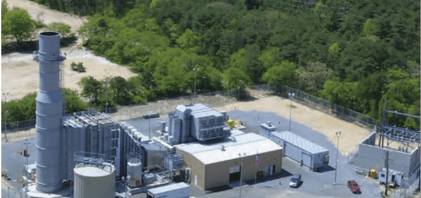
turbine retrofitted to utilize 5% to 44% hydrogen blended natural gas fuel.
The project represented the first retrofit of an existing U.S. natural gas power generating facility to operate on a blend of green hydrogen. Tests revealed a clear reduction in CO2 emissions with higher blends of hydrogen paving the way towards a net zero carbon future and further development of using green hydrogen as fuel at other sites.
Earlier this year, Australia’s CS Energy announced its new Brigalow Peaking Power Plant to be Queensland’s first hydrogen-ready power station.
Expected to reach commercial operation in 2026, the plant will be powered by twelve LM2500XPRESS aeroderivative gas turbines (Figure 5) which will provide crucial firming capacity to support the region’s energy transition, in alignment with the Queensland Energy and Jobs Plan.
The plant will be built at CS Energy’s under-development Kogan Clean Energy Hub, home of the Kogan Renewable Hydrogen Demonstration Plant, from which the green hydrogen fuel will be sourced.
The Brigalow peaking plant is expected to start operation on a 35% (vol) green hydrogen blend, with a pathway to 100% hydrogen over this decade.

A path forward for aeroderivative gas turbines
As the world sees continued growth in renewable generation, we can expect to see an almost parallel growth in aeroderivative gas turbines driven by the increasing demand for their characteristic flexibility of installation and operation, high efficiency and responsiveness, and their low environmental impact.
GE Vernova’s aeroderivative solutions have emerged as a strong technology of choice for many power generation operators for different applications seeking these characteristics. With their proven capabilities and with a path to zero CO2 stack emissions with clean hydrogen as a fuel over the next decade, GE Vernova aeroderivative gas turbine solutions will remain an important option for power generation utilities and energy providers across the globe.