Globally growing at record levels, renewables-based power capacity now represents about 95% of capacity additions being installed worldwide.
Generally, this might be viewed as a limiting scenario for gas turbines. However, the growth of intermittent and variable renewable sources is increasing demand for aeroderivative gas turbines (or simply “aeros”) for flexible and rapid-response grid protection.
Despite inroads being made by reciprocating engines (aka RICE or “recips”), aeros are widely accepted as better suited for enabling this greater penetration of renewable energy to the grid. Advantages include:
- improved grid stability and frequency control
- fast starts and cyclic operation
- faster grid demand following
- higher reliability and availability
- lower emissions
- lower O&M costs
- smaller footprint
Grid stability and frequency
A major challenge to maintaining a stable and reliable power grid is keeping the frequency stable. Varying frequency makes it difficult for generating units to stay synchronized to the grid, leading to more frequent power grid trips and blackouts. By delivering superior grid stability and frequency control, aeroderivative gas turbines can help grid operators and power generators avoid those trips and blackouts while also lowering maintenance costs associated with grid-connected equipment.
Varying frequency interferes with the operation of frequency inverters needed to convert solar power, generated in direct current (DC), to alternating current (AC) for injection into the grid. Electronic circuits generating this AC power must meet a highly stable frequency (i.e., 50 or 60 Hz) to stay connected to the grid. If the frequency strays beyond specified limits, trips may occur or inverters and batteries could suffer premature failure.
Based on inherent engineering features enumerated below, aeroderivative gas turbines like General Electric’s LM2500, LM6000 and LMS100 generator packages provide exceptional grid stabilization supporting renewable integration.
Key design factors that make aeros better suited than recips or single-shaft gas turbines for that purpose:
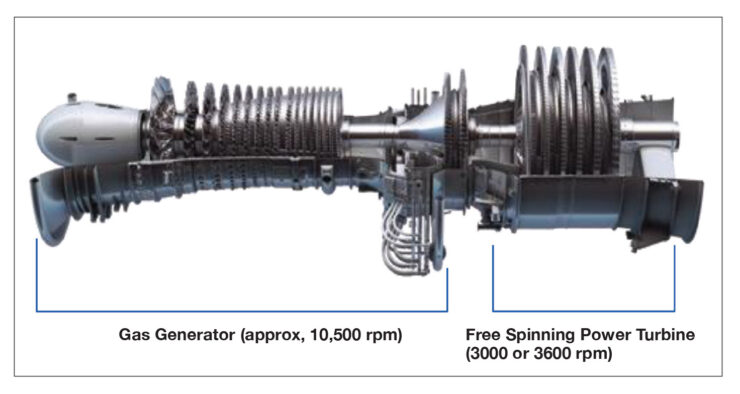
Multishaft design. Aeroderivative units feature multi-shaft designs so the free-spinning power turbine connected to the generator is not mechanically connected to the high pressure turbine/compressor assembly.
With this configuration (Figure 1), the high pressure turbine can accelerate quickly in response to a grid frequency drop and increase power output when needed most by the grid. This compares favorably to single-shaft machines which typically lose power output during a frequency drop and are slower to respond. The result with multi-shaft aeros is a more stable grid and smoother operation for all equipment connected to the grid.
Ramp rate. The ramp rate of a turbine generator indicates how fast the turbine can increase power output in response to changes in power demand.
Nominally rated at 20 MW per minute from zero to full power, but capable of higher rates in specific situations, the LM2500 ramp rate is another important feature that helps it maintain grid stability.
When responding to rapid grid changes such as a decrease in frequency caused by sudden drops in wind or solar generation, aeroderivatives can respond with high ramp rates. The LM2500, for example, can react to load change dips within ~100 milliseconds to provide extra power. Such responses are programmable by adjusting the ramp rate or time in seconds up to the full load capability.
Full load rejection. Due to their multi-shaft configuration, aeroderivatives can essentially instantly reject a full load by opening the main breaker without tripping the unit and remain at a minimum load to maintain power to plant auxiliaries. It is common for recips to trip under similar scenarios, whereas aeroderivatives like the LM2500 remain ready to quickly reconnect to the grid and supply power.
Inertia. The inertia of generating units is crucial to maintaining grid stability – especially for smaller grids below 500 MW. Inertia can be thought of as the capacity to maintain speed, so systems with higher inertia help stabilize grid frequency better than low inertia systems.
Due to the size and rotating speed of its generator and power turbine assembly (3,000 rpm for 50 Hz and 3,600 rpm for 60 Hz), the LM2500 can provide up to 5 times the inertia of a reciprocating engine (inertia is a product of mass and the square of the speed of rotation). Although aeroderivative gas turbine inertia is lower than frame turbine counterparts, this is more than compensated for by their faster response time and ramp rate, providing an excellent balance for grid operators.
(Consider this analogy: A laden truck has high inertia when driving along the highway, but a small nimble sports car can react to changes much faster.)
Wide frequency range. GE’s LM2500 generator package can operate continuously within a 5% range from nominal frequency. Because there is no under-frequency trip function (alarm only) and only a high over-speed trip function to protect the equipment, a wider operating range also is possible. This means that in the event of an under-frequency event on the grid, the units can remain in operation and won’t worsen the situation by tripping on frequency when needed the most.
The LM2500 package is expected to maintain power to within 3% of full load between 47 Hz and 50 Hz or between 57 Hz and 60 Hz, across ambient temperature ranges, with no impact on equipment life and no under-frequency tripping. Primary Frequency Control and Reserve Margin Control are fully programmable with inner and outer dead bands, ramp rates (lag or linear response), and primary frequency reserve contribution.
Synchronous condenser operation. As an extension of the role aeroderivative gas turbines can play in enhancing grid stability, an optional feature allows their generator packages to operate as a synchronous condenser.
In this mode, the electrical generator remains connected to the grid, providing inertia and voltage/power factor support (via MVAR control) while the core engine is effectively idle and consuming no fuel. When requested to do so, the packages can seamlessly switch from synchronous condenser to power generation mode.
For the LM2500 specifically, because it has a free-spinning power turbine, it is possible to have this mode of unfired operation without need of a clutch between the free-spinning power turbine and the generator, reducing operational complexity and maintenance costs. In this clutch-less arrangement, the power turbine remains connected to the motoring AC generator. Resulting airflow induces adequate rotation of the high pressure turbine/compressor assembly to enable quick restart.
When operating as a synchronous condenser, the motoring generator provides reactive power control, either consuming or generating MVAR depending on the grid requirement, to the limits of the generator rating. Larger generators may also be used if a higher MVAR rating is required for the application. The synchronous condensing mode helps grid operators regulate voltage to maintain grid stability and avoid any over- or under-voltage tripping within the controlled zone, in addition to allowing more active power transmission.
Fast starts
The characteristic lightweight configuration of aeroderivative gas turbines inherently allow faster cold start times compared to recips and heavy frame gas turbines. For example, the LM2500 gas turbine package can start in as little as five minutes, from cold iron to full load (Figure 2). Additionally, when operating as spinning reserve at the unit’s minimum emission compliant load (MECL), the time to achieve full power is between 15 and 30 seconds, depending on control parameters.

An important feature of a multi-unit aeroderivative power plant is that the units may start up simultaneously. This contrasts with reciprocating engine plants where individual engines typically start up sequentially due to restrictions on compressed air supply, resulting in considerably longer start- up period for plants with many units.
While reciprocating gas engines are often claimed to be capable of five minute starts, in reality this is true only in hot standby mode, requiring jacket water above 140ºF (60ºC) and lube oil temperature above 158ºF (70ºC). Since this requires electric heaters to maintain these temperatures, the resulting parasitic power consumption may be more than 100kW per unit, or 1 MW for a typical 10-unit utility site. The parasitic load for maintaining hot standby condition for large recip units can represent an annual cost on the order of US$100,000 per unit, easily reaching over $1 million per year for a utility scale site. When operating with heavy fuel oil, the cost to maintain hot standby condition is even higher.
Daily cyclic operation
Unlike heavy frame gas turbines, aeroderivative units such as the LM2500 can perform daily starts and stops without affecting their scheduled maintenance cycle and cost.
This feature has long been recognized in the power generation industry and has been a primary factor in their extensive use around the world as peaking units, available to start quickly whenever needed.
In grids with high renewable power penetration, this ability to shut down and restart aero units daily without affecting maintenance cost is of great value to grid operators, since it reduces the cost of dispatching such units as required to offset the variability of renewable generation on the grid. If equipped to do so, units shut down when not needed can continue to operate as synchronous condensers, as explained earlier.
Reliability and availability
High engine reliability for safety is essential to the aviation world. Industrial aeroderivative gas turbines based on aviation technology as a result have inherited this trait, demonstrating a fleet-mean reliability above 99%. What’s more, at least half the fleet operates at 100% reliability. This exceptional demonstrated reliability is especially vital for small grids that rely on the performance of each generating unit on the system.
High availability is another key factor. While higher reliability translates to a reduction in unscheduled outages, higher availability focuses on reducing the number of scheduled maintenance outages and downtime.
Fleet data collected by ORAP, the proprietary Operational Reliability Analysis Program owned by Strategic Power Systems (an organization that collects and analyzes data from power plants around the world) shows that the LM2500 has demonstrated average reliability of over 99% and availability higher than 98% over a 20-year period. See Figure 3 for the latest four-year data (2018-2021) as reported by ORAP. Many mission-critical units have demonstrated availabilities of 99.5% when operating on base load duty.

Another legacy of the aviation industry is the ability to quickly swap out engines to reduce outage time needed for a major overhaul. By replacing an engine in the field with one that has undergone required maintenance, the plant can resume operation in as little as two days, compared to more than 20 days of downtime for other technologies.
Fewer maintenance events
The high availability demonstrated by aeroderivative gas turbines results directly from fewer and shorter required maintenance events as compared to reciprocating engines. Figure 4 compares the type and frequency of minor and major maintenance events and the estimated maintenance outage hours for aeroderivative gas turbines versus recips in multi-unit power plant installations of roughly the same total site power rating.

Typically, an aeroderivative only has to undergo a borescope inspection (about 12 hours outage duration) every 4,000 hours of operation, or at least once a year. A hot section maintenance outage, typically 3 days duration, is performed at 25 or 35,000 hours of operation. Major overhauls, which can be completed in as little as 2 days, are performed after 50 or 70,000 hours, depending on the model and operation.
Actual timing of these maintenance events is somewhat flexible based on borescope inspection results, which means gas turbine run times may be extended before hot section maintenance or overhaul is necessary. Under this regimen of planned maintenance, about 18 days of outage are required in 100,000 operating hours, or approximately 12 years of continuous operation.
Meanwhile, as shown, typical reciprocating engines used for power generation require planned stoppages after every 2,000 operating hours to perform various minor and major maintenance events requiring downtimes ranging from about 12 hours to 15 days. Over a similar operating period and complete maintenance cycle to reach major overhaul, accumulated scheduled outage time for reciprocating engines would amount to over 100 days, over 5 times that of the aeroderivative gas turbine.
It is also noted in Figure 4 that that the estimated man-hours of maintenance labor required for recips over a complete maintenance cycle (108,000 man-hours), assuming a 12-unit site, is on the order of 50 times that required (2,268 man-hours) for a 7-unit aero site of similar power rating.
The bottom line: aeroderivative gas turbine plants require significantly reduced manpower due to fewer units and substantially fewer routine maintenance activities compared to a reciprocating engine-based plant of similar size. This means much lower annual expenditures for O&M material, staff and labor. For a peaking plant dispatched about 1,000 hours per year, O&M personnel required for recips may cost as much as fuel on a $/MWh basis, since the full staff must be ready for when operation is required.
Also, due to their lower availability, recip-based power plants typically need one standby unit for every five to six units in operation. This leads to higher CAPEX, greater operation and maintenance costs, and larger parts inventory.

Aeroderivatives and low emissions
Land-based power generation is subject to much more stringent emissions requirements than airborne engines. Advanced low-emissions gas turbine combustion technology, primarily focused on reducing NOx, has been developed to meet stringent regulations established for stationary gas turbines in the US and elsewhere.
As so-called best available control technologies (“BACT”) evolved, the capabilities of modern gas turbines to operate with lower emissions became the basis for tighter regulatory limits and guidelines, which acknowledge the inability of other forms of power generation to meet such stringent limits.
For example, the World Bank Environmental Health and Safety Guidelines set the NOx emissions limit for gas turbines operating on natural gas at 51 mg/Nm3 at 15% O2, equivalent to the US EPA limit of 25 ppmv (@15 O2) or 152 mg/Nm3 (74 ppmv) when running on other fuels, such as diesel oil or propane.
Meanwhile, dual fuel reciprocating engines are allowed by the same guidelines to emit up to 400 mg/Nm3 ( ~200 ppmv) NOx, or almost eight times (8x) higher emissions on natural gas fuel – and up to 2000 mg/Nm3 (~1000 ppmv) or 13x higher when running on liquid fuels.
The sharp contrast in estimated emissions (NOx and CO) between aeroderivatives (specifically the LM2500) and reciprocating engines is shown on Figure 5. It is seen that the LM2500 with dry low emissions (DLE) combustion meets the lower regulatory standards set for stationary gas turbines when burning either diesel oil or natural gas fuel.
Methane issue with recips
Methane, a potent greenhouse gas, is an increasingly important exhaust emission to be considered when evaluating power generation options. According to the Intergovernmental Panel on Climate Change, the global warming potential of methane in the atmosphere over 20 years (GWP20) may be 86 times higher than that of CO2.
When burning natural gas, a relatively small amount of methane may be emitted unburned from any power generating unit. For gas turbines, the inherently low emission rate is reflected by the US EPA, which defines the methane emission factor to be 0.0086 lb per MMBtu of fuel consumed.
But due to inherently high methane emissions of reciprocating engines (sometimes called “methane slip”) the EPA indicates a methane emission factor of 1.25 lb/ MMBtu, 145 times more than for gas turbines, greatly contributing to greenhouse gas emissions from power generation almost equivalent to a coal plant.
Comparing GHG emissions
Figure 6 shows specific greenhouse gas emissions, expressed as kg CO2 equivalent/MWh (aka “carbon intensity”) of various power generating technologies, comparing coal/steam plants with natural gas fired reciprocating engines and aeroderivative gas turbines, both simple cycle and combined cycle.

Based on these data, and considering the methane slip typically associated with recips which adds about 80% (equivalent) to the CO2 emitted due to combustion, switching from reciprocating engines to simple cycle aeroderivative gas turbines would result in a 36% reduction in GHG emissions per MWh generated.
Based on the same model aeroderivative gas turbine (i.e., the LM6000) used in a combined cycle configuration, the increased MWh generated without burning additional fuel would result in a reduction of carbon intensity on the order of 50%.
With 111 countries signing the “Global Methane Pledge” at COP26 (2021), it is expected that methane emissions will become more greatly controlled. The agreement calls for 30% reduction in emissions worldwide from 2020 levels. According to the International Energy Agency (IEA), this global methane pledge represents the first significant policy commitment toward methane control for many countries.
Aeroderivatives offer fuel flexibility for energy security
The ability of aeroderivatives to operate on a wide range of fuels – both gaseous and liquid – helps to deliver energy security if the main fuel is unavailable for any reason. They can seamlessly switch between fuels, even from gas to liquid, without shutting down and with little or no reduction in output or efficiency.
Aero units also can operate over a full range from 100% gas to 100% liquid fuel, without having to maintain expensive liquid pilot fuels during gas operation. Dual fuel reciprocating engines, however, require about 1 to 2% diesel oil when operating on natural gas, increasing both costs and emissions.
GE’s aeroderivative gas turbines have extensively burned alternative fuels such as lean gas, rich gas, naphtha, bioethanol, biogas and refinery waste gas, among many others. This proven operating flexibility over a wide range of fuels adds greatly to energy security.
Another advantage for aeroderivative gas turbines is their ability to operate on up to 85% concentrations of hydrogen blended with natural gas. When sufficient quantities of H2 are available, this would result in greatly reduced CO2 emissions.
This capability is true of both new gas turbines and existing units, which can be retrofitted for operation on high H2 fuel.
Lube oil consumption
Aeroderivative gas turbines consume significantly less lubricating oil than reciprocating engines representing potentially significant cost savings.
For example, the lube oil consumption of an LM2500 is about 2 ml/MWh. This compares to about 400 ml/MWh for a reciprocating engine, or 200 times as much. Lube oil alone can represent a savings of more than $2 million USD per year for a 200 MW baseload aeroderivative turbine power plant compared to a reciprocating engine plant (assuming lube oil at $3/L).
For a standby plant, lube oil consumption may not have a significant impact on cost. However, the oil must be replaced regularly due to limited shelf life.
Higher power density
Another important characteristic of the aeroderivative gas turbine is its high power density enabling multi-unit power plants to have compact footprints. For example, Figure 7 shows the layout of a plant with 7xLM2500 units on a 3-acre site. Such a plant, ISO rated at 250 MW output, could supply 215 MW in hot day operation.

Summing it up
Aeroderivative gas turbines are now widely used to support grids with a high penetration of renewables in a way that is more reliable and economical than other solutions.
Higher reliability and availability, lower emissions, and greater operational flexibility compared to reciprocating engines make aeros a valuable tool for both power generators and grid operators.
This should keep aeroderivative gas turbines relevant as part of the energy mix for years to come.
About the authors: John McNeill Ingham is GE’s Regional Product Director for Aero Gas Turbines. Sanjay Sawant is the Global Commercial Development Director, GE Gas Power.
For further details, including the full lineup of GE’s Aeroderivative gas turbines, please CLICK HERE.