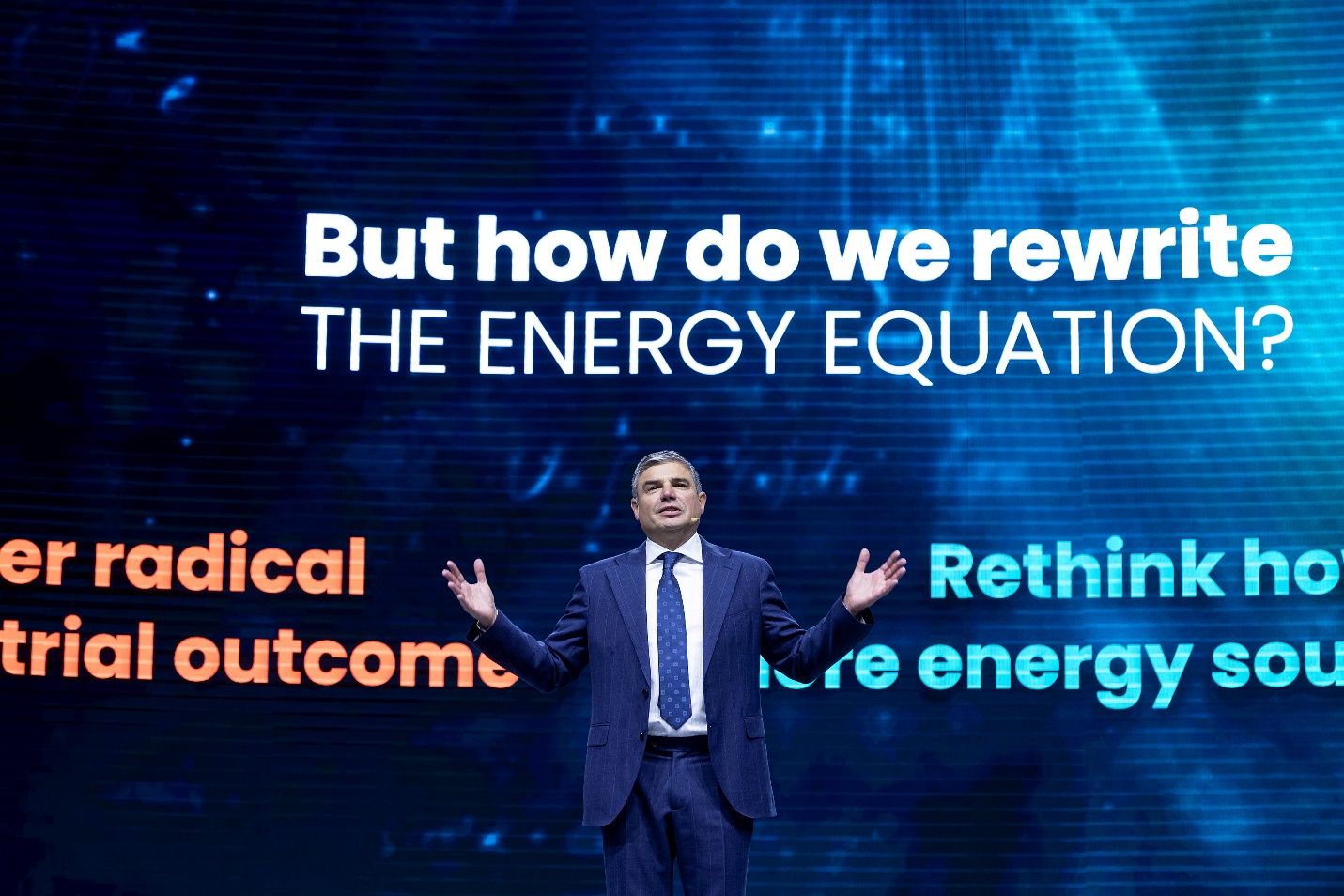
Lorenzo Simonelli, CEO of Baker Hughes, delivers the keynote at the company’s annual meeting.
At the Baker Hughes Annual Meeting (AM) earlier in 2026, Chairman & CEO Lorenzo Simonelli opened the conference to the theme of rewriting the energy equation.
“As well as sustainability, we need affordability and security to balance the energy equation,” he said to an audience of 2,500 participants from 80 countries. They represented industries as diverse as oil & gas, mining, fertilizers, cement, petrochemicals, power generation, and data centers.
Instead of favoring one source of energy over another, he said that all energy sources need to be expanded to meet demand. That includes geothermal, nuclear, wind, solar, and natural gas fueling prosperity together.
“We need to rethink how we can bring more energy to the word, maximize recovery rates, and bring cleaner energy to data centers,” said Simonelli. “Natural gas and LNG are not transition fuels, they are destination fuels and they should be prioritized for investment.”
He was followed by Shaikh Nawaf S. Al-Sabah, Deputy Chairman and Chief Executive Officer of Kuwait Petroleum Corporation (KPC). The moderator asked him if his company name might change to KEC (Kuwait Energy Corp) to indicate an eventual shift away from hydrocarbons.
“KPC will remain KPC [He put emphasis on the P] as it is oil we do best,” he said. “Oil will still be in heavy demand 50 years from now.”
He noted the winds of geopolitics have less impact today in the Middle East than they did five years ago. Various countries have tried to mitigate risk and prevent market disruption.
As a case in point, he cited a large Saudi Arabian facility that has bombed by Houthi rebels from Yemen three years ago. It hardly caused a ripple in the price of oil.
Baker Hughes Turbines
Baker Hughes had a good year on turbomachinery sales. In the company’s most recent earnings report (Q4 2025), the company reported $4.0 billion in Industrial & Energy Technology (IET) orders. That added up to a record $14.9 billion of IET orders (this includes turbines and compressors).
One order was for gas turbine and refrigerant compressor technology for Train 5 of NextDecade’s Rio Grande LNG facility. Baker Hughes will also deliver six LM9000 gas turbines to drive its centrifugal compressors for the liquefaction process at Commonwealth LNG’s export facility.
Nicola Marcucci, General Manager, Gas and Steam Turbine Engineering, Baker Hughes, said the company’s roll-out of the relatively new LM9000 gas turbine is progressing solidly.
“We have several prospects where the LM9000 has been selected and it will be the focus of aeroderivative development efforts,” he said. “Its high efficiency, high power density and length between maintenance intervals make it the first aeroderivative to meet industrial needs such as LNG.”
He added that the speed of the LM9000 is optimized for compression. It can deliver 87% compressor efficiency as the compressor can couple with the turbine without the need for gears.
The biggest recent order came from Dynamis Power Solutions. This turbine packager ordered 10 LM9000s as well as 15 LM2500 and LM6000 units for mobile power generation.
Daniele Marcucci, Strategy & Product Director, Industrial Power Generation, Baker Hughes, covered the NovaLT turbine series. He said that 2025 was a big year for the NovaLT16 in the data center market. With data centers built in steps over a period of a couple of years, adding 16 MW at a time with the NovaLT16 often fits with project needs.
Reservation slots of 1 GW have been received for the NovaLT16 turbines, said Marcucci. Frontier, for example, ordered over 250 MW for two sites. Projects like this are combining these gas turbines with battery energy storage systems (BESS) and synchronous condensers to manage transients generated by AI applications.
Lead times for NovaLT16s are in the two-to-three-year range, which puts them ahead of most other gas turbine OEMs.
“AI is not a bubble; demand growth will stay for at least for five years, especially in the U.S.,” said Marcucci. “Our big jump in orders will continue in 2026 as demand for power is increasing, including plenty of onsite generation.”
Green Energy Update
Jon Moore, CEO of analyst firm BloombergNEF, presented the latest findings from his 2026 Energy Transition Investment Trends report at the Baker Hughes meeting. “We have a multi-speed energy transition which is driven largely by economics,” he said.
What he meant is that some cleaner energy sources are progressing rapidly, while others are stumbling along. And more than a few traditional sources of energy are stubbornly refusing to fade into the sunset.
Among the many statistics unveiled, a few stood out. Out of $2.3 trillion in energy transition investment in 2025, grid investment exceeded $500 billion. This is good for all forms of energy. The U.S., China, and the rest of Asia dominated grid investment.
“As grid bottlenecks have become a big topic, the year saw a 70% increase in grid investment worldwide,” said Moore.
Investment in clean energy, though was slightly down due to China cutting back on renewable projects. That’s the first dip in this statistic in about 15 years, though U.S. renewable investment was up by 4.5% and remains slightly ahead of dollars spent on traditional energy sources. Biofuels spending was also down worldwide.
Among the clean energy technologies that are not scaling, Moore listed heat pumps, hydrogen, and carbon capture and storage (CCS). Investment in them peaked in 2023. Energy storage funding, on the other hand, continues to rise sharply.
How about data centers? The Capex of the largest publicly owned data center operators was $441 billion in 2025. Moore predicts that it will rise to $712 billion by 2029. Investment varies heavily by geography with the U.S. dominating.
To underline the strength of this market, Baker Hughes announced another large data center order shortly after the meeting. The company will provide 25 Brush Power Generation DAX 7 generators that will work in junction with Boom Supersonic 42 MW Superpower aeroderivative turbines.
Boom has received a 1.21 GW commitment from construction firm Crusoe for turbines to power next-generation Stargate data centers in the U.S. The delivery of the Brush generators plus Automatic Voltage Regulators (AVRs) will begin in 2026 as a massive site in Texas is already mid-construction.