DOE/EPRI-funded 2.5-year $8 million study of retrofitting a 550MW 2-on-1 7F.03 combined cycle plant with post-combustion carbon capture for 95% CO2 removal.
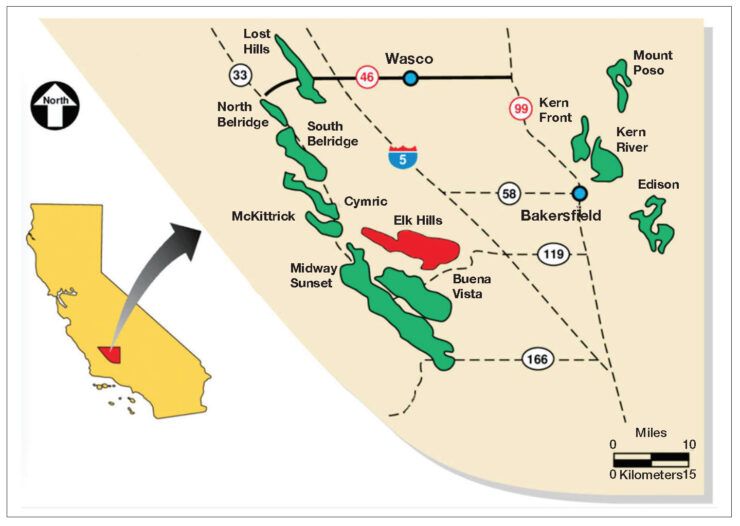
Among the more promising CO2 reduction projects selected for in-depth study by the U.S. DOE is one known as “CalCapture,” being developed by California Resources Corp. (CRC), owner of the Elk Hills oil and gas field (Figure 1) and the 550MW Elk Hills combined cycle power plant.
EPRI, partnering with CRC and Fluor, signed a contract with DOE in 2019 to conduct a Front End Engineering Design (FEED) study to retrofit that 2 x 1 GE 7F.03 plant with a post-combustion carbon capture unit (CCU).
A report on this study was published in the 2023 GTW Handbook. Since then, key objectives remain the same but some key guidelines have changed:
- Feasibility. Determine technical and economic feasibility of retrofitting a modern F-Class natural gas combined cycle plant for carbon capture.
- Capacity. Capture 4,000 tonnes per day of CO2 from plant flue gas.
- Process. Fluor’s Econamine FG+ aqueous amine CO2 removal technology designed for 95% capture (was 90%).
- Storage. Compress captured CO2 to up to 160 bar for deep underground injection and permanent storage.
- Funding. Besides funding from DOE and cost sharing from EPRI, the study has received financial support from the climate investment arm of the Oil and Gas Climate Initiative (OGCI).
The FEED study was completed in 2022. Results indicated the project would take nearly five years to execute, require an investment of about $750 million (excluding owner’s costs), and result in the deep injection of about 1.5 million tonnes CO2 per year into depleted reservoirs.
Project description
Based on a 95% capture rate, the CalCapture Carbon Capture Unit is designed to eliminate essentially all of the Elk Hills power plant carbon emissions by removing a nominal 4,000 tonnes of CO2 per day from the two combined cycle flue gas streams.
(Note: the FEED study was based on 90% CO2 capture and installing a separate gas-fired boiler for supplying process steam to the capture unit. Recent post-FEED design changes include an increase in capture rate to 95% and adopting steam integration with the combined cycle which eliminates the need for an auxiliary boiler and avoids associated CO2 emissions.)
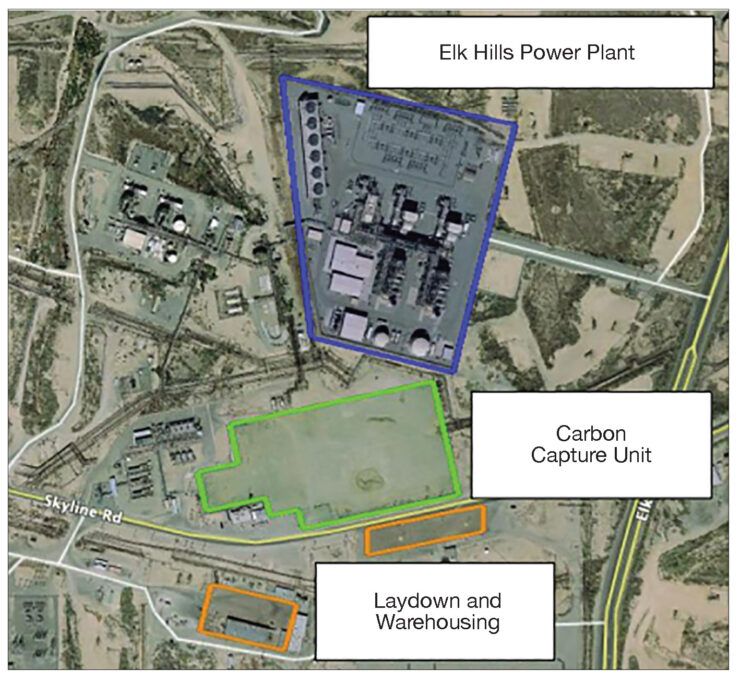
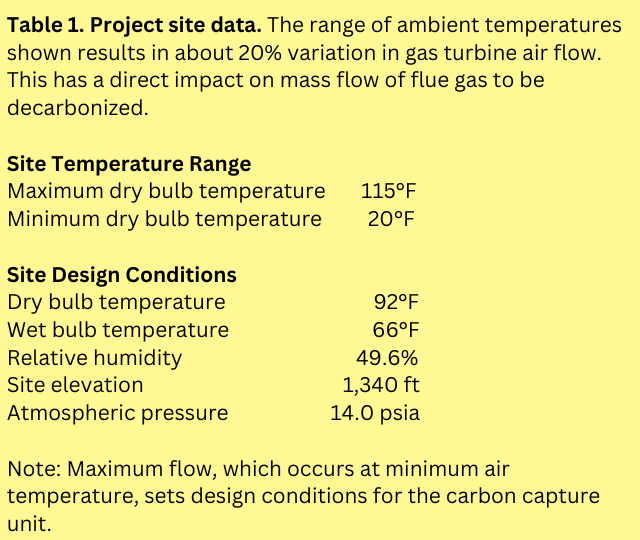
The area allocated for the CCU facility (Figure 2) is adjacent to and just south of the existing Elk Hills power plant. See Table 1 for design site conditions showing the range of ambient temperature which directly affects the mass flow of flue gas to be decarbonized.
Originally, the project was to take advantage of enhanced oil recovery (EOR) resulting from CO2 injection that would average about 7,000 incremental barrels per day of low-carbon oil over the life of the project.
Back in 2022, this would have resulted in about an 18% increase over the average daily production rate at the Elk Hills field. Equivalent, in revenue, to monetizing 60 million barrels of added oil reserves to the project. However, late in 2022, California adopted legislation which effectively bans the use of injected CO2 for enhanced oil production. As a result, CRC is now looking to Federal incentives for CCS provided in the Inflation Reduction Act (IRA) to help fill the financial gap.
While acknowledging that this new legislation has caused a substantial shift in the project, CRC states there is a possible and viable path to transition the project from EOR to deep permanent storage, with additional incentives and future changes to the current Cap and Trade program.
Primed for CCS
The project is anticipated to result in removing the equivalent emissions of roughly 300,000 gasoline-fueled vehicles, offering significant support to California’s ambitious climate goals and national and global objectives.
According to CRC, the Elk Hills oil and gas complex is primed for CCS in terms of commercial readiness of the site, facilities and storage targets, availability of carbon credits (both Federal and State), and corporate commitment to such carbon management projects.
Estimates, based on the increase in Federal 45Q tax credits to $85 per tonne, expect the project to benefit at the rate of about $125 million per year, for 12 years, from 45Q. Should California adopt a sequestration protocol into its “Cap-and-Trade” program, the project could also benefit from an avoided cost of $35 to $50 million per year.
Because the Elk Hills Power Plant supplies electricity directly to oil field transportation fuels, an estimated $35 to $45 million per year from California’s Low Carbon Fuel Standard (LCFS) credit could also support project economics.
Under the Innovative Crude pathway, LCFS eligibility is based on one-third of the output of the Elk Hills power plant being used for oilfield power. Each LCFS credit represents one tonne of CO2 reduced. Credits are generated as the incremental fuel is consumed within transportation.
Commenting on the project, CRC says that it “sees CalCapture as one of the central components of a robust future carbon capture network in California which potentially could pave a way to reduce existing industrial emissions while providing a sustainable and consistent base load to California’s grid”.
Elk Hills power plant
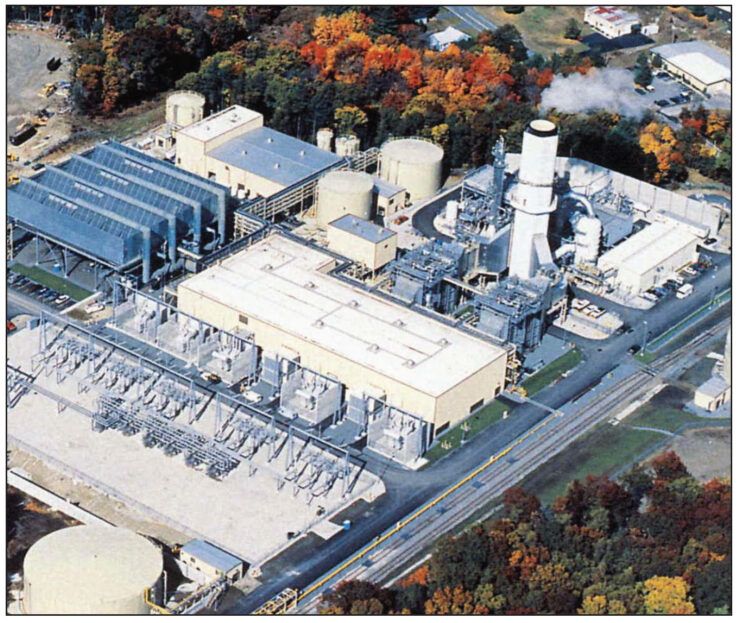
The Elk Hills combined cycle power plant (Figure 3), which was commissioned in 2003, is built around two natural gas-fired GE 7F.03 gas turbine units and two multi-pressure heat recovery steam generators (HRSGs).

Supplementary-fired duct burners make up for hot-day falloff in gas turbine exhaust energy and to increase peak power available to the grid. The combined HRSG steam output of the two gas turbines is fed to a GE D11 triple-pressure reheat steam turbine, nameplate rated at 225MW.
A six-cell mechanical draft wet cooling tower equipped with high-efficiency drift eliminators provides heat rejection for the steam cycle.
At site design conditions, i.e., 92ºF and 1,380 ft. elevation, the plant rating is 550MW net base load output, with duct firing, and 460MW unfired. (Note: Based on GE data, estimated unfired plant rating is 545MW and almost 58% efficiency at ISO standard 59ºF and sea level ambient conditions.)
To meet California’s stringent emission limits, the plant utilizes selective catalytic reduction (SCR) for NOx control and oxidation catalysts for CO and VOC control. Currently, the plant operates to supply electricity to the Elk Hills oil field with excess power supplied to a local utility and the California grid.
Harvesting flue gas for processing as a basic design objective, the Carbon Capture Unit is expected to remove 95% of the CO2 in the flue gas delivered for processing.
There are two individual sources of flue gas, assuming no supplemental firing, namely the two existing gas turbines that power the combined cycle. At the specified minimum 20°F site ambient temperature, the gas turbine air flow and, therefore, the flue gas and CO2 emissions, are at the maximum mass flow design condition.
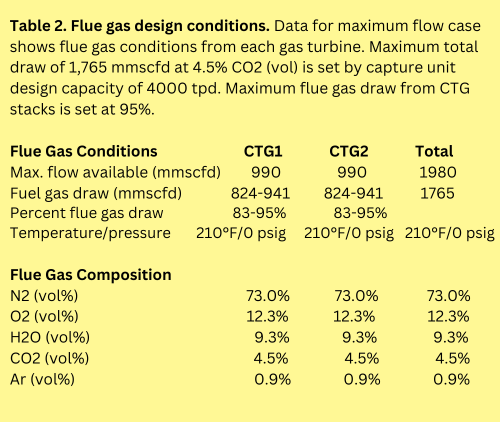
Data for the flue gas streams to be delivered to the Carbon Capture Unit under this condition are shown on Table 2. At maximum flow conditions, each gas turbine (or CTG) will produce 990 x106 scf of flue gas per day (990 mmscfd) with a CO2 content of 4.54% by volume.
On a mass flow basis, each CTG emits 2,366 tonnes CO2 per day (tpd). So, at maximum flow conditions, the combined cycle emits 2 x 2,366 = 4,732 tpd CO2. See flue gas flow diagram, Figure 4.
To avoid infusion of outside (dilution) air into the HRSG stacks, the flue-gas diverter control system limits the flue gas draw rate from each stack to 95% to maintain positive pressure in the stack.
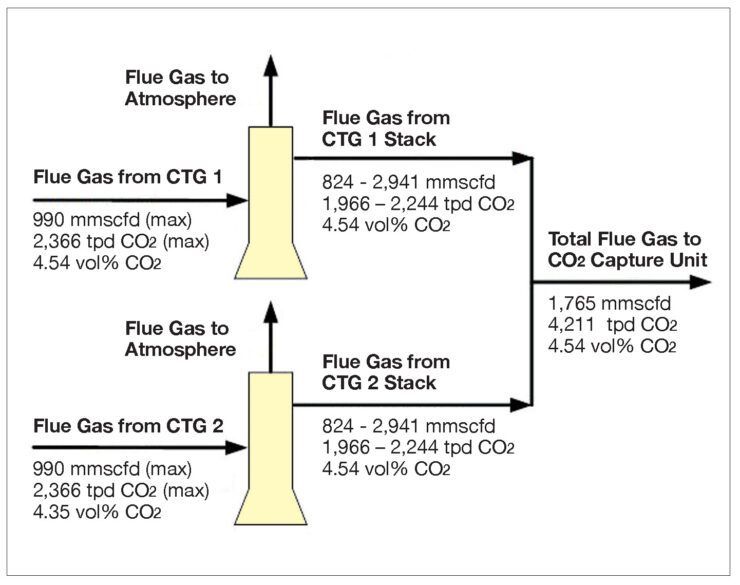
In this way, there will always be at least 5% flow exhausting from the stacks, and, therefore, the actual maximum total CO2 available for processing is approximately (4,724 x 0.95) or 4,488 tpd. The balance of about 236 tpd (118 tpd per CTG stack) is exhausted to the atmosphere.
Since, for the purpose of the current design update, the design capacity of the process unit was held at a nominal 4,000 tpd CO2, at a 95% capture rate, the maximum total CO2 fed to the CPU is limited to 4000/0.95 = 4,211 tpd. This is just slightly (~6%) less than the maximum CO2 available and provides a reasonably close match for this stage in the design process.
Under these design assumptions, at minimum site temperature and maximum flue gas and CO2 mass flow rates, 89% of plant CO2 emissions would be removed, while the remaining 11% (about 520 tpd) would be vented to the atmosphere.
At higher ambient temperatures (and lower flue gas and CO2 mass flow rates) any additional CO2 produced by the duct burners, should they be employed, would be either be accommodated by the Carbon Capture Unit, or the flue gas diverters would be adjusted to lower draw rate and limit the total CO2 flow to the CCU to its design capacity.
Carbon capture process selection
The carbon capture technology selected for the DOE funded FEED study by CRC is Fluor’s Econamine FG+ (EFG+) process.
This is a commercially proven amine-base absorption process described in the FEED study as offering the highest technology readiness level for scale-up to the 4,000 tpd CCU capacity established for the project.
Fluor describes their process as a “proprietary carbon capture solution” with over 30 licensed plants and three decades of operating experience at power plants, refineries, and chemical facilities around the world. They say that the technology builds on over 400 CO2 removal units in natural gas and synthesis gas processing applications. Fluor also points to the fact that their first-generation Econamine FG (EFG) process may be the only technology ever used commercially to capture CO2 from the flue gas (albeit a slipstream) of a full-scale gas turbine combined cycle plant.
The EPA even cites that unique experience in supporting its recently proposed guidelines and standards for limiting CO2 emissions from combined cycle plants.
This is in reference to the nominal 300MW combined cycle/cogeneration plant (2 x 1 Westinghouse W501D5) in Bellingham, Massachusetts where a 15-20% slipstream of plant flue gas was decarbonized in a Fluor EFG carbon capture process unit (Figure 5).
There, the process steam required by the Carbon Capture Unit was extracted from the combined cycle as dictated by Federal rules governing qualified cogeneration facilities (QFs) when the project was developed in the late 1980s. The Bellingham plant, now owned and operated by Northeast Energy Associates, was commissioned in 1991. The CCU operated continuously for near-ly 15 years with a nominal production rate of 350 tpd of food grade CO2. Capture rates ranged from 85% to 95% and the unit achieved 98.5% on-stream reliability, according to Fluor.
In 2005 the Bellingham capture unit was retired when high natural gas prices resulted in the host power plant (and steam supplier) being relegated to cyclic load-shaving duty and CO2 production had to be discontinued. Fluor credits the highly successful operation at Bellingham as enabling the advancement of their process to the current EFG+ technology level.
Demonstrated results, says Fluor, include 30% lower steam consumption, 20% lower electric power demand, and up to 50% lower solvent consumption. The EFG+ CCU technology also boasts of smaller environmental footprint due to lower emissions of ammonia, amine vapor and VOC, and reduced waste generation.
Capture process design
The simplified process block diagram for the Elk Hills CalCapture project (Figure 6) shows the two controlled flue gas streams from CTG1 and CTG2 being routed to a common duct and cooled before being delivered to the CO2 absorption tower.

Water condensed out by cooling the warm flue gas from 210ºF to 92ºF is routed to the plant cooling system to reduce overall water usage in the capture unit by almost half. In water-conscious drought-prone California, this is in line with the goal of water minimization, a key part of the project charter.
The cooled flue gas entering the ab-sorption tower contains about 4.5% (v) CO2. As the gas stream flows upwards and counter to a downward amine sorbent spray, 95% (wt.) of the CO2 is chemically absorbed by the solvent. The treated decarbonized flue gas, containing only about 0.5% (v) CO2, is then washed to remove vapor phase and entrained sorbent before being vented to the atmosphere.
CO2-rich solvent at the bottom of the absorption tower is pumped to the solvent regeneration unit (or ‘stripper’) where it is pre-heated and contacted with stripping steam (supplied from the combined cycle) to free the bound CO2 from solution. Next, hot CO2-lean solvent from the bottom of the regeneration unit is cooled and returned to the absorption unit.
Finally, the captured low-pressure CO2 is delivered to a 7-stage intercooled compressor. A glycol-based air-cooled cooling system, used between each stage of compression, condenses out most of the water. This is followed by a dehydration unit which further dries the CO2 to a specified <25lb H2O per mmscf (-13.6ºF dew point). The dried pipeline-grade product CO2, at 97%+ purity, compressed to up to 2,300 psi (~160 bar), is then delivered to a dedicated CO2 pipeline for delivery to the injection point.
Figure 7 is a rendering of the complete capture unit installed behind the Elk Hills plant. It highlights several components of the hybrid cooling system including dry air-cooling, wet surface air cooling, and cooling tower.

Carbon capture CAPEX
A primary objective of the FEED study was to determine the economic and technical feasibility of the carbon capture retrofit at the Elk Hills power plant.
With the front end engineering design of the retrofit established, Fluor prepared a Class III estimate (+/- 15%) of the capital cost (CAPEX) of the installation. Black & Veatch was contracted to fill the role of Owner’s Engineer to review and update the estimate.
As is customary, estimated CAPEX excluded CRC owner’s costs, which were segregated from those attributable to items within the boundary of the Carbon Capture Unit. Project owner’s costs include those related to land acquisition and pre-construction site preparation including excavation (due to pre-existing conditions), project development and financing costs, insurance, legal fees, permitting, utility interconnects to site boundary, and other “outside the fence” expenses. Depending on the extent of such expenses, owner’s costs can amount to 5% to 10% of total project cost.
In addition to the exclusion of owner’s costs, other significant assumptions behind the cost estimate:
- project execution on basis of a lump-sum Engineering, Procurement and Construction (EPC) contract with performance guarantees.
- construction execution based on union labor.
- $39 million escalation of costs during construction.
- project contingency at $57.0M. plant design based on Seismic Zone 3.
In total, the CAPEX for the retrofit EFG+ carbon capture unit is estimated to be $710 million, with an accuracy range of plus/minus 15%. (Ed. Note: This estimate reflects a reduction of about $40 million compared to that reported in the FEED study due to the design change to steam integration with the combined cycle and the elimination of the auxiliary process-steam boiler and related equipment.). The FEED’s estimated CAPEX was completed in 1Q 2021 and is current to that time frame. It does not include inflation of costs (materials and labor) to any assumed future project start date.
Based on an estimated 545MW ISO standard (59ºF, sea level) power rat-ing of the Elk Hills Power Plant, this amounts to a unit cost of about $1,300/kW, or roughly equal to today’s total cost of building the combined cycle plant itself.
The following breakdown of the estimated $710 million total installed CAPEX by plant area was provided in the FEED study:
- CO2 capture island $387M
- Utility systems $229M
- CO2 compression $61M
- Balance of plant – $33M
Unique project aspects
In considering the estimated CAPEX of the Elk Hills CCU retrofit, the FEED study final report points to some unique aspects of the project. First was the project’s commitment to water minimization that became an import-ant influence on the design and cost. This involved the inclusion of hybrid water/air cooling systems in the scope, such as wet surface air coolers (WSACs), dry air coolers, wet cooling tower, secondary glycol cooling and water cooling.
While incorporating these systems increased the CAPEX of the project, they significantly reduced water usage, thus lowering operating expenses. Additionally, a costly Water Reverse Osmosis System is included within the project scope for water reclamation, reducing waste water from cooling tower and WSAC blowdown by 65%.
Electrical tie-in considerations
Another unique aspect of the project cost estimate is that the project was designed with a single connection to CRC’s existing 115kV line. Approximately 35MW of electrical power is delivered via an existing Elk Hills transmission system and substation to a new 115kV line and stepped down to 13.8kV, 4160V and 480V for various plant uses.
Project scope includes a transmission tie line to interconnect the project switching station to the existing CRC transmission line and must use redundant line current differential protection over fiber with Direct Transfer Trip per CRC requirements. Approximately ½ mile of single conduction 115 kV transmission tie line is expected to be built using tubular steel poles with anchor bolt foundation designs, for approximately $1.3M.
The switching station is expected to utilize a single bus, single breaker configuration for about $1M. Redundant fiber optics paths will be required at a cost of approximately $0.3M. The estimated total project interconnection cost is $2.6M and is in addition to the estimate discussed above.
Steam integration vs. aux. boiler
As mentioned, the original design basis for the DOE funded FEED study was use of a separate gas-fired boiler system to supply process steam to the CCU. The updated design includes steam extraction from the steam turbine (i.e., steam integration) and eliminates the add-on boiler and all associated equipment, controls, etc.
Though many cost-cutting measures are said to have been incorporated into the original design and cost estimate, consideration of steam integration with the existing power plant was identified in the FEED study as a potential cost-cutting measure and became the subject of a thorough post-FEED engineering evaluation.
The main reason that the dedicated boiler for process steam was originally elected for the FEED over steam extraction was CRC’s wish to avoid modifications to the existing steam turbine that could lead to untenable power plant operational issues when the CCU was offline. (For example, what is to be done with the extra steam flow at the back end of the steam turbine when the CCU is not operating and the process steam extraction port is closed?)
Also, estimates were that steam extraction would reduce steam turbine output by 30-35MW with the CCU operating at design capacity. However, this loss in steam turbine power would be at least partially offset by elimination of the power demand to run the packaged boiler system (pumps, etc.), and eliminating the need for boiler fuel.
It is reported that the steam turbine design and operating issues have been evaluated by GE who supplied the steam turbine for the plant. This included looking into the required modification to the steam turbine should some 450,000 lb/hr be extracted for the CCU.
Since the extracted steam supplied to the CCU stripper tower is condensed within the CCU, one added benefit offered by steam integration is that a portion of the existing power plant condenser cooling load is freed up for other cooling needs. Analysis has shown this can eliminate up to five of the eight WSACs in the CCU scope.
Another benefit of steam integration is that it eliminates the added CO2 contained in the flue gas of the auxiliary boiler. All the Elk Hills power plant flue gas then could be processed by the CCU, even at maximum flow conditions, and the final CO2 emissions would be significantly reduced.
Fluor has preliminarily estimated a potential CAPEX savings of $35-$45M to be realized with implementing the steam extraction and integration. However, a complete evaluation was outside the scope of the FEED study and detailed results of the post-FEED evaluation have not been made available at the time of this writing.
Level 1 project schedule
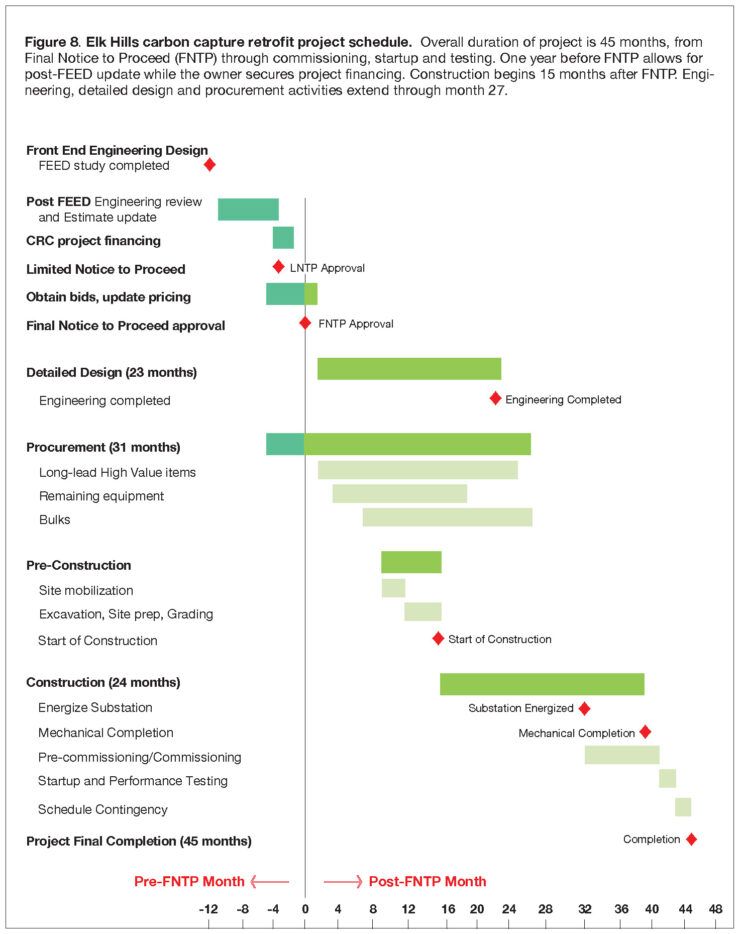
A deliverable of the FEED study was a Level 1 (management summary) Engineering, Procurement, Construction and Commissioning (EPCC) schedule to support execution of the project (Figure 8, adapted from FEED final report).
The total project duration from Final Notice to Proceed (FNTP) through commissioning, startup and testing is expected to span 45 months. The schedule is broken down into engineering, procurement, construction and commissioning activities, followed by startup and testing.
Before FNTP, there is a 12-month post-FEED period shown for updating pricing and improving accuracy of the cost estimate while CRC obtains project financing. Including this pre-NTP activity, the overall project execution period is estimated to be nearly 5 years.
Procurement activities for all equipment and materials including long lead and critical equipment occurs after contract award and FNTP, and extends for 24 months (overall 31 months including Pre-NTP activities). Start of Construction occurs at month 15 and extends to Mechanical Completion of the facility at month 38. Final Commissioning activities for plant systems and subsystems (2 months) is followed by plant Startup and Performance Testing (2 months) plus an allowance (3 months) for “schedule contingency”.
What’s next?
In the FEED study final presentation to the DOE in February 2022, it was commented that requisite “economic drivers” exist for the project to go forward to commercial deployment.
Enhanced financial incentives for carbon capture incorporated into the Inflation Reduction Act (IRA) signed into law later that year improved those drivers, but this was offset by the transitioning of the CalCapture project to deep permanent storage.
CRC’s President and CEO, Francisco Leon, says he sees “tremendous opportunity” with passage of the Inflation Reduction Act and its associated expansion of Section 45Q tax incentives for carbon capture. Late in 2022, CRC’s subsidiary, Carbon Terra Vault (CTV), entered into a joint venture agreement with Lone Cypress Energy Services to build a planned 65 tpd blue hydrogen plant at the Elk Hills oil field. The project would employ proprietary steam methane reforming (SMR) technology with an integrated carbon capture system and would sequester up to 200,000 tpy CO2.
“CTV’s first blue hydrogen storage-only agreement with Lone Cypress is a meaningful step forward in CRC’s rollout of carbon capture and sequestration technology across the state,” says Leon. “We are working hard to meaningfully expand our carbon management strategy while reducing California’s emissions, strengthening the communities where we live and work, and building a more sustainable and viable future.”
CRC’s latest additions to their Elk Hills Net Zero Industrial Park include Carbon Dioxide Management Agreements (CDMAs) with biomass gasification leader InEnTec and renewable gasoline producer Verde Clean Fuels for up to 100,000 tpy of CO2 each.
In February 2022, at the Elk Hills FEED study final presentation to DOE, Abhoyjit Bhown, the project’s Principal Investigator and EPRI’s Sr. Program Manager of Advanced Generation and CCS, stated: “This FEED study could lead to the world’s first full-scale, commercial deployment of carbon capture on an NGCC power plant, and can be readily duplicated at other NGCCs across the world.”
Author’s note: The FEED study conducted by Fluor under EPRI and DOE/NETL management was completed in February 2022. The final project report is now available to the public at: https://www.osti.gov/biblio/1867616