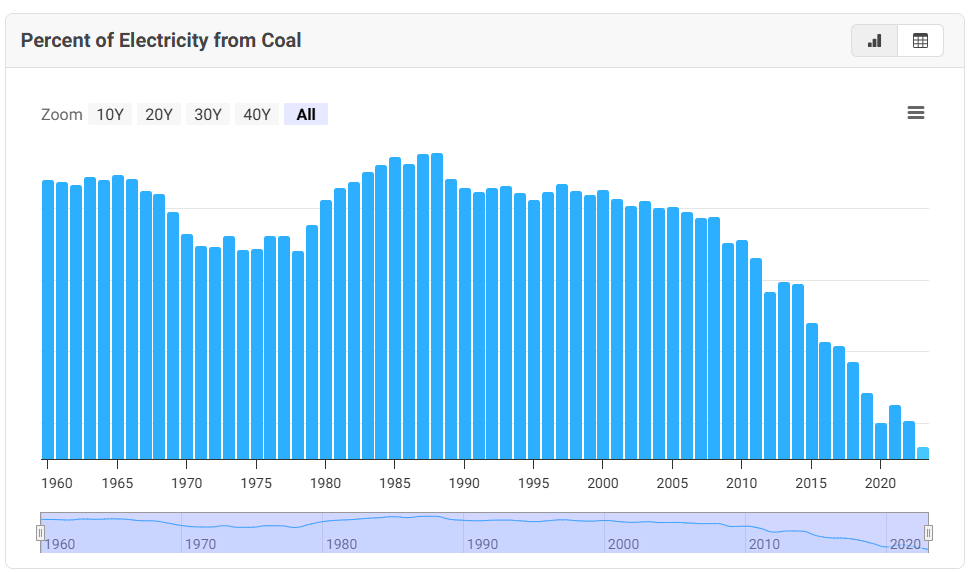
U.S. coal usage has been in sharp decline for decades. Source: U.S. Energy Information Administration.
The energy transition hype took another beating courtesy of recent news
- Several U.S. utilities revealed plans to keep their coal plants running beyond their planned decommissioning dates
- The federal government has clarified it wants to keep all current coal plants meeting the nation’s energy growing demands
- An International Energy Agency (IEA) report noted that worldwide coal usage hit an annual highest ever for the third consecutive year.
The 2025 edition of the World Energy Outlook found that almost 9 billion tons of coal were consumed globally in 2025, up half a percent on 2024. IEA hopes that global coal demand will plateau at that level and drop by up to 3% by 2030. But growing need for mobility, heating, cooling, lighting, household, industrial and increasingly for data and AI-related services call that prediction into question.
Back in 2023, IEA predicted that coal demand had peaked. They keep getting it wrong. China continues to bring coal plants online almost as fast as Jersey Mike’s opens new stores across the U.S. And India, Indonesia, and other developing Southeast Asian nations are demanding more coal to fuel expansion.
In true IEA fashion, the agency praised China for slowing the growth of its coal industry (China continues to use more coal each year although the percentage increase each year has lowered) while criticizing the U.S for a tiny rise in output.
No doubt the following year’s report will be even more scathing since the Trump Administration has made it clear that it stands in the way of any more coal plant closures and has made $100 million available for coal plant refurbishment and upgrades.
Energy transition hits a coal speedbump
Worldwide coal consumption has risen over the last several years and recorded another highest ever in 2025. Current net-zero initiatives seem to penalize Europe and the U.S. while letting Asia, Africa, and Latin America can get away with emissions murder.
Yet Europe and the U.S. have made enormous headway on emissions reduction and gradual coal phase-out. Consider the graph of U.S. coal usage over the past few decades. Emissions from power plants show a similar trend.
According to agencies like the IEA and various climate groups, the energy transition is supposed to be about replacing natural gas generation with renewables. However, the actual transition – from coal to natural gas and renewables – is being ignored.
Anyone seeking to lower global emissions meaningfully would be advised to focus on the rest of the world, especially China. Per the IEA report: “Most global coal demand, 55%, comes from electricity generation in emerging market and developing economies, largely China.”
IEA presents hopeful models for the decline of coal based on its unrealistic net-zero targets for 2050. More than likely coal consumption will continue rising for the next few years. With three quarters of a billion people still without electricity worldwide, coal will be used if there are no other cheap alternatives available.
Natural gas renaissance
The EIA hopes that natural gas will quietly fade away over the next decade or two as most plants will be reduced to playing a backup role in a renewable and battery-powered economy. However, electricity demand is now surging in Europe and North America, not just the developing world. Hence, natural gas is experiencing a renaissance.
Attitudes to coal have even become more tolerant, at least until nuclear energy has reestablished itself. AI has unleashed a scramble for generation. A lot of new plant construction is aimed at data centers and they want all the power they can get. That means combined cycle plants operating 24/7, not as emergency backup or peaking assets.
Now factor in LNG. The IEA report says “United States has driven global liquefaction capacity growth for the past decade and is set to expand its capacity by a further 160 bcm to 2035.”
LNG capacity additions worldwide between 2025 and 2030 will exceed 300 bcm. That’s almost as much new capacity as has been brought online in the previous 15 years. There is no slowing the LNG juggernaut.
China is the world’s biggest LNG consumer, followed by Japan, South Korea, India and Taiwan. But Europe has emerged as a huge market, too.
Meanwhile oil and natural gas consumption are predicted by IEA to keep rising through 2050 in all but one of its many scenarios. IEA is tacitly admitting that its global net-zero 2050 plans are a fantasy.
“In a break from the trend of the past decade, the increase in electricity consumption is no longer limited to emerging and developing economies,” said IEA Executive Director Fatih Birol. “Breakneck demand growth from data centers and AI is helping drive up electricity use in advanced economies, too. Global investment in data centers is expected to reach $580 billion in 2025.”