Doosan Enerbility has invested over KRW 1 trillion (about $US 700 million) in R&D dedicated to gas turbine development. With completion and delivery of the first Doosan 270 MW gas turbine in 2019, South Korea became the fifth country in the world to develop an H-class gas turbine for power generation.
Major milestones in Doosan’s gas turbine technology success story:
2011: Manufactured and tested 5 MW proof-of-concept unit
2013: Selected for lead role in national GT development program
2019: Designed, manufactured, and delivered first 270 MW unit
2023: Received first order for upgraded H-class 380 MW unit
In 2024, 8,000 hours of demonstration operations of Doosan Enerbility’s first 270 MW gas turbine was completed in collaboration with the Korean government to ensure the reliability of the technology.
Securing this original gas turbine technology is now leading to new business opportunities. Doosan is developing an upgraded 380 MW-class model with significantly improved performance, reporting that it has already secured a significant number of important orders. The company is also expanding its presence in the gas turbine services business, developing hydrogen turbines as carbon-free energy solutions, and entering the aircraft engine business.
Three decades of development
Doosan Enerbility’s history in gas turbine development and repair service offerings with Houston TX-based Doosan Turbine Services (DTS) dates back to the 1990s. In 2011, a 5MW proof-of-concept unit was completed and tested to confirm their technical capability.
This initial engineering achievement led to additional R&D and, in 2013, selection for a major role in the Korean national program aimed at creating a modern, fully capable domestic gas turbine industry.
This program was initiated by the Ministry of Trade, Industry, and Energy (MOTIE) and the Korea Institute of Energy Technology to reduce the nation’s dependence on imports. Ultimately, Korea expects to compete in the global marketplace among the long-established community of gas turbine manufacturers.
Doosan advanced design technology
Development of Doosan’s advanced 270 MW utility scale gas turbine began in 2013 after being selected to lead Korea’s national program.
The totally in-house program began with securing and developing the necessary broad-ranged technical expertise. In parallel was the establishing of fully capable manufacturing facilities, process management, and full-scale test facilities.
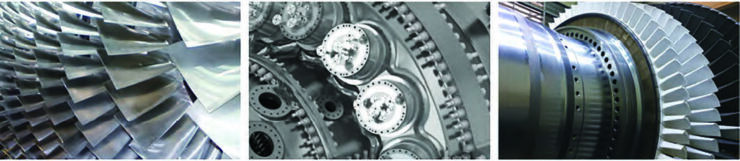
Leveraging the expertise of Doosan worldwide, advanced subcomponents were designed and fabricated for testing in an expedited manner. Critical components (Figure 1) to the successful design of the H-Class gas turbine include:
- Compressor Section: An advanced aerodynamic design compressor equipped with multi-stage variable guide vanes delivers optimized performance under a wide range of ambient temperature and load operating conditions. Axial and circumferential dovetail blade root design ensures structural stability, while providing ease of maintenance. Cantilever stationary vanes allows easy assembly, while the bowed airfoil design enables wider operation margin and enhanced reliability.
- Combustor Section: The modern premixed DLE combustor features state-of-the-art low emission performance, as well as extremely low turn down capabilities. A wide fuel flexibility performance includes the ability to operate on liquid fuel and various low caloric value fuels. All design goals and fuel flexibility were validated through full-scale combustion rig testing.
- Turbine Section: Advanced four-stage turbine designed to maximize power output and efficiency. The design process utilized steady state CFD and a time-accurate transient model to verify performance and circumferential variations Blades and vanes were designed with state- of-the-art 3D-aero design features. Proprietary thermal barrier coatings are applied on the first two stages, enabling high turbine inlet temperatures.
- Control System: To add to in-house capabilities, the design team leveraged the GuardianTM control system. This industry-proven package is a flexible platform used worldwide in gas and steam turbine applications. It features a simple dual redundant controller and high-speed Ethernet based I/O which provides easy integration and extension.
Full-scale gas turbine test facility
To prove the capabilities of the design of the DGT6-300H, Doosan developed the world’s largest and most comprehensive full-scale, full-speed, full-load gas turbine test facility, located at its plant in Changwon, Korea (Figure 2).
Providing ability for off-grid testing at both 50Hz and 60Hz, the facility permits operation independent of limitations of the grid to verify turbine performance, operability, and durability. This means testing not only under normal conditions, but also under a range of load and operating conditions that cannot be implemented when connected to the power grid.
The facility’s data acquisition system was designed to capture real-time data on all aspects of gas turbine components and operation. Over 2,500 instruments allow 3,500 gas turbine parameters to be measured, including temperatures, pressures, stress, combustion pulsation, and vibration throughout the gas turbine. A rotating telemetry system enables measurement of temperature and stress of rotating components at high speed. A fully equipped gas monitoring system captures data on exhaust gases.
The full-capability gas turbine test infrastructure was established to ensure thorough in-house performance evaluation and design validation prior to market launch. With the successful completion of the DGT6-300H.S1 test campaign, the test facility has been retrofitted as the test bed for developing next-generation technology.
A to Z manufacturing capabilities
Doosan Enerbility’s complete gas turbine component manufacturing facilities provide internal capabilities ranging from casting and forging to final assembly, at its Changwon-based site occupying almost 4.5 million sq. m. (about 1100 acres). Qualified manpower are dedicated to each process to assure high quality mass production of existing Gas Turbine OEM hot parts and development of optimum process parameters for newly developed hot parts.
A most noteworthy feature of Doosan’s manufacturing capability is the dedicated hot parts manufacturing facility with more than 44 types of specialty equipment, including:
- Creep Feed Grinding: Turbine blade fir-tree shape machining and vane assembly face milling.
- EDM and Laser Drilling: Complex cooling hole machining.
- Die Sinking EDM: Vane seal slot, blade damper pin groove, and brazing preparation machining.
- Welding and Brazing: Low crack- sensitivity welding technology, low heat input TIG, microplasma welding, and vacuum brazing.
- Thermal Barrier Coating Application: Air Plasma Spray (APS), High Velocity Oxygen Fuel (HVOF), Vacuum Plasma Spray (VPS) and internal anti-erosion/corrosion coating with Vapor Phase Aluminide (VPA).
- Heat Treatment: Vacuum heat treatment furnaces capable of solution heat treatments, coating diffusion and aging processing for nickel superalloy materials.

These manufacturing capabilities are enhanced by introduction of Product Life Cycle Management (PLM) and Manufacturing Execution System (MES) to the hot parts factory. This connection enables the link of design information with the production process path and to record/manage/track the manufacturing history of hot parts by serial number.
First unit delivered in 2019
The culmination of this accelerated and all-inclusive development initiative was the delivery of a world-class gas turbine for South Korea. In 2019, in collaboration with its first customer, Korea Western Power (KOWEPO), Doosan completed the first local manufacture of a nominal 270 MW gas turbine (designated model DGT6-300H.S1) in Korea. The unit was delivered for installation at the Gimpo Combined Heat and Power (CHP) Plant, operated by KOWEPO.
First fire of the unit was achieved in 2022. Following extensive testing, calibration and a series of operational validation tests (e.g., load-change follow and emergency shutdown), an 8,000 hour grid-connected demonstration run was carried out to demonstrate the gas turbine’s reliability. More than 2,500 instruments were installed in the factory to enable data gathering to assess the unit’s performance.
In July 2023, after completing a 240-hour continuous operational run, the Gimpo CHP unit was officially declared commercially operational on LNG fuel. At the time of this writing, Doosan reports that the unit has been operating for about 10,000 hours without any operational issues.
Additional orders booked
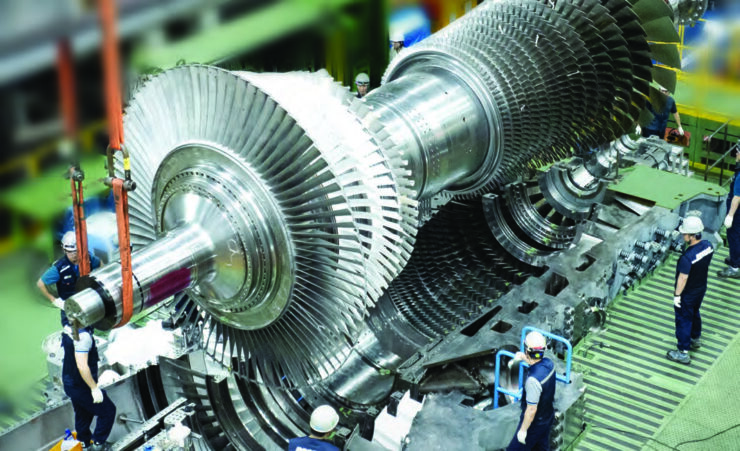
In parallel to the real-world field validation at Gimpo, Doosan made rapid progress with continued technology development and received orders for their upgraded 380 MW (nominal) gas turbine – designated as the DGT6- 300H.S2 (see photo, Figure 3).
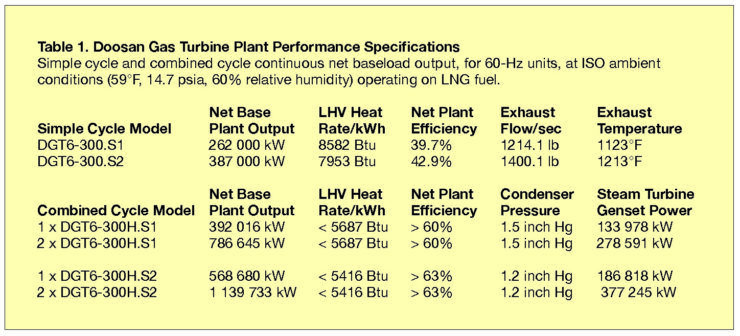
The “S2” features a higher “H-class” turbine inlet temperature (typically upwards of 1,600°C), higher pressure ratio (24 vs. 21) and 15% more air flow than the “S1”. The upgraded model boasts a 42.9% net simple cycle LHV efficiency, a significant improvement over the 39.7% of the “S1” (performance ratings for both models are provided in Table 1).
In June 2023, the first order for the “S2” was received for Korea Midland Power (KOMIPO)’s Boryeong New Combined Cycle Power Plant. This was followed in January 2024 by an order for Korea Southern Power (KOSPO)’s Andong Combined Cycle Power Plant Unit 2.
In July 2024, Doosan received two additional orders for the “S2” gas turbines, one to be deployed at KOMIPO’s 569 MW Haman Combined Cycle Power Plant, scheduled for 2026 commercial operation, and the other for Korea Energy Power (KOEN)’s Bundang Combined Cycle Power Plant, scheduled for a 2028 commercial operation date.
Doosan’s scope for aforementioned projects covers all major power block components, including the gas turbine, steam turbine, heat recovery steam generator (HRSG) and control system, making these plants fully Korean-equipped combined cycle power plants.
Expanding GT services business
In addition to the development and supply of new gas turbines, Doosan Enerbility is also working to expand its gas turbine services business, particularly as related to servicing other OEM units.
Doosan points to the total of more than 900 model 7F gas turbines worldwide, with more than 650 of these operating in the US. The plan is for Doosan Enerbility to cooperate with its US subsidiary, Houston, TX-based Doosan Turbomachinery Services (DTS), to tackle this very large worldwide gas turbine services market.
In the South Korean market, Doosan is taking on contracts including upgrades and turbine rotor lifetime extensions. Notably, six units of the Busan Combined Cycle Power Plant operated by KOSPO will receive rotor overhauls with new Doosan-manufactured rotor wheels and Hot Gas Path (HGP) upgrades under its “DART” (Doosan Advanced Re-engineered Turbine) program.
The upgrades are targeted to achieve similar output levels to the existing 7F.04 AGP uprates, while increasing the durability and longevity of the plant.
Most recently, in 2024, contracts were closed with KOSPO covering a 10-year long term service agreement (LTSA) for its fleet of gas turbines and for the replacement of eight gas turbine casings for its Shin-Incheon Combined Cycle Power Plant.
By securing this major contract for replacement gas turbine casings, on the heels of the previously won contracts for turbine rotors and hot gas path parts, Doosan has gained recognition for the three primary capabilities regarded as essential in the gas turbine services business.
“This contract holds significance as we managed to have 100 percent of all the key technologies for gas turbine services locally procured,” said Seungwoo Sohn, CEO of Doosan Enerbility’s Power Services Business Group.
Service as a recurring business
Doosan explains that the gas turbine services business is a recurring business. As such, it is seen as a source of stable revenue and underlying profitability, and it is expected to contribute to the secure long-term business operation of the company.
Recently, the company’s cumulative order intake for the manufacturing of main components, including gas turbines, and related services, surpassed the KRW 1 trillion mark (approximately $700,000,000).
With the company’s target being a cumulative order intake that exceeds 100 units for its gas turbines by 2038, Doosan says that it expects that its gas turbine services business alone will be able to achieve revenue of KRW 1 trillion by that time.