Preparing Gas Turbines for Co-Firing with Hydrogen-Natural Gas (H2-NG) Mixing Skids
Gas turbines play a crucial role in supporting future energy systems by providing flexible, dispatchable power to compensate for the inherent intermittency of solar and wind.
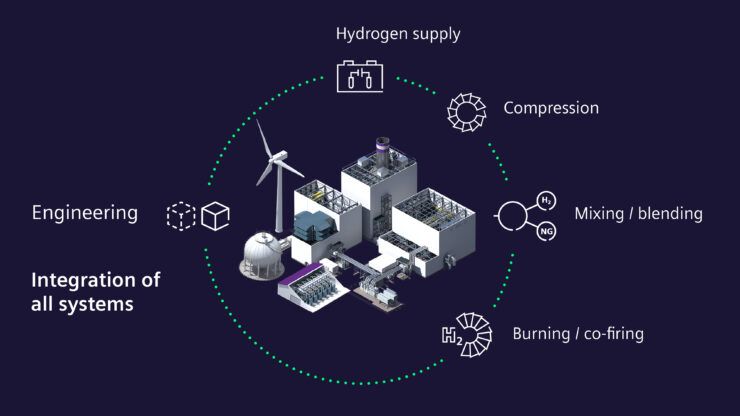
With a gas turbine portfolio that covers the entire H2 value chain – from low-emissions hydrogen production and transmission to its eventual combustion in gas turbines – Siemens Energy can uniquely support customers on co-firing projects.
As part of its ongoing efforts to accelerate hydrogen adoption, the company is now offering integrated hydrogen-natural gas (H2-NG) mixing skids for select models of industrial gas turbines. The mixing skids enable gas turbines running on natural gas to safely operate on hydrogen blends once supply becomes available. By installing an H2-NG mixing skid, operators can take an essential step towards future-proofing their assets and protect investments in existing infrastructure.
The case for co-firing
Over the last two years, numerous gas-fired power plants across the globe have announced formal plans to burn hydrogen blends as part of decarbonization initiatives. Industrial operators who use gas turbine mechanical drives (i.e., in process facilities such as pipeline stations, LNG plants, refineries, etc.) are also exploring its potential via pilot projects.
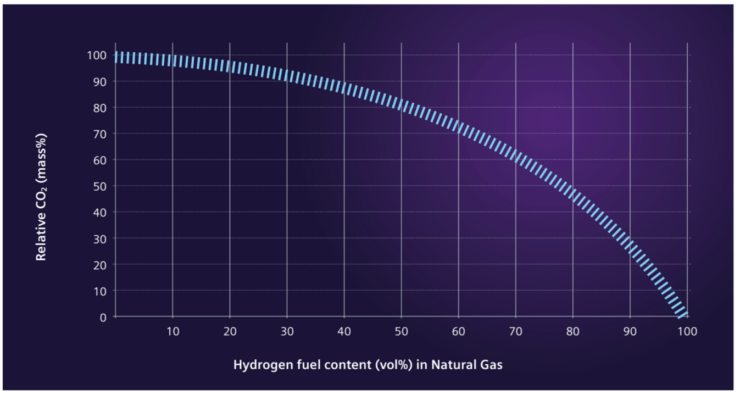
Blending hydrogen with natural gas can substantially lower carbon emissions from gas turbines. But the relationship between CO2 reduction and hydrogen volume content in the fuel stream is non-linear. As shown in Figure 1, to reach a 50% reduction in CO2 emissions, a fuel stream containing approximately 77% hydrogen by volume is required.
Although this blend ratio may not be practically or economically viable for most operators today, it likely will be in certain regions of the world over the coming years. According to the International Energy Agency (IEA), low-emissions hydrogen production could reach 49 metric tons per year (MTPA) by 2030. Strong growth is being driven by announced electrolysis projects, which globally now exceeds 500 GW of capacity.
Hydrogen co-firing in smaller quantities is feasible today and can incrementally lower the emissions footprint of gas turbines at an acceptable cost.
For example, adding just 10% hydrogen by volume in the fuel stream will reduce CO2 emissions by 2.7%. This would reduce 30,000 metric tons of CO2 for an 850MW combined cycle power plant that runs for 6,000 hours/year at 60% efficiency.
For another example, adding 30% hydrogen by volume results in an 11.4% reduction in CO2 emissions. For a 62MW simple cycle power plant that runs 8,000 hours/year, the resulting CO2 avoidance would be around 28,000 metric tons annually.
Siemens Energy has been a pioneer in developing hydrogen-capable gas turbines. The company’s fleet has accumulated numerous hours of operating service on H2 blends using unabated diffusion flame, wet low emissions (WLE), and dry low emissions (DLE) combustion technologies.
In recent years, several manufacturers have announced plans to develop gas turbines that can run on 100% hydrogen using already mentioned dry low emissions (DLE) combustion technologies. Some OEMs, including Siemens Energy, have plans to introduce 100% hydrogen-capable frames before 2030.
Current efforts are focused on overcoming key technical barriers related to hydrogen’s unique combustion characteristics, including its lower ignition energy, significantly higher flame speed, and broader flammability limits compared to natural gas
The role of mixing systems
Co-firing in power plants necessitates additional systems and components upstream and downstream of the gas turbine. In the case of a blended H2-NG mixture, all components in the fuel gas system upstream of the turbine must be assessed for hydrogen compatibility.
The blend ratio, temperature and pressure will ultimately determine if pipes, valves, filters, preheaters, measuring devices, and/or transmitters must be replaced. In addition, an H2-NG mixing skid with isolation and flow control valves and gas composition and flow measurement, is required.
Siemens Energy offers integrated H2-NG mixing skids for its industrial gas turbines in the 24–62MW power band. The mixing skids enable gas turbines running on natural gas to operate on hydrogen blends ranging from 0% to 100% vol (depending on the turbine’s hydrogen capabilities).
The mixing skid connects a pressurized hydrogen gas line to the natural gas line. The stream leaves the mixing skid with the required properties to be used as fuel for the gas turbine, as per the end-user’s specifications.
Coriolis flow meters measure the natural gas and hydrogen feed flows inside the mixing skid. This information is sent to flow controllers, which operate the control valves for natural gas and hydrogen, regulating the feed mass flow rate to meet the target blend ratio.
Mixing skid (MXS) design and operation
Figure 2 shows the specifications for the three H2-NG mixing skids made by Siemens Energy. These standardized mixing skids cover 355 gas-and-H2 vol% content scenarios. They feature a standard design and arrive onsite pre-packaged and ready for installation on a concrete foundation.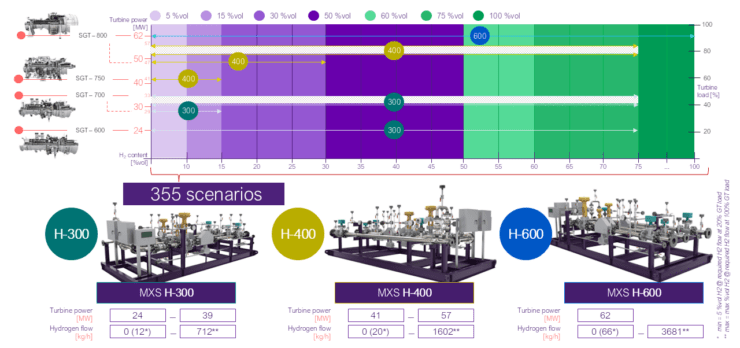
The mixing skids have pneumatically-actuated control valves and emergency shutdown (ESD) valves (both require an external air supply). A static mixer provides a homogenous mixing of gases in a short piping installation next to the gas turbine.
Final control of the mixing is provided with a thermal conductivity gas analyzer/detector (TCD) to maintain safe operation of the overall fuel gas system. The gas analyzer and a unit control panel, which includes functionalities of the flow control and ESD system, are in an enclosure for outdoor installation.
The overall design concept minimizes onsite work and allows for using existing tie-in points at the fuel gas line, eliminating the need for “hot work”. If hydrogen is unavailable during operation, a process interlock closes the ON-OFF valve to cut off the hydrogen stream. The gas turbine then burns 100% natural gas from the main supply line. The interlock initiates due to:
- Gas turbine trip
- High hydrogen content in mixed stream (trip signal from gas analyzer)
- Backflow from natural gas to hydrogen line (trip signal from pressure transmitters differential)
- Backflow from hydrogen to natural gas (trip signal from pressure transmitter differential)
- Mixed gas low pressure

The skid control system communicates with the gas turbine control system in real time via direct current loops and a digital communication layer. Gas detectors for potential hydrogen and natural gas leaks are installed within the skid limits. They can be connected to the centralized fire and gas detection system or to the mixing skid’s unit control panel (UCP).
Typical mixing skid
In a typical power plant or industrial facility operating a gas turbine, a Coriolis meter is installed close to the turbine inlet to measure the fuel mass flow rate. Installation of a mixing skid requires two tie–in points: one on the line upstream of the Coriolis to route natural gas to the skid and a second to deliver the blended fuel back to the supply line.
Ideally the hydrogen supply line should have a tie–in point close to the existing natural gas line and connect to the skid inlet. The hydrogen line inside the mixing skid has a Coriolis meter and a control valve to regulate the hydrogen mass flow rate to meet the desired hydrogen content/percentage in the fuel mix.
The hydrogen line and natural gas skid inlet lines are connected to the two inlet nozzles of a static mixer, where the gases will be mixed. All the process tie-in points of the mixing skid are provided with double block and bleed, including automatic shutdown valves (SDV) to isolate the skid when required.
A vent (purge) line is provided for skid depressurization and routed to a safe location since hydrogen, natural gas, and the fuel blend will occasionally require de-inventory. Nitrogen is provided to purge the skid for safety purposes and before any line opening for instrument maintenance or removal of the entire skid.
Gas turbines typically require inlet pressure between 15 – 35 bar (depending on the model). The hydrogen supply must be above this pressure to allow for a pressure drop along the skid, yet must still have enough pressure to mix with the natural gas in the existing line.
It should also be noted that the mixing skid installation will add a pressure drop to the existing natural gas fuel supply line, representing a decrease of 3–5 bar in fuel pressure at the turbine inlet – if the same upstream pressure is maintained. The exact pressure dynamic will need to be evaluated case-by-case.
Siemens Energy has received multiple orders for H2-NG mixing skids over the last year. In one application, a power plant operator will install a skid to enable combustion of a 30% vol hydrogen blend (~300 kg/h) in an SGT-700 industrial gas turbine with a 35MW power output. In another case, a mixing skid will support the hydrogen co-firing of a gas turbine mechanical drive in a pipeline compression station.
Siemens Energy is developing additional mixing skid concepts to support the decarbonization of other applications, including smaller and larger gas turbines, furnaces for cement and steel plants, and H2-NG pipelines. In addition to hydrogen, the company has plans to accommodate blending with eFuels, including methanol and ammonia.
Laying the foundation for a low-emission future
Hydrogen-capable gas turbines can play a critical role in driving a successful energy transition by providing stability to grids with a high share of renewable generation.
Hydrogen blending not only lowers CO2 emissions, it also ensures that the gas turbines can act as long-term electricity storage using hydrogen reelectrification. Today, sufficient hydrogen supplies exist for many gas turbine operators to plan pilot projects.
For applications where blend ratios will be low (5-15%), it may be possible to co-fire with very few (or no) modifications to the existing gas turbine.
Siemens Energy can support customers on these projects by handling the entire work scope – from the initial feasibility/conceptual study to compression, blending, and systems integration to final commissioning and operation.
About the Author: Danijel Bukša is a sales and process expert at Siemens Energy, focusing on energy storage, tank farms and terminals, LNG, and fuel shift solutions. He studied Mechanical Engineering and Naval Architecture in Zagreb, Croatia. With 24 years of experience in mechanical design and sales engineering in the oil and gas industry, his roles include R&D, business development, global sales, and training in growth, energy transition, fuel shift, and decarbonization.
For additional hydrogen coverage, see links in this overview on OEM hydrogen readiness.