LNG exports to Europe are hitting record levels when U.S. natural gas prices are on the rise. Analysts predict that prices could rise over $4 soon, bolstered by cold weather events in January across the nation. The LNG market is also gaining due to an outage at a Norwegian terminal and recent expansion in U.S. production capabilities.
Cheniere Energy’s Corpus Christi Liquefaction facility (CCL) in Texas now has three operational liquefaction trains. Each one can produce 5 million tonnes per annum (mtpa) of LNG and the facility’s three containment tanks each have the capacity to store 160,000 cubic meters of LNG.
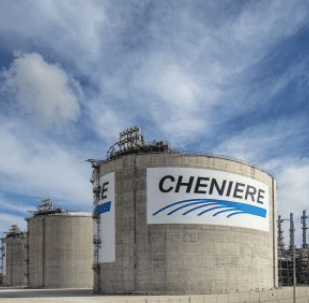
Two berths can receive the world’s largest LNG carrier, the Q-Max, which is 344.4 meters long with a cargo capacity of 266,000 cubic meters. CCL Stage 3, now in the construction and commissioning phases, will consist of seven trains and add over 10 mtpa of production capacity.
That will bring CCL’s capacity to over 25 mtpa. Train 1 of CCL Stage 3 produced its first LNG in December of 2024 and is expected to reach full completion in early 2025. Two additional trains will be online this year with the other four trains completed in 2026.
Cheniere’s 22-mile, 48-inch Corpus Christi pipeline connects CCL to interstate and intrastate pipelines. The company has plans to add another two trains to this site.
Further, Plaquemines LNG achieved first cargo for what is now the eighth export terminal in the U.S. It uses midscale liquefaction technology and was developed by Venture Global.
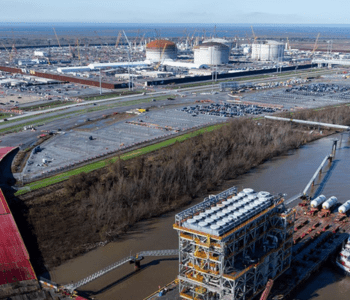
This is first of two phases of the project. Each phase consists of nine blocks, Each block contains two liquefaction trains for 18 liquefaction trains. When completed, it represents a combined capacity of 1.3 billion cubic feet per day (Bcf/d) and peak capacity of 1.6 Bcf/d.
When both phases are completed, Plaquemines will reach 2.6 Bcf/d (3.2 Bcf/d peak). Venture Global plans to commission and export LNG from Plaquemines Phase 2 in September 2025.
Completing Plaquemines and Corpus Christi Stage 3 will bring U.S. production capacity to 15.4 Bcf/d. By 2028, that will expand to 21.2 Bcf/d once another three under-construction projects (Golden Pass, Rio Grande, and Port Arthur) are completed. Overall exports from the US have increased from 4 Bcf/d in 2019 — in 2024, the DOE authorized up to 48 Bcf/d in annual exports.
LNG export growth is fueling gas turbine sales in the oil & gas sector. The sales outlook for OEMs remains brisk. For an analysis of sales performance by OEM and gas turbine model, and a look at what’s expected over the next 5-10 years, please see our Gas Turbine Global Market Forecast.