If the transition to gas turbines firing 100% hydrogen gas (while maintaining today’s low NOx emissions) is feeling like a race between OEMs, Mitsubishi Power has been making giant strides toward the finish line.
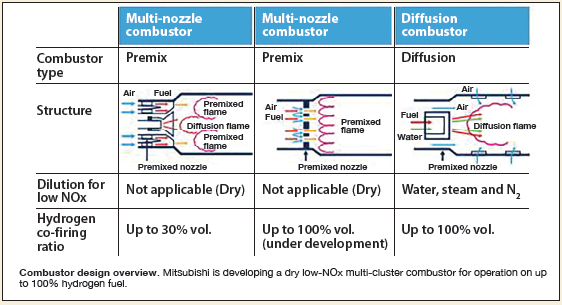
Mitsubishi Power has developed three types of gas turbine combustors that can be used for co-firing hydrogen blended with natural gas and for burning hydrogen (see diagram for an overview of those technologies).
Multi-nozzle combustor
The Dry Low NOx (DLN) multi-nozzle combustor is a newly developed combustor for hydrogen. It is based on conventional DLN technology modified to prevent flashback. The design features rapid mixing by passing combustion air through a swirler to establish a swirling flow, and supplying fuel through small holes in the swirler’s wing surface. Validation testing was performed at J-series firing conditions with a 30% vol. hydrogen and natural gas mix.
Multi-cluster combustor
Mitsubishi Power has adopted a new multi-cluster combustor as a promising alternative to the DLN design. It uses a greater number of nozzles than the eight fuel supply nozzles of a DLN combustor, and allows air and hydrogen to mix at a smaller scale without using swirling flow.
This contributes to both high flashback resistance and low NOx. Combustion characteristics with up to 80% vol. H2 co-firing have been confirmed at rig test.
Diffusion combustor
Mitsubishi has extensive hydrogen firing experience that dates back nearly 50 years and includes refineries, syngas and coke oven gas (COG) locations. A network of 31 power plants burning fuel with up to 90% vol H2 content has been in operation for over 3 million hours.
Applications involve the traditional diffusion combustor where the fuel is injected directly into the main air flow in the combustor. Compared with premixed combustion, a region of a high flame temperature is typically formed, increasing the NOx generated.
This requires a diluent such as steam, water or nitrogen be injected to reduce flame temperature and lower NOx emissions. Injecting the diluent, however, also reduces cycle efficiency.
Hydrogen projects
Mitsubishi currently has the following hydrogen projects under development, with estimated completion dates between 2024 and 2027.
NUON MAGNUM HYDROGEN CONVERSION PROJECT
Site: Eemshaven, Netherlands Major
Supplier: Mitsubishi Power
Developer/Owner: Nuon/Vanttenfall
EPC Contractor: N/A
Nominal Rating: 1,320 MW
Target Completion: 2027
The Magnum power station is a 1.32GW gas-fired combined-cycle power plant in Eemshaven, Netherlands. Operational since 2014, the three-unit plant is owned and operated by Nuon (aka Vattenfall Nederland), a wholly-owned subsidiary of Vattenfall of Sweden. The plant comprises three individual (1-on-1) 440MW M701F4 combined cycle power generation modules supplied by Mitsubishi Power.
In 2017 an ambitious hydrogen conversion project was announced with an initial target of converting one of the Eemshaven 440MW units to run on 100% hydrogen by 2023. Upon completion of the conversion project, plant emissions are expected to be reduced by 1.3 million tons of carbon dioxide (CO2) a year. The hydrogen fuel would be produced from Norwegian natural gas and the CO2 released during the process would be stored in underground storage facilities off the Norwegian coast, enabling carbon-neutral operation.
Along with Nuon, partners in the project are Gasunie and Norway’s Equinor (formerly Statoil). Equinor will be responsible for hydrogen production while Gasunie will focus on transportation, delivery and storage of hydrogen at the power station.
Early in 2018, Mitsubishi Power agreed to investigate the feasibility of the plan and to develop turbine technology for 100% hydrogen-based power generation at the power station. This project is to be part of a national program being supported by the Dutch government plans to invest €300 million in measures aimed at reducing the country’s CO2 emissions produced by the power generation and transportation sectors. Plans for coping with transportation emissions included a fleet of hydrogen fuel-cell powered buses, trucks and vans, and hydrogen filling stations.
“In order to meet the targets set by the Paris Agreement, CO2 emissions from the electricity sector in the Netherlands will have to be 55 to 75% lower in 2030 than in 1990,” says Alexander van Ofwegen, a director at Nuon who oversees operation of the Magnum plant.
According to most recent news on the project, it is being delayed due to stalling of government action to fund the national decarbonization program, along with expected subsidies to cover the added cost of hydrogen fuel.
Blue hydrogen for the project (i.e., produced by steam reforming of North Sea gas with carbon capture and storage) is expected to cost 2-3 times more than natural gas. Green hydrogen, produced by renewable energy, would cost 4-5 times more than that, says Vattenfall.
Vattenfall now says the Magnum conversion can be completed no sooner than 2027, subject to government support to bridge the cost gap and make the project economically feasible. Meanwhile, the company says it is considering an intermediate phase in which hydrogen is blended with natural gas. Up to 30% hydrogen (by volume) is achievable with existing gas turbine technology and would reduce plant CO2 emissions by 20 percent.
In addition, Vattenfall is investigating whether customers would pay a premium for electricity partly generated with hydrogen and help subsidize the project. In the long term, the company’s vision is to rely on locally produce hydrogen to fuel the entire plant.
INTERMOUNTAIN REPOWERED COAL PLANT CONVERSION
Site: Delta, Utah
Major Supplier: Mitsubishi Power
Developer/Owner: Intermountain Power
EPC Contractor: Black & Veatch
Nominal Rating: 840 MW
Operation: 2025
The existing Intermountain Power Plant is a relatively modern 1,800MW coal-fired power station in central Utah operating since 1986. Intermountain Power Agency (IPA) is the plant owner, while the Los Angeles Department of Water and Power (LADWP) operates the plant and purchases most of its output.
In early 2020, IPA announced that the coal plant will be retired and replaced with an 840MW (site-rated) gas-fired combined cycle facility. It was further announced that, although the new plant will start operation on natural gas, it will transition to a mix of 30% hydrogen (by volume) and 70% natural gas by 2025, the scheduled project completion date.
The plan also commits the plant owner to increasing the fuel mix to 100% green hydrogen fuel by 2045, with renewable energy to power electrolysis facilities for hydrogen production and storage at the site.
The combined cycle plant will be built around two single-shaft units equipped with an advanced technology power block supplied by Mitsubishi Power. Each power block will include one M501JAC gas turbine, a heat recovery steam generator and a steam turbine.
Each 1×1 M501JAC combined cycle is ISO rated at 630MW net plant output at over 64% efficiency on natural gas fuel. At an elevation of 4634 feet above sea level, and summer temperatures of close to 100°F, each Intermountain block is nominally site rated at 420MW.
Although the gas turbines will burn natural gas fuel when first installed, the M501JAC gas turbines are hydrogen-capable to operate on up to 30% hydrogen fuel mixture and transition to 100% hydrogen once enough hydrogen fuel becomes available,
Los Angeles says it will continue to purchase most of the new combined cycle station output and will rely on the Intermountain project to help meet California’s target to decarbonize all retail power sales in the state by 2045.
“Our mission is to provide affordable, reliable power with a future vision of becoming a net-zero carbon energy resource,” says Dan Eldredge, IPA general manager. “The unique Intermountain Power Project site and existing regional energy infrastructure provide an ideal opportunity for accomplishing this mission.”
DANSKAMMER PLANT REPOWERING PROJECT
Site: Newburgh, New York
Major Supplier: Mitsubishi Power
Developer/Owner: Danskammer Energy
EPC Contractor: N/A
Nominal Rating: 600 MW
Operation: 2024/2025
The Danskammer Repowering Project will be sited at the existing Danskammer Power Station site where the 1950s-vintage steam turbine power plant will be replaced with a Mitsubishi M501JAC 1x1x1 combined cycle rated at around 600 MW. According to Mitsubishi Power (MP), the new plant will incorporate quick-start, fast-ramping technology designed to provide the NY State system operator with added flexibility to handle new additions of renewable energy sources being developed in the Hudson Valley area.
“The project will cost over $400 million,” says William Reid, CEO of Danskammer Energy. “The new technology will dramatically improve the environmental profile of the site and support the state’s renewable energy goals.”
By installing an air-cooled condenser, the plant will cease using Hudson River water for once-through cooling, and air emissions will be greatly reduced by low-NOx gas turbine combustion technology, and use of an SCR (for further NOx reduction) and a CO catalyst, both installed in the heat recovery steam generator.
Although the plant initially will burn natural gas, the developer says plans call for a fuel-gas mixture containing increasing amounts of green hydrogen produced from surplus renewable energy.
“We are committed to helping New York meet its climate targets,” says Reid, “the project will serve as a bridge to the state’s renewable energy future. We selected Mitsubishi technology because it would ready our facility to be a hydrogen-based zero-carbon power generator.
“By partnering with Mitsubishi Power for integrated green hydrogen generation and storage technologies, we hope to provide leadership in developing short- and long-duration energy storage infrastructure in New York State.”
According to the project developer: the upgraded Danskammer plant can transition to “zero-emission hydrogen when the technology to transport and store hydrogen is available.”
In this regard, Paul Browning, President & CEO of Mitsubishi Power, says that the M501JAC combined cycle can provide “the extreme flexibility to partner with new intermittent renewable generation of the future.”
HARRISON COUNTY INDUSTRIAL PARK COMBINED CYCLE
Site: Harrison County, Ohio
Major Supplier: Mitsubishi Power
Developer/Owner: EmberClear
EPC Contractor: Gemma Power Systems
Nominal Rating: 1,085 MW
Operation: 2024
EmberClear is in final stages of developing a 1,085MW natural gas-fired, combined cycle power project to be constructed about 50 miles west of Pittsburgh, in the Village of Cadiz, Harrison County, Ohio. Mitsubishi Power is the major supplier of equipment and Gemma Power Systems the EPC contractor for the two unit single-shaft 2x2x1 M501JAC combined cycle power block.
The $1 billion project is being built in the Harrison County Industrial Park on a 100 acre site in the heart of the Utica shale region. The primary natural gas source for the plant will be through a 2 BCF/day gas production and gathering operations less than one mile from the site. Given the access to low cost shale-produced natural gas, and utilization of highly efficient combined cycle technology, the plant will have a very competitive production cost and be one of the first plants dispatched in the PJM wholesale market, according to EmberClear.
“In order to minimize water usage and discharge at the site, the project will employ air cooled condensing, thereby enhancing the developer’s commitment to the environment,” says EmberClear VP and project leader, Steve Goff.
The project’s key siting, air and water/pollution discharge permits are in place, as is the PJM Interconnection Services Agreement, for start of construction in 2021, putting the project on track to reach its planned commercial operation date in Q1 2024. The project also has an eye on its hydrogen future with hydrogen production facility and storage in its future design plans.
“There are several geological formations within 5-10 miles of the plant site to store hydrogen”, says Goff. “We are working with Mitsubishi Power to support future transition to power production from hydrogen.”
EmberClear President and CEO, Raj Suri, notes: “We look forward to the flexibility that the Mitsubishi Power technologies will provide as we ramp green hydrogen integration.
“This plant will probably be the first hydrogen-capable project to reach commercial operation east of the Mississippi River.
CHICKAHOMINY COMBINED CYCLE POWER PROJECT
Site: Charles City County, Virginia
Major Supplier: Mitsubishi Power
Developer/Owner: Balico
EPC Contractor: Gemma Power Systems
Nominal Rating: 1,650 MW
Operation: 2024/2025
The permitted 1,650MW Chickahominy Power Project design features three 1x1x1 advanced-class single-shaft combined cycle power trains and air-cooled condensers to limit water use. Gemma Power Systems has been awarded the EPC contract, and Sargent & Lundy is the plant design engineer.
Each power train will consist of one Mitsubishi M501JAC gas turbine equipped with evaporative inlet cooling, one triple pressure reheat steam turbine, one hydrogen cooled electric generator and one heat recovery steam generator (HRSG) . The HRSG will be equipped with supplemental duct firing to increase steam output, selective catalytic reduction technology for NOx, and an oxidation catalyst for CO and VOC reduction.
Balance of plant scope includes two auxiliary boilers to supply steam to the steam turbines at start-up and to warm the HRSGs for rapid cold or warm start-up. Also three fuel heaters to warm the incoming natural gas fuel and keep the gas pressure regulating valves from freezing.
Initially, the project will be fueled by natural gas sourced from the Marcellus shale formation. The developer has stated plans for transitioning to gas-hydrogen mixtures when hydrogen is available.
The project site is on a 185-acre parcel where it will serve the rapidly growing economy of Northern Virginia/Hampton Roads.
“The Chickahominy Power Project is poised to deliver the critical Dominion Zone PJM system with the most efficient gas turbine technology in the world,” says Balico CEO, Irfan K Ali.
“We are excited at the prospect of even further environmental improvement by incorporating Mitsubishi Power’s innovative renewable hydrogen-based technologies.”
ORANGE COUNTY PROTOTYPE “HYDAPTIVE” PLANT
Site: Orange County, Texas
Major Supplier: Mitsubishi Power
Developer/Owner: Entergy
EPC Contractor: N/A
Nominal Rating: 1,200 MW
Operation: 2026
In September 2020, an integrated energy company Entergy Corp. with a 30GW power generating portfolio, agreed to collaborate with Mitsubishi Power under a “Joint Development Agreement” to take steps towards decarbonizing its utility businesses in Texas, Louisiana, Arkansas and Mississippi.
Their combined efforts will focus on:
• developing hydrogen-capable gas turbine combined cycle facilities
• developing green hydrogen production, storage and transportation facilities
• creating nuclear-supplied electrolysis facilities with energy storage
• developing utility scale battery storage systems enabling economic growth through partnerships with the Entergy utility customers.
Entergy says it has been working to lower its carbon footprint for some 20 years. In early 2019, it announced goals to cut year-end 2000 system-wide carbon emission rates in half by 2030 and achieve net zero emissions by 2050.
A significant piece of Entergy’s plan for implementing its decarbonization program (and most likely its first dedicated hydrogen-ready project) is the proposed 1,200MW Orange County Power Station, an advanced combined cycle project being developed in partnership with Mitsubishi Power.
The two M501JAC gas turbines supplied for the project will be hydrogen-capable, says Mitsubishi, project development plans include provisions to operate on a fuel mixture of 70% natural gas and 30% hydrogen by volume upon start of commercial operation.
Their plan is to adopt Mitsubishi’s “Hydaptive” hydrogen-fuel combined cycle plant concept of integrating electrolyzers for green hydrogen production with the gas turbines — a concept featured in other ongoing projects such as the 840MW Intermountain Power Project in Utah.
Once Entergy’s self-build proposal is accepted by the Texas system operator, and regulatory approvals are obtained, the final plant design will include provisions for transition to 100% hydrogen fuel consistent with hydrogen fuel supply and infrastructure.
In announcing project plans, Entergy Executive Vice President and Chief Operating Officer, Paul Hinnenkamp, noted that sustainability has been a company priority for two decades. “We have pledged to conduct our business so it is environmentally, socially and economically sustainable.
“New technologies and innovative solutions to the challenges posed by climate change present opportunities for us to significantly decrease carbon emissions from our generation portfolio while maintaining low rates. We are pleased to welcome Mitsubishi Power as a collaborative partner in developing strategies to integrate these new technologies and solutions that support achieving our environmental and customer commitments.”
This article is part of our series on “Transition 2 Hydrogen”, covering suppliers whose technologies and solutions will contribute to the switch to burning 100% hydrogen in gas turbines, and to the rollout of hydrogen solutions in power generation, energy storage, electrolyzer technology, and pipeline/distribution. To register for monthly updates, CLICK HERE