There is an increasing recognition among power generators, system operators and regulators alike that gas turbines will continue to play a vital role in the energy transition and into the era of net-zero power generation. Gas turbines, with their unparalleled fast-start on-demand power output and operational flexibility offer a proven solution to accelerate this transition.
As such, hydrogen, as an alternative to natural gas fuel, is positioning itself as a critical “energy pillar” for facilitating low-carbon or even CO2-free dispatchable gas turbine power generation.
Aside from geopolitical, cost and supply-side issues, technical challenges lie primarily in the area of hydrogen combustion due to its physical and chemical properties vs. natural gas: high reactivity, high flame speed, high flame temperature, short auto-ignition time, and high diffusivity leading to micro-level mixing anomalies. Valuable observations and achievements have been accomplished with the application of sequential combustion technology with fuel blends up to 100% hydrogen content:
- Operation. Ability to switch between fuels to operate stably over the full 0% to 100% range of hydrogen/natural gas blends.
- Combustion. Monitor and control flashback and maximum burner metal temperature for stable and safe flame propagation.
- Emissions. Optimize trade-off of NOx emissions vs. flashback margin as functions of sequential burner inlet and outlet temperatures.
- Pulsations. Maintain low-frequency thermo-acoustic pulsations within acceptable limits.
This underscores the importance of continued innovation and investment in hydrogen combustion technology for gas turbines to fully realize these benefits while reliably meeting future energy demands on path to net-zero.
To that end, Ansaldo Energia is working to adapt its unique two-stage sequential combustion (SC) technology to burn 100% hydrogen and totally eliminate gas turbine CO2 emissions.
100% Hydrogen Update
Last year an article entitled “Turning to Sequential Combustion Technology to Push Hydrogen Fuel Content to the Extreme” was published in the October 2023 issue of GTW magazine. That article dealt with modification of Ansaldo Energia’s GT36 sequential combustor design to burn high concentrations of hydrogen blended with natural gas. This article is an update on further development and testing of that modified design to safely operate on up to 100% hydrogen.
Optimized two-stage combustion
With sequential combustion technology, first introduced in 1996 on the GT26 gas turbine, fuel is burned in two distinct stages separately controlled to optimize the combined performance of the overall system.
The initial design has since been enhanced for the company’s new 563MW H-class GT36 gas turbine combustor (Figure 1). Note: GT36 output rating is based on the inclusion of an external once-through cooler to lower turbine cooling air temperature (standard design for combined cycle applications).
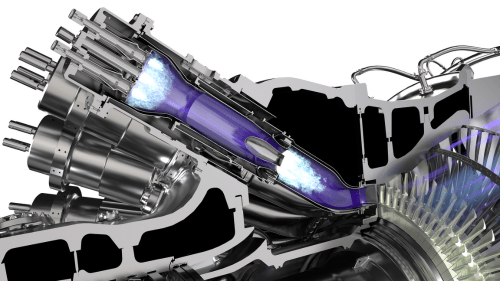
This two-stage combustion approach is proven to be more flexible compared to other systems. That is because operation of the second combustion stage can be adapted, together with the hot gas temperature exiting the first stage (e.g., as needed to accommodate hydrogen’s unique combustion properties) to maintain the high turbine inlet temperature.
This has been consistently demonstrated by the performance of the GT26 fleet characterized by excellent full-load emissions, low part-load limits, high part-load efficiencies, and enhanced fuel flexibility.
The 780MW (63% efficient) Porto Marghera combined cycle plant in Venice features the first GT36 unit in commercial service. Demonstrating reliable operation, it is providing outstanding grid stabilization capability with up to 100MW/min ramp rates.
Ansaldo Energia aims to further develop the sequential combustion system design to allow fully flexible CO2-free operation of the GT36 with hydrogen. As leading participant in the recently launched FLEX4H2 project (see project participants at the end of the article), Ansaldo Energia is collaborating closely with a consortium of European companies and research partners to make this a reality.
Key challenges and solutions
Comparing critical combustion properties of hydrogen such as flame propagation velocity and ignition delay time with those of other fuels (Figures 2 and 3, respectively) reveals the major challenges in developing a flexible 0% to 100% hydrogen combustion system:
- Flame propagation velocity. As shown in Figure 2 the laminar flame propagation velocity (aka flame speed) for different fuel gases is a function of the Equivalence Ratio under typical (20 bar, 450 °C) gas turbine combustion conditions.
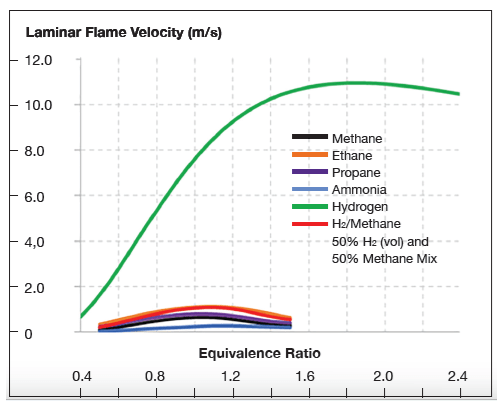
The Equivalence Ratio, for different fuels, is the actual fuel-to-air ratio in the combustion zone relative to the stoichiometric fuel-to-air ratio. To mitigate combustion NOx formation and emissions, modern DLE gas turbines are typically operated at fuel lean conditions with a high excess of air at equivalent ratios below 0.6.
Under these conditions, the nominal laminar flame propagation velocity of hydrogen is already 10 times that of natural gas. However, this significant difference in laminar burning rate is only a minor issue when compared with the more substantial practical challenge of predicting and controlling its turbulent counterpart, which actually prevails within the combustion chamber.
Turbulence increases the effective flame-front area. And hydrogen’s high diffusivity induces molecular-diffusion effects that alter the local flame stoichiometry and microstructure. This causes the turbulent flame-front propagation velocity to increase by several orders of magnitude compared to nominal laminar conditions.
Flame-front acceleration compromises flame stability in combustors originally designed for natural gas. This makes them more susceptible to flashback and increases formation of NOx due to locally fuel-rich flame segments burning at higher temperatures.
A growing body of empirical and theoretical evidence suggests that such effects of hydrogen diffusion from turbulent flame fronts (on flame speed and NOx formation) are exacerbated. This is especially the case at the higher pressures and flame temperatures found in the most efficient gas turbines available (H-and J-class) with turbine inlet temperatures approaching 1650°C (3000°F).
In this context, sequential combustion becomes a crucial technological advantage for using hydrogen in modern gas turbines, while keeping the flexibility for operation on natural gas and hydrogen blends.
- Auto-ignition time. Another hydrogen combustion property affecting burner design is its much shorter ignition delay time. This is defined as the time that elapses between when auto-ignition temperature is reached and the actual start of combustion of a fuel air mixture.
The higher reactivity of hydrogen greatly reduces it auto-ignition temperature and ignition delay time (Figure 3).
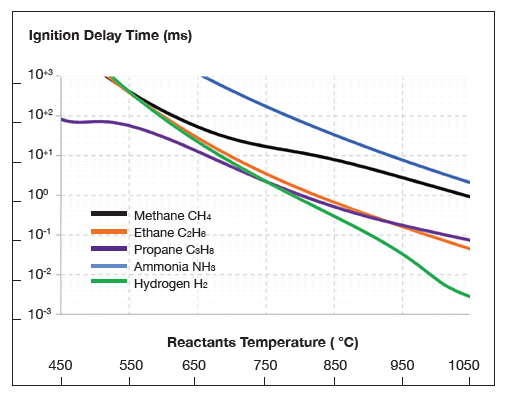
For example, while natural gas (black line) auto-ignites after about 4ms at a temperature of 1000°C, hydrogen (green line) only requires a temperature of 750°C for the same ignition delay time. (At 1000°C, hydrogen auto-ignites in about 0.01ms.)
The sequential combustion system is designed around a combination of two longitudinally staged burners: the propagation-stabilized Stage 1 burner and an auto-ignition stabilized Stage 2 burner. Uniquely, it can be adapted to specific fuels over a wide range of fuel reactivity without requiring change in burner geometries nor reduction of the final second stage hot gas exit (turbine inlet) temperature.
Auto-ignition stabilized flames are governed by a different physical process than propagation-stabilized flames. As a result, the propagation of fuel-lean hydrogen flames can be better controlled in such a sequential multi-mode combustion system (Figure 4).
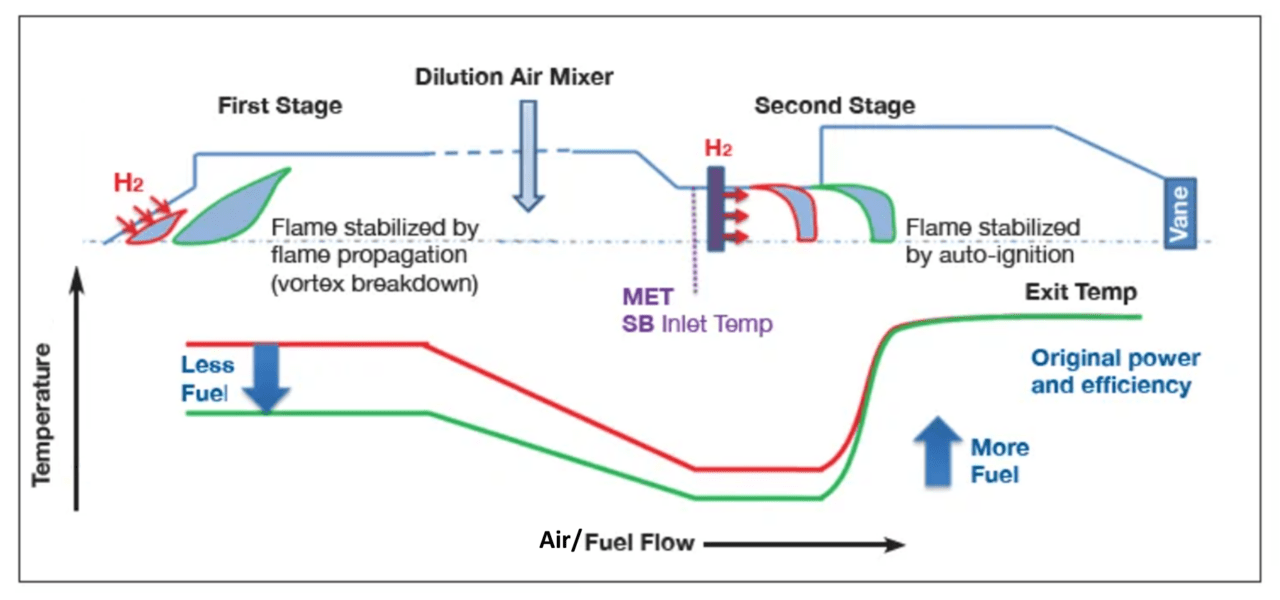
In the first stage, which is susceptible to the unstable flame-propagation processes described above, only a small fraction of the total fuel is used. The flame is stabilized under ultra-lean conditions, maintaining low flame temperatures and mitigating both flashback and thermal NOx formation.
Hot combustion products from the first stage are then mixed in the second stage with secondary air and additional fuel to reach the target mixture temperature. In this second stage, the flame is stabilized by auto-ignition which crucially mitigates the impact of thermal diffusivity effects and NOx formation characteristic of hydrogen flames.
The auto-ignition combustion mode also allows for higher flow speed, resulting in low residence time, further reducing the risk of flashback and NOx formation. However, at such higher bulk velocities, optimized flow dynamics and fuel-oxidizer mixing are necessary to address these issues while maintaining low pressure losses.
FLEX4H2 recent progress
The multi-national FLEX4H2 project is addressing all challenges related to hydrogen firing of the GT36 combustion system. It aims to enable rapid and reliable deployment of carbon-free power generation at large scale in the most efficient gas turbines.
To improve burner design towards better performance with high content hydrogen fuel, two key measures were identified (Figure 5):
- Optimized fuel injectors for faster mixing at reduced pressure drop, thus lower NOx, and
- High speed fuel-oxidizer mixing section for higher flashback resistance.
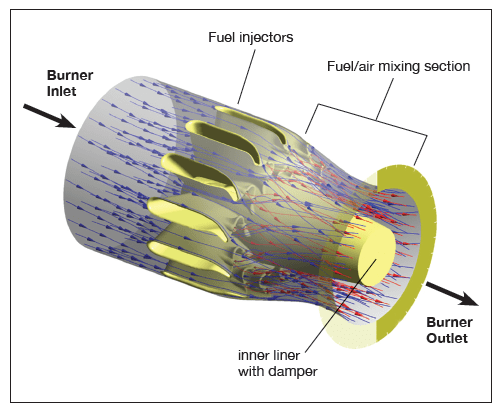
Other areas of importance in the R&D work conducted were a better understanding of the thermo-acoustics (combustion induced pulsations) of the sequential combustion system and an improved method for flashback detection.
Fuel injector optimization
The fuel injectors constitute one of the most delicate parts of the burner, driving the interaction between fuel and combustion air. As a result of detailed computational fluid dynamics (CFD) analysis incorporating hydrogen’s unique physical properties, the design was modified to allow fast mixing while avoiding recirculating regions (“dead” zones) detrimental for hydrogen induced flashback and increased burner pressure drop.
Reactive and non-reactive simulations were carried out to characterize the aerodynamic behavior of the burner and its operation with hydrogen. The velocity field, the fuel-air mixing, and the temperature distribution in the combustion chamber were analyzed and optimized towards a design with higher flashback resistance and lower NOx formation.
The fuel mixture fraction distribution at the flame front was also simulated and optimized. This parameter is particularly important to characterize the flashback behavior of the burner and post-flame NOx formation in the combustion chamber.
Fuel-oxidizer mixing
The shape of the mixing section and its volume was optimized for higher flashback resistance as demanded for operation with higher hydrogen concentrations. Prototype test designs were based on previous experimental test data, CFD analyses and chemical kinetics calculations.
The numerical modelling approach also employed high-resolution Large-Eddy Simulation (LES) and well established chemical kinetics for hydrogen combustion.
To support the LES-based models in predicting the turbulent burning rate of lean premixed hydrogen combustion, a computationally advanced approach is used. It combined high spatial and time-based resolution with the highest formal accuracy of the numerical method.
The temperature distribution (Figure 6) shows that high temperature regions are in the high fuel mixture fraction regions. Positioning the flame further downstream in the combustion chamber helps to reduce post-flame NOx formation and prevent flashback.

Thermo-acoustic behavior
Ensuring stable operation across the full operational range of the gas turbine fueled by hydrogen requires an in-depth understanding of the thermoacoustic (combustion-induced pulsation) behavior of the system.
The first step for achieving this is development of a surrogate model representing the thermo-acoustics of the two-stage GT36 combustor. This requires addition of a new dimension to the models commonly used for single stage systems to ensure that the behavior of a single flame can be extracted from that of the complete sequential combustion system, and vice versa.
To date, this analytical and test effort has led to development of an algorithm capable of modeling the behavior of the GT36’s subsystem containing the first-stage flame. The model will be constantly updated based on the experimental data provided throughout the project.
Flashback detection
To assess the flashback margin, the test hardware has buried thermocouples at multiple circumferential locations near the exit of the mixing section (Figure 7). These thermocouples provide local metal temperature readings and indicate the axial flame position.

The metal temperature at these points, although influenced by applied cooling, correlates well with the sequential burner (Stage 2) inlet temperature. Thus, as the sequential burner inlet temperature is adjusted by varying the fuel flow in the first stage, the local metal temperature varies accordingly.
However, under certain test operating conditions, such as with increasing hydrogen content (thus reducing ignition delay time) or increased Stage 1 exit temperature, the flame tends to move upstream and approach the exit of the Stage 2 burner section (i.e., imminent flashback).
This is detected by the embedded thermocouples which report an inordinate increase in metal temperature, necessitating a reduction in the Stage-2 inlet temperature to maintain the initial flame position and prevent flashback.
Combustion rig testing
The overall validation target for the FLEX4H2 project in 2023/2024 was to test and evaluate the performance and limitations of the first development iteration (Gen1) combustion system hardware.
The crucial objective of the test program was to assess the limitations of the sequential combustion concept for high-hydrogen content fuels and to provide data to serve as input to subsequent development steps. Planned test program consisted of both atmospheric pressure and high-pressure rig testing.
- Atmospheric pressure tests. Atmospheric pressure rig testing represents an initial step in evaluating the operability of the sequential (Stage 2) burner with fuel blends ranging from 100% CH4 to 100% H2. Primary objectives of this test phase were:
- Thermo-acoustic characterization. Flame transfer function measurements with different H2 blends under different atmospheric conditions.
- Validation of computational fluid dynamics (CFD) model. Baseline experimental results with focus on emissions, flashback and overall thermal/aerodynamic behavior.
- Ignition procedures. Ignition procedures and safe ignition windows can be tested in the atmospheric combustion rig and transferred to engine conditions.
- Input for subsequent high pressure tests. Quantitative and qualitative comparison to baseline sequential burner results.
Ansaldo Energia’s “VESTA” atmospheric pressure test allowed testing of full-scale GT36 combustor components. Additionally, the rig enabled Flame Transfer Function (FTF) measurements to characterize the thermo-acoustic response of the combustion system by applying external acoustic excitation.
To validate and optimize the ignition procedure, dedicated tests were carried out demonstrating stable ignition with various H2 blends, including 100% H2. Testing confirmed that the safe ignition window, as defined by maximum fuel conditions on the rich end and the lean blowout (LBO) limit on the lean end, narrows with increasing hydrogen content (Figure 8).

- High pressure tests. Ansaldo Energia’s “HELENA” test rig accommodates the full-scale GT36 combustor hardware in pressure vessels equipped with extensive probe and measurement access. The rig flow path represents a 1/16th sector of the GT36 engine, from compressor diffuser through the combustor exit. Its design allows rapid changes of test hardware during each test campaign.
Gen1 burner prototype testing
High pressure testing of the Gen1 burner prototype hardware was carried out over a two-week period covering a range of natural gas/hydrogen fuel from zero to 100% H2.
Test conditions represented GT36 combustor part-load and full-load operation – while proving the ability to reproduce a prescribed set of stable steady-state conditions over the full range of hydrogen blends.
Further testing conducted with blends of hydrogen and methane up to 100% H2 indicated the development areas to be addressed within the subsequent development iterations of the FLEX4H2 program.
Flame images from the exit of both stages (Figure 9) confirmed the instrumentation readings, namely, with pure hydrogen the flame was observed to be stable, with no signs of overheating.
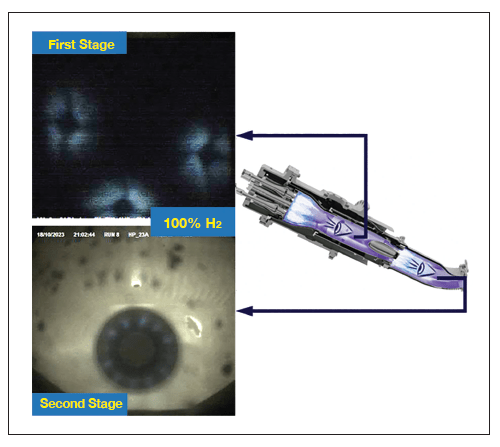
The first-stage flame was barely visible; both because of the low light emissions of hydrogen and operating conditions set to achieve the targeted low second stage inlet temperature to maintain flame front at the desired location.
The tests highlighted the combustor’s ability to switch seamlessly between natural gas and hydrogen, demonstrating its capability to cover the full range of hydrogen and natural gas mixtures.
Demonstrating flashback control
As pointed out earlier (ref. Figure 7), if the Stage 1 exit temperature is too high for a given fuel composition, the flame in the sequential (Stage 2) combustion section can move upstream and come too close to the burner section exit (imminent flashback).
This occurrence is then detected by the thermocouples imbedded circumferentially in the burner wall near to the exit plane. It can be seen occurring under test conditions by following the time trace of the burner exit thermocouple reading, illustrated in Figure 10.
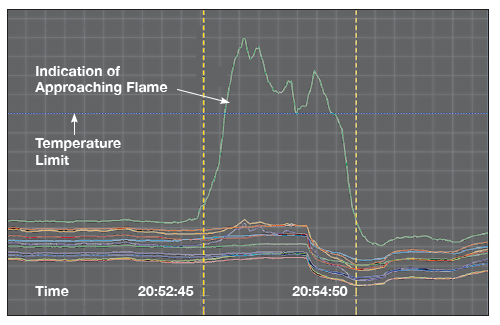
Initially, the metal temperature measurement was constant, and substantially below the limit required to ensure the long-term burner lifetime. As the flame moved upstream and approached the exit of the burner, the burner metal temperature reading surged, surpassing the long-term lifetime limit.
This high temperature reading indicated that the local metal was no longer exposed solely to the vitiated reactants, but also to the downstream combustion reaction zone. However, due to the flexibility of the sequential combustion system, it was possible, after a roughly two-minute excursion, to adjust operation of the first stage (lower flame temperature) to re-establish the appropriate operational margin, allowing the second stage flame to return to its correct axial position.
This successful demonstration of this corrective procedure to control Stage-2 flame location was confirmation of the basis of the operating concept necessary to accommodate high-reactivity fuel, as described earlier.
In short, as the reactivity of the fuel increases (as with higher H2 content), the operation of the first stage, defining the second stage burner inlet temperature, can be adjusted in real-time to maintain both flames in their optimal locations.
Other observations
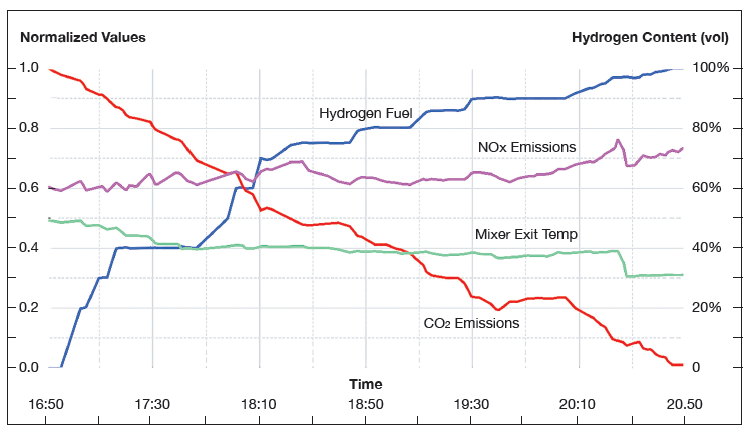
Other valuable real-time observations during the full-pressure testing regime are depicted in Figure 11 where hydrogen content (right Y-axis and blue line) is increased from zero to 100% over a test period of 4 hours.
This data allows appreciation of the fact that reaching 100% H2 operation was fully possible, bringing the CO2 emissions (red line), measured at the combustor exit, down to zero. Additionally, NOx emissions were observed (purple line) and limits were measured. Note the rise in NOx level at around test time 20hrs 10mins and the lowering of the mixer exit temperature (MET, green line) to bring the NOx emissions back to within nominal limits.
Some low frequency pulsations were observed (not shown) but were maintained within acceptable limits.
Validation milestone achieved
This article presents the latest validation test results of Ansaldo Energia’s novel constant pressure sequential combustion (CPSC) system, demonstrating its adaptability for operation on any blend of hydrogen and methane.
These results offer clear evidence that gas turbine technology can be adapted to deal with the challenges of achieving net-zero carbon with 100% hydrogen capability.
While development is still in progress, work to date has established that smart control of sequential combustion inlet and exit conditions can be utilized to accommodate sharp variations of fuel reactivity.
The demands of achieving a cleaner future require that OEM development activities focus on the integration of such solutions into existing products. To that end, the CPSC combustor and its adaptation to operation on 100% hydrogen, represent a very promising prospect for the evolving future of gas turbines.
FLEX4H2 Project Scope and Mission
Sponsor
FLEX4H2, more formally known as Flexibility for Hydrogen, is a pioneering project co-funded by the Clean Hydrogen Partnership (through its members European Union, Hydrogen Europe and Hydrogen Europe Research) and Switzerland.
Aim of the four-year project is to achieve a technology readiness level of six (TRL6) by end of 2026.
Mission
The project is focused on developing a fuel-flexible combustion system capable of operating with any hydrogen content in natural gas, up to 100% hydrogen. Its goal is to advance the understanding of hydrogen combustion in gas turbine, premix and auto-ignition supported by high-pressure experimental test data and related numerical modelling.
This will allow the further development and optimization of sequential combustion technology to achieve better control of auto-ignition and flame stabilization for up to 100% hydrogen content.
Fuel-air mixing and staging are to be optimized to minimize NOx emissions and avoid engine performance loss whilst maintaining relevant H-class gas turbine operating temperatures. This will pave the way for future R&D activities at higher technology readiness levels and provide a clear perspective for replication, uptake, and operation for commercialization beyond completing FLEX4H2.
Membership
The project is a collaborative effort that brings together a well-balanced multidisciplinary consortium of eight partners from six European countries:
Ansaldo Energia: Gas turbine original equipment manufacturer as project coordinator
ARTTIC Innovation: Consulting company for publicly funded research and innovation
CERFACS: European Center for advanced research and training in scientific computing
DLR: German Aerospace Center Institute of Combustion Technology
Edison: Italian electric utility and power plant operator
ETN Global: Non-profit association bringing together the entire value chain of gas turbine technology
SINTEF: Independent European research organization
ZHAW: Zurich University of Applied Sciences, Institute for Energy Systems and Fluid Engineering (IEFE)
Ansaldo Energia wishes to offer sincere thanks to its FLEX4H2 project partners for their support and enthusiasm in achieving this significant milestone.