In August 2022, Siemens Energy’s 60Hz SGT6-9000HL gas turbine achieved a power output of 410.9 MW (corrected to ISO standard conditions) operating under a multi-year field-test and verification program at Duke Energy’s Lincoln Combustion Turbine Station near Denver, North Carolina. This marked a major milestone in the development and commercialization of the advanced state-of-the-art Siemens Energy HL-Class gas turbine unveiled five years ago. Siemens Energy and Duke Energy were awarded the Guinness World Record title for the most powerful simple cycle 60Hz gas turbine power plant.
This was followed by a second Guinness World Record title in October 2022 for achieving the highest ramp rate for 60Hz gas turbine power plants at 100.56 MW/min. These awards came at a time of record-high gas prices, making power density and efficiency more important than ever.
Operational flexibility demonstrated by the HL is also good news for a market seeing a rapid growth of renewables in the power generation mix, underlining the critical need for grid support.

Market outlook for gas-fired power generation
With high gas prices and climate change pressure, there is ongoing debate in the industry over the future of the utility power generation gas turbine market. Recent data point to a positive outlook. Market data for 2020 shows that only 44GW of new gas turbine capacity was added worldwide. Data for 2021, the latest full year available, show an increase of nearly 40% to 61GW. The general forecast is for this level to hold steady through 2025 and climb to 65GW by 2030.
Several factors account for this projected growth in gas turbine capacity. The first, mostly affecting the market for small units, is distributed generation due to increasing industrial on-site electricity demand and evolving decarbonization activities in sectors such as Oil & Gas. Demand for decarbonization of central heating is also increasing. Countries with high reliance on district heating are moving away from coal-based systems and installing gas fired combined heat and power (CHP) plants.
In the large heavy frame gas turbine segment, several trends are driving new capacity additions. One is the accelerated shift away from coal to gas, particularly in China, but also in parts of Asia, United States and Europe. At the same time, the increasing penetration of intermittent wind and solar renewable energy calls for more backup generation to meet demand for reliable power and to keep grids stable. At the moment, the backup choice worldwide is gas power.

Even in Germany, which is severely affected by the Ukraine crisis, new gas turbine capacity is being bid over the next 2-3 years even as renewables are being added to replace coal. Similarly, gas projects are being bid in the United States, United Kingdom, Italy, Belgium and in Asia. Low rainfall in Brazil, China and elsewhere has also driven additions of gas capacity to make up for reduced hydropower.
In the longer term, Siemens Energy believes that gas power will remain a vital part of the energy transition and a viable solution for reliably supporting the accelerating growth in renewables.
Evolutionary gas turbine technology
In markets where the rapid growth of renewable capacity has driven down the cost of electricity, the increasing need for flexible grid support greatly influenced and shaped the design philosophy behind the Siemens Energy HL-Class gas turbine. The machine is designed to be an excellent complement to fluctuating renewables as well as the core of a highly-efficient and reliable base load power generating system.
When the 50Hz SGT5- and 60Hz SGT6-9000HL were first announced five years ago, the expected simple cycle ratings were 567MW and 388MW respectively; combined cycle ratings (1-on-1 single shaft) were 841MW and 577 MW. Combined cycle efficiencies were expected to be over 63% with stated simple cycle efficiencies of 42.6% and 42.3% for the 50Hz and 60Hz versions, respectively.
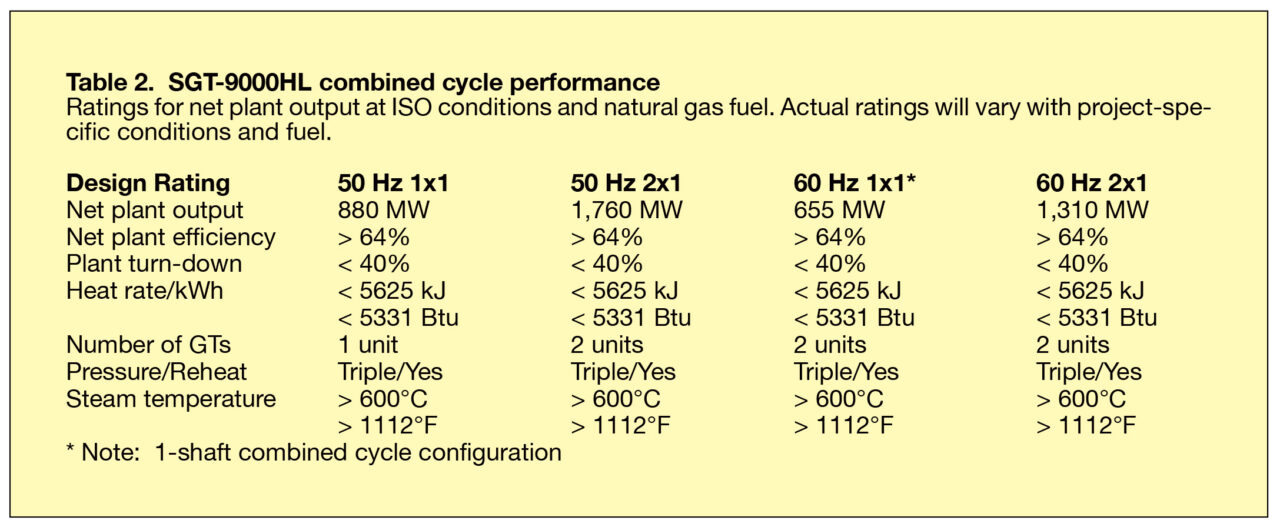
Following two years of test and validation operation at the Duke Energy Lincoln Station, the current ratings offered for simple cycle and combined cycle substantially exceed those early expectations, with the 60Hz plant power rating increased by about 13% versus original published ratings and the 50Hz plants by almost 5% (see Tables 1 and 2).
Like the H-class gas turbine, from which it evolves, Siemens Energy HL-Class gas turbine is air-cooled and has the same single tie-bolt rotor construction concept with interlocked discs using Hirth serration couplings. It also uses Hydraulic Clearance Optimization to minimize the clearance between the turbine case and rotating blade tips during operation for increased efficiency. During start-up, clearances are increased to avoid rubs. As with the H machine, the turbine stationary vane carriers and all turbine blades can be replaced without lifting the rotor from the engine.
Five areas of improvement
To complement the continued use of such proven design features, the Siemens Energy HL-Class gas turbine design’s notable improvements in efficiency and operating flexibility (compared with the H-class machine) stem from technology advances in five key areas:
- compressor flow path,
- low emissions combustion system,
- enhanced turbine blade cooling,
- advanced thermal barrier coating (TBC), and
- cooling for the 4th stage turbine blade.

Figure 2 shows a “covers-off” drawing of the HL and the H gas turbines to illustrate the “shared DNA” between the two designs — and highlights the evolutionary advancements achieved by the HL engine.
The new HL compressor makes use of advanced (3rd generation) 3D blade design technology (Figure 3) for improved aerodynamic efficiency which increases the compression ratio from 21:1 in the H-class machine to 24:1 for the HL. In addition, to reduce complexity, the HL has one less variable guide vane than the H design (two instead of three).

A similar can-annular dry low emissions combustion system retained from the H machine was modified to improve fuel/air mixing. The HL design also has a higher number of pre-mix burners surrounding the pilot burner which allows increasing the firing temperature for higher engine efficiency while maintaining low NOx levels. In addition to enabling higher engine efficiency, the combustor design is a key contributor to the gas turbine’s improved ramp rate and part-load capability.
The HL retains a 4-stage turbine design, a long time feature of Siemens Energy heavy frame gas turbines. But the higher firing temperature calls for blade design improvements, including upgraded thermal barrier coatings (TBC). In the HL turbine, TBC is used on vane rows 1 to 4 and blade rows 1 to 3. The last (4th) stage turbine blade is not coated.
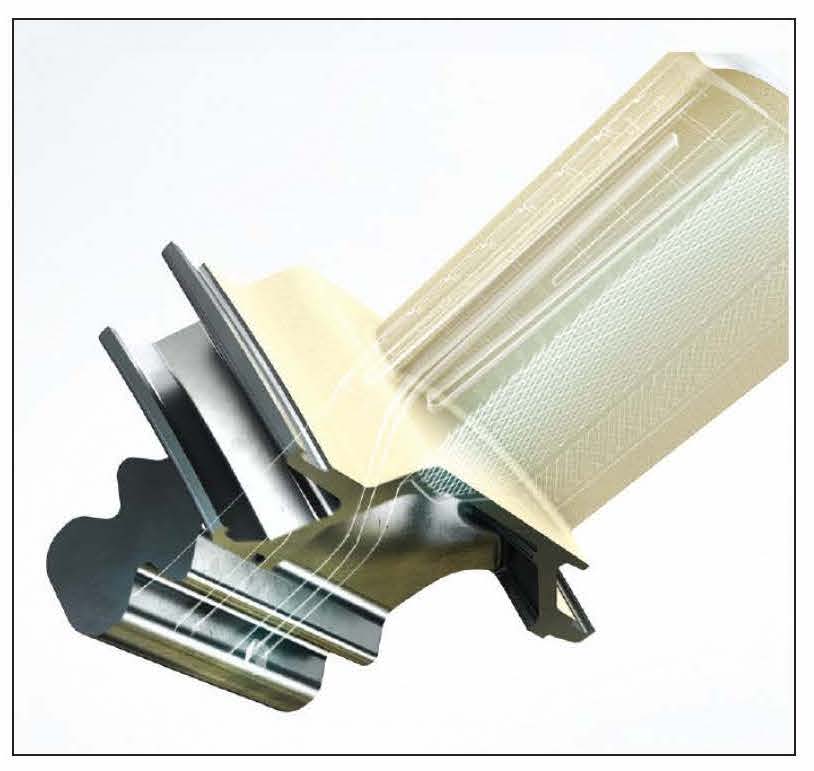
Special attention was given to the row 1 vane where higher operating temperatures call for increased coating thickness and structural reliability. For this purpose Siemens Energy developed a technology to enable increasing the thickness of the TBC while minimizing the increase in thermal stresses. In addition to improved TBC application, higher firing temperature is enabled by an enhanced turbine blade heat transfer design (Figure 4) without requiring more cooling air. This is important since bleeding compressor air for turbine cooling reduces engine power output and efficiency.
The new HL last stage turbine blade features internal cooling to cope with higher exhaust gas temperatures which increased by over 40°C (72°F) from that of the H-class to about 680°C (1256°F). This has a positive impact on the steam bottoming cycle, delivering higher combined cycle power and efficiency. Also, the new HL last stage blade is a free-standing design (i.e., unshrouded), which reduces exit losses and thus improves both simple cycle and combined cycle efficiencies.
In another move to improve engine performance, Siemens Energy HL-Class gas turbine features ambient air cooling for the turbine exhaust struts, whereas the H machine uses compressor bleed for this purpose.
Testing and validation
The two-year on-grid field test operating period represents the third and final step in Siemens Energy’s three-phase process for testing and validating the HL engine. The process began with testing key components at the company’s Clean Energy Center in Berlin, followed by engine tests on a full-scale rig. The Duke Energy installation allows the engine to be put through its paces under real-life conditions for extended periods — with results fed back into the design. Over 6,000 sensors monitor performance of the new 3D compressor blading, advanced combustion system, internal turbine cooling features, thermal barrier coatings, and new last stage turbine blade.

The engine at the Lincoln Combustion Turbine Station is installed in a simple cycle arrangement featuring a dilution SCR for added NOx reduction and an air preheater to simulate a range of ambient temperatures (see Figure 5). Essentially, says Duke Energy, it was installed to complement the growing number of renewables in the company’s portfolio.
“Duke Energy is pursuing an aggressive clean energy transition, already achieving more than 40% carbon reduction since 2005,” says Kevin Murray, vice president of Project Management & Construction at Duke Energy.
“The new gas turbine at our Lincoln site will become the most fuel-efficient gas turbine in our fleet”, continues Murray. “The unit’s fast start and high ramp rate capability will support the increase in renewables we are placing on our system while complementing our journey to net-zero carbon from electricity generation by 2050.”
Duke Energy has over 45 solar farm facilities in the state of North Carolina, adding its first solar projects in Surry, Cleveland and Cabarrus counties at the start of 2022. The new gas turbine will provide backup power when there is no or low renewable generation and to help smooth any fluctuations in the grid caused by intermittent renewable generation (see Figure 6).
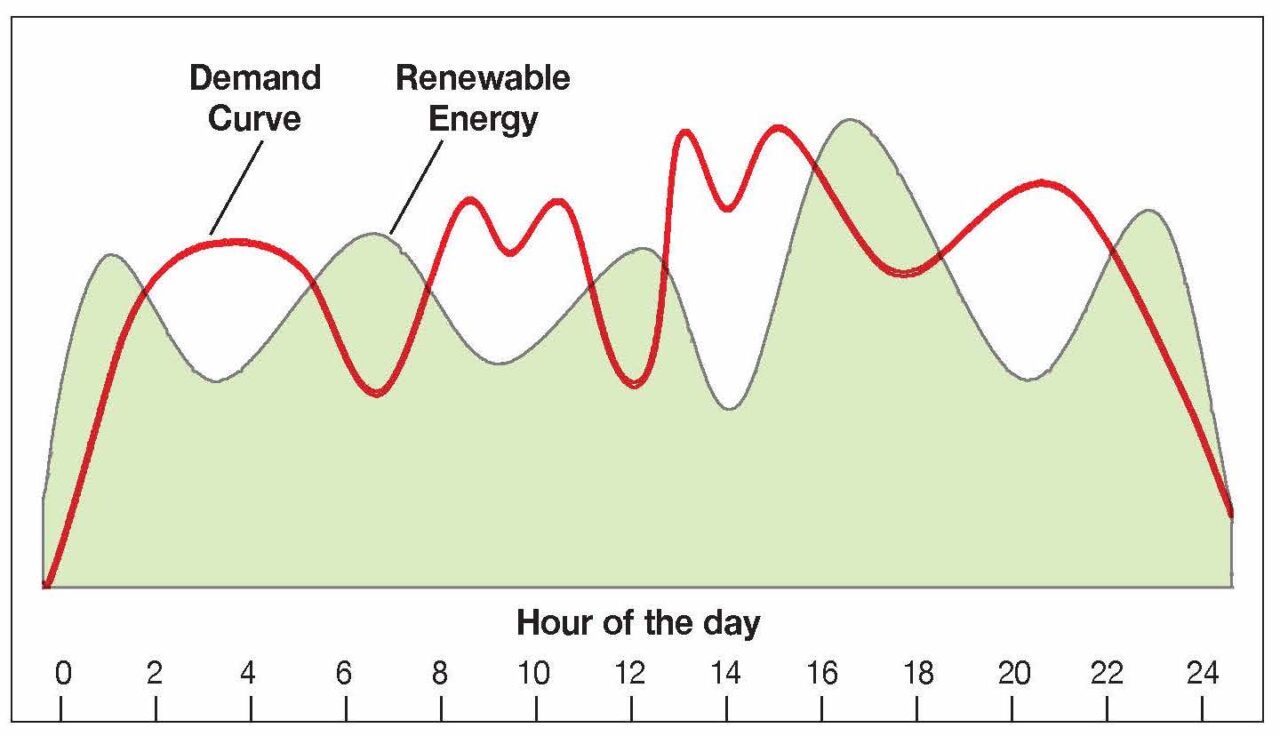
The HL’s fast ramping capability and high power output are key features for balancing the grid with the addition of more renewables capacity. Since it became operational, Duke Energy has been dispatching the plant as needed to perform critical load-following service. Despite its large size, the gas turbine has demonstrated a fast load-ramp rate and short overall start time, going from turning gear to full load in less than 10 minutes. Although the original fact sheet promised a ramp rate of 85MW per minute, the engine demonstrated capability even beyond that, 100.56 MW/min to be precise, which earned that second Guinness World Record title.
Exceeding expectations
Overall, targets for operational flexibility have been exceeded at the Lincoln site and the engine has demonstrated 100% ignition reliability. The combustion system has shown robust low-emissions performance due to Siemens Energy’s combustor premix design. All emissions targets have been met, with the engine demonstrating 25 ppm NOx and 10 ppm CO on natural gas fuel.
With these field-proven results, Siemens Energy can now offer the HL with a minimum emission-compliant load of <28% its full base load power output. Also, the SGT6-9000HL runs longer between maintenance cycles than earlier designs and will be the most efficient gas turbine in Duke Energy’s fleet when they assume ownership in 2024. It is 34% more efficient, i.e., displaying 25% lower heat rate, than existing combustion turbines at the site.
Since installation, the engine has been through an endurance run to accumulate hours on the clock and to evaluate long-term effects on critical components. Thermal paint tests and, more recently, wet compression testing have been completed. Dual fuel capability has also been demonstrated. The HL engine at the Lincoln site has been operated on both natural gas and distillate fuel — with all design targets and test-rig results validated on both fuels. Operators have demonstrated not only running capability but also fuel transfer in both directions and start-ups on both gas and distillate fuels. Based on rig testing in Berlin, the engine can also run on 100% propane.
Given today’s emphasis on the energy transition, it is noteworthy that the Siemens Energy HL-Class gas turbine engine was also rig tested on a fuel blend of natural gas plus up to 50% (by volume) hydrogen to ensure the turbine is future-ready.
Commercial operation
An agreement with Duke Energy allows ongoing testing and operation of the engine until the end of 2024 when the utility officially takes possession of the plant. This will allow Siemens Energy to continue using the HL to develop further technology advances. Meanwhile, Duke Energy has issued a formal letter to Siemens Energy to confirm that the plant has been commercially dispatching to the grid while the engine has been under test since May 2020. This replaces the customary certification of the unit’s Commercial Operation Date (COD) since the engine has been running for some time. For Siemens Energy, this means that the plant can be an official commercially operating reference.
Because of the 2-year field testing and validation program, and exceeding the Duke Energy contractual values, the simple cycle power rating for future offerings of the 60Hz 9000HL has been increased by over 13% to 440MW (up from an original 388MW rating). Likewise, simple cycle efficiency has been increased by almost a full percentage point to 43.2% (up from 42.3%). For Duke Energy, this high efficiency means the engine will be the first to be dispatched on the grid.
For future 60Hz combined cycle offerings, the 60Hz 1-on-1 9000HL plant is now rated at 655MW (up 13.5% from 577MW) at over 64% LHV efficiency.
Validation of 50Hz design
Validation and testing of the 50Hz SGT5-9000HL machine has also been carried out at SSE Thermal’s new Keadby 2 gas fired combined cycle gas turbine (CCGT) power plant project in the United Kingdom.
Initially planned as an 8000H project, the gas turbine was upgraded to the 9000HL in 2018 following introduction of the HL engine. In March 2020, through the UK’s Capacity Auction process, the station secured a 15-year capacity agreement at a derated capacity of 803.7MW. The ‘1-on-1’ combined cycle installation at Keadby 2 will be the largest and most efficient CCGT plant in Europe providing reliable and flexible back up to renewables.
In the case of the 50Hz HL field test program, over 3,000 sensors were installed on the engine. Fewer sensors were needed than with the Duke Energy unit because it is a scaled version of the 60Hz engine — so many tests carried out at the Duke Energy facility need not be repeated. This is a good example of leveraging the theoretical and well proven scaling rules between 50 and 60Hz machines. However, experience has proven that certain items, particularly the combustion system, do not follow these rules and require more thorough testing and validation.
Field verification testing at Keadby 2 means that both the 50Hz and 60Hz versions of the 9000HL have now been validated, with all but the final performance test and reliability run still to come. The Keadby 2 installation also demonstrated the improved field constructability offered by applying standardization of the auxiliary systems as adopted under Siemens Energy’s Auxiliary Integrated Packages (AIP) concept. Under AIP, the majority of the auxiliaries are delivered to the site as container-sized modules and enjoy “plug and play” connectivity. That saves significant time, effort, and project risk in the field.
The road ahead for Siemens Energy HL-Class gas turbine
Keadby 2 illustrates that Siemens Energy is supporting the journey towards a zero CO2 emissions world. Once operational, the HL plant in the industrial Humber region will realize a savings of 3.7 Mt of CO2 per year or a 62% reduction in carbon emissions compared to an equivalent coal fired plant. When the unit is run on 50% hydrogen as planned, this will result in a further 22% reduction.
The journey towards zero CO2 emissions plants continues with potential for running on 100% green hydrogen or adding post combustion carbon capture. In the UK’s Humber area alone there are already several industrial projects being developed to capture carbon and produce potential sources of hydrogen. The same is true in other parts of Europe, Asia and the United States where large investments in decarbonization are being accelerated by several government incentive programs.
The impressive results from Duke Energy’s Lincoln Station and SSE Thermal’s Keadby 2 installations are the first steps for the development and commercialization program that Siemens Energy implemented for the 9000HL. While there are over 100 H-class GTs under contract, with over 84 units in commercial operation, there are also 21 Siemens Energy HL-class gas turbines under contract. These HL turbines on order, both 50Hz and 60Hz, are spread throughout the world including the US, Mexico, Brazil, UK, Greece, Belgium, Italy, South Korea and Taiwan – demonstrating a confidence in the technology that spans across the globe.
About the authors: Hans Thermann is Head of HL Portfolio Management at Siemens Energy, and Gennadiy Afanasiev is the (former) Head of Siemens Energy HL-Class Gas Turbine Engineering.
Please visit the following link for more information on the HL-Class gas turbines: https://www.siemens-energy.com/global/en/offerings/power-generation/gas-turbines/hl-class.html