In a world’s first, SGT-400 powered CHP plant demonstrates the viability of on-site integrated power-to-H2-to-power concept, called HYFLEXPOWER.
In 2023, the gas turbine powered combined heat and power (CHP) plant at a paper mill in the small French village of Saillat-sur-Vienne was operated with up to 100% hydrogen. This was the first time that an integrated power-to-X-power system was demonstrated under real conditions within a single site.
Under an EU-funded R&D project known as HYFLEXPOWER, launched in 2020, required modifications took place at the Smurfit Kappa paper mill for enabling the CHP facility to operate on admixtures of green hydrogen and natural gas fuel — leading to the successful demonstration during 2022-23 of an integrated industrial power-to-H2-to-power pilot installation.
In addition to fuel-related modifications at the CHP plant, the HYFLEXPOWER project scope involved production, compression and storage of green hydrogen, design, development and testing of a modified Siemens Energy SGT-400 combustion system capable of operation on 100% hydrogen fuel, and the validation demonstration test program. Demo highlights:
- Fuel supply. Hydrogen production rate of the newly installed 12 MW proton exchange membrane (PEM) electrolyzer was about 164 kg/hr.
- Gas turbine. Fuel consumption of SGT-400 producing 10 MW operating on 100% hydrogen was about 810 kg/hr
- Test operation. Total 90 hours on blended fuel, included approx. 10 hrs at over 80% (vol) hydrogen with over 4 hrs on 100% hydrogen (limited by fuel supply).
Results: New 100% natural gas to 100% hydrogen-capable burner performed consistently within design margins and NOx emissions <25 ppm under all test operating conditions.
In assessing design requirements for developing a gas turbine capable of running on all blends from pure natural gas up to 100% hydrogen, Siemens Energy engineers observed that it was not enough to simply adapt existing natural gas fired models. Rather, they found that new combustors must be designed from scratch and optimized for burning hydrogen, moving progressively from natural gas fuel blends to burning 100% hydrogen. This design philosophy guided the successful execution of the HYFLEXPOWER project.

Simulations vital
The first step in the redesign process for the SGT-400 gas turbine was to design and run detailed hydrogen combustion simulations. This was no small undertaking, consisting of over two weeks of high-powered computations to simulate complex aspects of heat transfer and gas flow interactions.
The higher reactivity and broad flammability limits of hydrogen pose unique challenges for the premix combustion process characteristic of dry low emission (DLE) burners. The simulations therefore proved vital for designing the new hydrogen-capable burners since hydrogen’s higher flame speed and temperatures can result in damage to burner hardware in the event of flashback, ie. when the flame front moves upstream into the fuel/air mixing zone from its design location.
New DLE burner design
Assisted by these state-of-the-art simulation tools, Siemens Energy engineers designed the SGT-400 burners for 100% hydrogen combustion. This process was further enhanced by the application of 3D printing techniques to allow use of complex design features not otherwise practical using conventional fabrication methods.
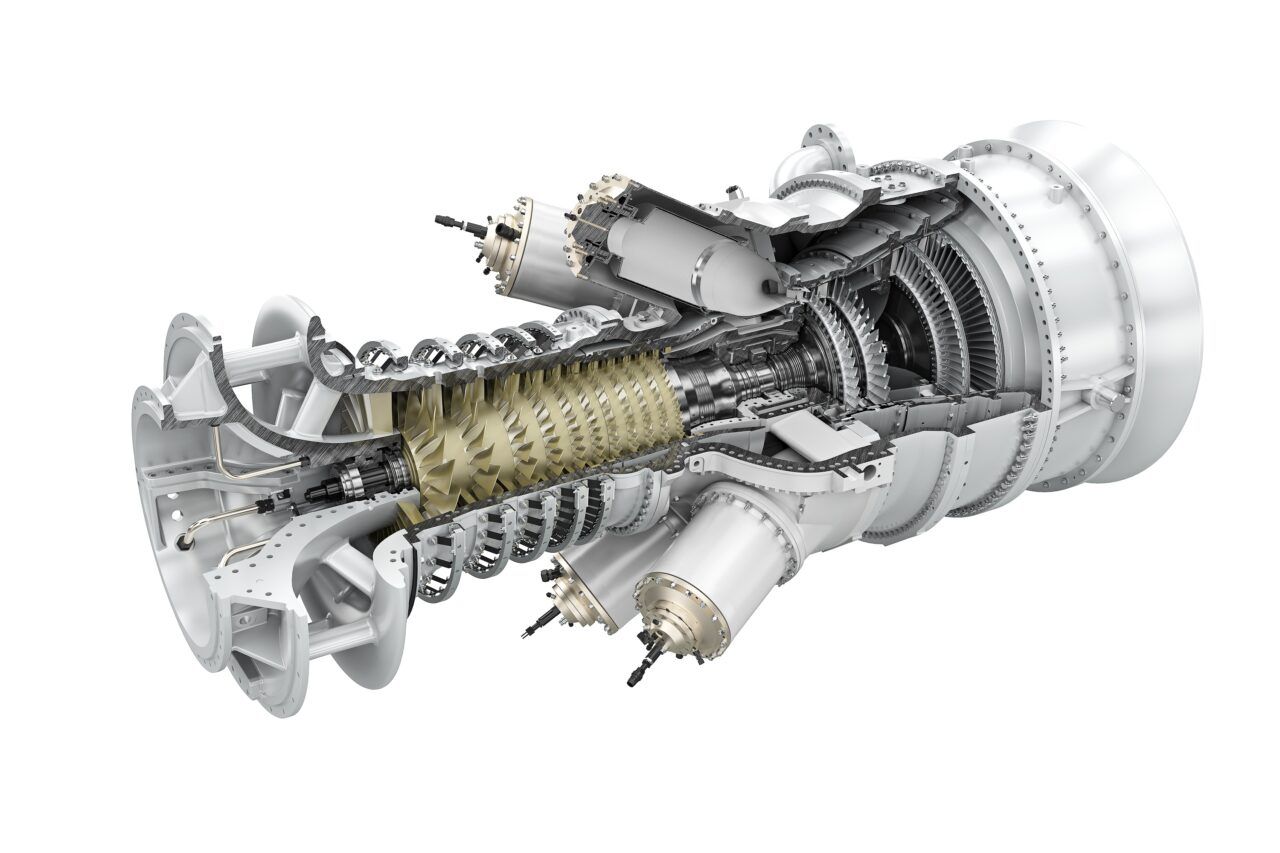
Additive manufacturing enables monolithic reproduction of the burners as a single piece of metal, ensuring structural integrity and allowing the new designs to incorporate intricate internal features such as miniature cooling and purge flow channels. Further, as designers need to alter certain details during the development process, this method of fabrication allows for fast design iterations due to rapid prototyping.
Results confirmed these benefits. Thanks to 3D printing, the engineering team optimized the hydrogen-capable DLE burner design to increase the upstream speed of fuel-and-air mixture to protect the burner hardware from harmful flashback.
H2 burner verification testing
Before deploying the new burner design to the field for the full-engine testing and verification, Siemens Energy conducted design validation tests to confirm its operation and performance.
The prototype burner was first tested in a high-pressure single-burner combustion test rig at the company’s Clean Energy Center in Ludwigsfelde, near Berlin. Testing covered a wide range of hydrogen and natural gas blends, including 100% hydrogen.
Rig testing was followed by engine testing at the gas turbine test site in Lincoln, UK, where the updated burner was installed in an SGT-400 test engine to quantify engine operability and satisfy multiple quality checks operating on natural gas. Finally, two more preparatory gas turbine engine tests were run on site at the CHP plant in France.
These engine tests proved to be an important complement to rig testing which can never faithfully reproduce real-world operating conditions of a power plant integrated into an industrial site, such as varying fuel gas pressure, temperature changes, air flow patterns, etc. Full engine testing also provides valuable data for establishing rig-to-engine correlations for future rig testing.
Fuel system upgrades
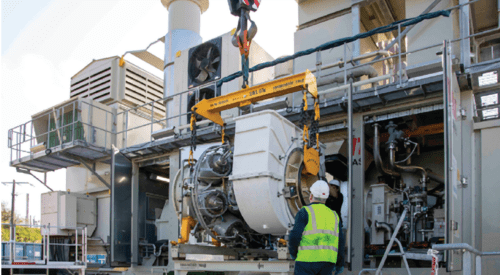
Another central change in design of the HYFLEXPOWER setup concerned the fuel gas system. Due to hydrogen’s roughly one-third volumetric energy density (kJ/Nm3) compared to natural gas, volumetric fuel flow to the engine must be greatly increased to achieve rated power output when operating at higher percentages of hydrogen content.
This necessitated an increase in flow capacity and required development of a larger capacity fuel system. Additionally, a third fuel injection port (vs. two for natural gas) was introduced, allowing the premixed combustion system to be fine-tuned, resulting in even lower NOx emissions.
For safety, to minimize the risk of hydrogen ignition, modifications were made to the standard gas turbine fuel system double block and vent piping design. The vent line was equipotential bonded and well earthed (aka grounded), flow rate minimized, and pipe system cleaned to ensure it was free of any debris or particles that could promote ignition through static discharge. Last, the gas detection system was adjusted to operate safely with hydrogen fuel.
Additionally, the turbine enclosure ventilation system was analyzed using computational fluid dynamics to determine gas cloud formations across the full range of system operating pressures. Results confirmed that the system provided sufficient ventilation airflow to prevent the buildup of hazardous gas clouds.
Over 200 sensors were added to the gas turbine engine monitoring system, especially to collect data for establishing a combustion rig-to-engine correlation, and the engine control software was upgraded to supply more real-time data to oversee the changed gas turbine setup and operating characteristics.
Green hydrogen production
To generate green hydrogen at the site, renewable energy from the grid was used for the electrolysis of water using a 12 MW proton exchange membrane (PEM) electrolyzer supplied by Siemens Energy.
The design hydrogen production rate of the electrolyzer (Silyzer 200 model) was about 16.4 kg/hr, while the fuel consumption rate of the SGT-400 gas turbine producing 10 MW of power while burning 100% hydrogen was approximately 810 kg/hr. The green hydrogen produced by the electrolyzer was compressed to 140 bar and stored in a bank of pressurized tanks installed at the plant site.
For delivering blended fuel to the gas turbine, a fuel mixing station was designed and installed for metering and mixing hydrogen with natural gas, with the ability to supply blends ranging from 100% natural gas and up to 100% hydrogen.
Demonstration test programs
In autumn 2022, field testing at the CHP plant was initiated primarily focusing on the commissioning of all the new equipment systems installed at the site. For these preliminary tests of the HYFLEXPOWER system, the SGT-400 gas turbine had a set of modified standard DLE burners and the testing was, therefore, limited to 30% (vol) hydrogen fuel blend.
Following initial test runs, and after making only minor modifications, including pilot burner fuel-side and combustor liner air-side adjustments, a planned series of tests was successfully completed. An important observation made during these tests was that the improved flame stability of the modified burner design contributed to lowering the exhaust gas NOx concentration.
For the second and central hydrogen combustion demonstration program, conducted during much of 2023, the new combustion technology SGT400 burners were installed. These advanced design burners utilized an added axial fuel stage, along with a central pilot stage and jet-stabilized main burner.
Overall, the new three-stage burner performed well across the full fuel-composition spectrum from 100% natural gas to 100% hydrogen fuel, where full decarbonization of the exhaust emissions was demonstrated. The new burner also demonstrated improved flashback resistance while operating on high hydrogen mixtures.
The HYFLEXPOWER project team completed 90 hours of testing, which included approximately 10 hours of operation with concentrations above 80% (vol) hydrogen. Of those, more than 4 hours were run on 100% hydrogen — cut short only due to limited hydrogen storage tank capacity.
Besides validating good overall performance of the new combustion system, other predictions regarding burner functional behavior were also confirmed. For example, combustion dynamics and metal temperatures remained within acceptable margins and NOx emissions stayed within the expected range, always remaining under 25 ppm.
Occasional operational challenges, such as consistency of the mixing station, were minor and easily addressed. Finally, thanks to the success of a new instant flashback detection system, the hardware remained undamaged.
Not the only game in town
Given the important role to be played by green hydrogen in the energy transition, there are other active projects with similar objectives to those of the HYFLEXPOWER project.
For example Braskem Brazil, the largest petrochemical company in Latin America, is one of several organizations that already use hydrogen blended fuel to reduce carbon emissions.
The company is using two SGT-600 gas turbines installed at a cogeneration plant at its ABC Petrochemical Complex in Mau‡, Brazil, fueled by residual process gas with up to 60% (vol) hydrogen content.
And, at the Donaustadt CHP power station in Vienna, Wien Energie, and energy suppliers RheinEnergie from Germany and Austrian Verbund, have demonstrated blending the natural gas fuel of the plant’s SGT5-4000F gas turbine with green hydrogen.
The first stage of this project burned a blend of 15% (vol) hydrogen, while the goal for the second stage is to double this to 30%. (See “Green hydrogen co-firing demonstration slated for F-class CHP plant in Vienna”, GTW, March, 2023)
Decarbonization framed in green H2
These hydrogen projects are signs of things to come for the future of gas turbines in the power and industrial sector — whether for the energy transition, avoiding curtailment, or ensuring dispatchable energy. In support of this pathway to decarbonization, all new gas turbines to be supplied by the major OEMs are expected be capable of burning 100% hydrogen by 2030 or sooner.
It is noted that using the word ‘capable’ here means these turbines can do so with no further conversions, whereas ‘H2-ready’ refers to new power plant designs and equipment for minimal changes for a fully capable conversion at a later stage. We feel that both labels apply to the CHP plant in Saillat-sur-Vienne.
And the story doesn’t end there. Starting in February 2024, building on the success of HYFLEXPOWER, a new project at the same plant, known as HyCoFlex, aims to develop a retrofitable decarbonization package for cogeneration of power and industrial heat with 100% hydrogen-fired gas turbines.
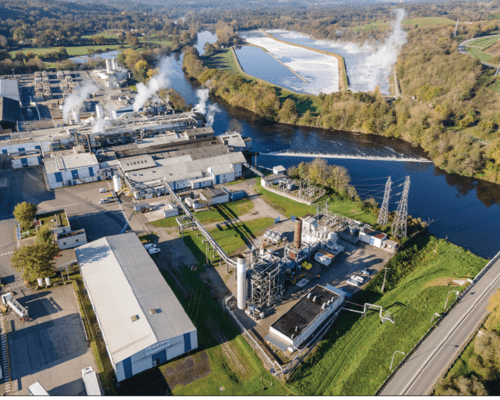
The objective is to develop operational flexibility capabilities and protocols to satisfy operating profiles typically experienced by industrial cogeneration plants.
By doing so, HyCoFlex will establish credible pathways for upscaling and replicating the retrofit package, ultimately accelerating the achievement of industrial and energy sector decarbonization.
Without a doubt, the international energy community will keep a keen eye on this small, unassuming village in west-central France.
HYFLEXPOWER project team: a diverse partnership
The HYFLEXPOWER project, with a total budget of about €15 million, of which €10.5 million was funded by the European Union under the “Horizon 2020” framework program for research and innovation, is run by a diverse consortium of partners:
Siemens Energy: responsible for the hydrogen combustor design and development, and other modifications to make the SGT-400 gas turbine hydrogen-capable plus supplying the Silyzer 200 12 MW PEM electrolyzer.
Engie Solutions: as CHP plant operator developed the advanced plant concept and upgraded the plant site for hydrogen compression, storage, mixing and supply.
Centrax: supplied the gas turbine package upgrades to ensure its safe operation on hydrogen fuel.
Arttic: provided support for operational project management.
In addition, research institutions such as the University College London, University of Duisburg-Essen, Lund University, and National Technical University of Athens all made valuable contributions.