Mitsubishi Power, a power solutions brand of Mitsubishi Heavy Industries (MHI), is integrating hydrogen demonstration infrastructure with the existing T-Point 2 single-shaft combined cycle validation facility at Takasago. The new combined asset is called “Hydrogen Park” and will incorporate hydrogen production and storage, as well as existing large and small/medium gas turbine units. The integrated facility will be used to validate hydrogen gas turbine capabilities including design, performance and durability to support commercialization of hydrogen gas turbines by 2025. Scope of facilities and operations to be co-located with MHI’s Takasago gas turbine R&D center and factory and scheduled to begin by the start of the fiscal year 2023:
- Hydrogen. Produce hydrogen on-site via conventional water electrolysis, advanced solid oxide electrolysis cell (SOEC), and methane pyrolysis technologies. Other next-generation hydrogen production technologies also to be tested.
- Storage. Provide both battery energy storage system (BESS) and pressurized gaseous hydrogen storage facilities.
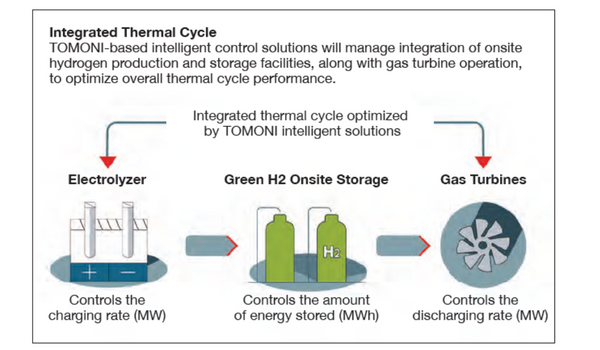
- TOMONI. Digitally integrate hydrogen production and storage with combined cycle operation to minimize process costs and optimize plant performance.
- Gas turbines. Operate validation facility for large, small, and medium-size gas turbines fueled by natural gas/hydrogen blends up to 100% hydrogen.
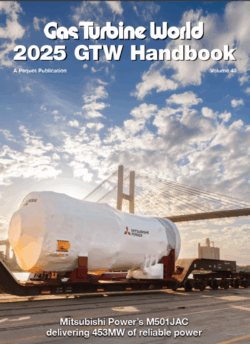
Testing will involve both the existing nominal 453MW M501JAC gas turbine installed at the T-Point 2 site and existing 40MW H-25 gas turbine – both at actual engine operating conditions. Operation of the large JAC unit will begin by using a 30% (vol) hydrogen blended natural gas fuel and go on to validate progressively higher levels of hydrogen co-firing.
Meanwhile, the H-25 will be fitted with the latest multi-cluster combustion system, being upgraded at the Takasago Research and Innovation Center, to validate capability of operation on 100% hydrogen. This modified combustor design will reduce carbon dioxide emissions to zero, says MHI, while still maintaining low NOx levels.
An integrated system
According to MHI, the plan is to establish an integrated in-house system covering all aspects of hydrogen-related technologies, from development to demonstration and verification. The Hydrogen Park will be the final element of the system where the technology will be demonstrated in an actual single-shaft combined cycle unit connected to the local grid.
In an exclusive interview, Mike Ducker, Mitsubishi Power Americas Sr. Vice President of Hydrogen Infrastructure told GTW that Mitsubishi Power is excited about having an integrated hydrogen facility at Hydrogen Park in order to demonstrate the Hydaptive integrated power plant concept, featuring on-site production and storage of hydrogen.
Ducker explained that with Hydaptive, it can run an electrolyzer to produce hydrogen and provide a productive load on the grid that could use over-produced or surplus wind and solar energy rather than curtail it.
Then, when wind or solar fall off and additional generation is needed, “we first shut down the electrolyzers to shed load and the gas turbine quickly ramped up using stored hydrogen, to assure grid stability and reliability.”
Stored hydrogen can also act as a long-term storage battery, he points out. “This enables optimal use of renewables to operate hydrogen-fueled gas turbines which can flatten out the seasonal cyclical nature of wind and solar energy.
“Conventional batteries, which are seeing growing use for short-term storage, fall short when it comes to providing needed long-term energy storage.”
Clean energy storage
In his role as Chief Operating Officer of ACES Delta, Ducker is involved with several partners in developing the Advanced Clean Energy Storage hub in Delta, Utah (see details at bottom).
This hub, the world’s largest, will incorporate several large salt caverns, each “as big as the Empire State Building” to store green hydrogen, with an announced capacity of 150,000 MWh for each cavern. With the potential to house 70 to 100 caverns, this will be enough for weeks or even months of storage for the entire west coast of the United States.
Adjacent to the hub site is the 1,800MW Intermountain Power Plant which supplies power to the City of Los Angeles. This coal-fired plant is to be replaced by an 840MW (summer site rating) combined cycle plant designed around two 1×1 hydrogen capable M501JAC combined cycle units.
Project calls for the new combined cycle plant to be commissioned in 2025 when it will use a 30% (vol) green hydrogen and natural gas blend and build up to 100% hydrogen over time. A majority of the power from the plant will continue to be sold to LADWP (Los Angeles Department of Water and Power).
Hydrogen Park design decisions
Regarding final design of the Takasago validation test facility, Ducker explains that optimization studies for the Hydrogen Park aimed at pinning down equipment size, and split between hydrogen production and storage, are still underway.

The first hydrogen production system to be installed will be based on water electrolysis using a conventional alkaline electrolyzer design. However, the capacity of that unit is still to be decided.
Alkaline electrolysis is the most mature hydrogen production method available, says Ducker. It is also a bit more efficient and less costly than alternative polymer electrolyte membrane (PEM) hydrolyzer designs.
While not confirming any commitment to a specific supplier, Ducker mentioned that MHI has invested in HydrogenPro, a Norwegian manufacturer of high-pressure alkaline electrolyzers. This supplier recently announced an order placed by MHI for 40 units of unspecified size. (GTW understands this order is still pending a final investment decision.)
Plans for the hydrogen park include installation of other more advanced electrolyzer types still in development. These include solid oxide electrolyzer cell (SOEC) technology and a process known as methane pyrolysis for producing “turquoise hydrogen” from natural gas which results in a form of solid carbon as a byproduct.
MHI views the natural gas based turquoise hydrogen as offering significant opportunities, says Ducker, although its attractiveness depends heavily on the market for carbon black and other uses of the solid carbon byproduct.
The size of the production unit (usually measured in terms of kg hydrogen per hour or MW power input) and amount of hydrogen storage capacity, he explains, will depend on “results of trade-off studies based on several factors, optimizing between costs and desired test runtime.”
Ducker indicated that the decisions will be made before too long since, according to the current project timeline, operation of the hydrogen park facility is targeted to begin in Fiscal Year 2023, i.e., in less than two years.
Run-time vs cost trade-off
Continuous run time capability is a key consideration in the design and selection of hydrogen production and storage equipment for gas turbine validation operations.
Long-term validation testing of the natural gas-fired 566MW M501JAC combined cycle plant at T-Point 2, the world’s first to operate at a gas turbine inlet temperature of 1650°C (3000°F), which started in July, 2020, is ongoing at the site. However, running validation testing on a real gas turbine using 100% hydrogen (instead of natural gas) is an entirely different issue, Ducker points out, in light of the amount of hydrogen required to be produced and stored at the site.
To put numbers on this, we used published performance ratings of the H-25 gas turbine (41MW and 9432 Btu/kWh LHV heat rate), to determine that running on 100% hydrogen at full load will require approximately 3,400 kg of hydrogen per hour.
Using a typical conversion efficiency (i.e., power input to hydrogen output) for a modern alkaline electrolyzer of 55kW per kg/hr, running the H-25 continuously on 100% hydrogen would require more than 180MW of electrolyzer input power capacity. At a unit cost of anywhere from $500 to $1,000 $/kW, that size electrolyzer installation at the test facility is probably not a viable option.
A practical alternative is to run a smaller electrolyzer installation around the clock perhaps for days at a time, says Ducker, and store the hydrogen in high-pressure storage tube tanks. This will allow for long-time gas turbine operation on stored hydrogen supplemented by hydrogen produced during the actual validation-run time.
“So the objective of the current project design study,” he explains, “is to optimize the choices to be made in the design of the facility taking into account electrolyzer and storage costs, operating costs, available space, and actual running time needed for validation purposes.”
For example, a 20MW electrolyzer installation (e.g., 4 x 5MW cell stacks) would produce almost 9,000 kg/day, enough hydrogen to operate the H-25 at full load for almost 3 hours. So, under this scenario, validation-run times would amount to roughly 3 hours for each full-day of hydrogen production.
Using the same example of a 20MW electrolyzer, running time considerations for the large-frame M501JAC (453MW and 7755 Btu/kWh LHV) with a 30% hydrogen (vol) fuel blend are very similar to the case of the H-25 using 100% hydrogen.
Since the hydrogen in a 30% (vol) blend works out to be approximately 10% of total fuel energy input (about 3.5 x 10⁹ Btu/hr), 30% (vol) blend requires just under 3,000 kg/hr of hydrogen (at 113,800 Btu/kg LHV).
When compared to the 3,400 kg/hr required to run the H-25 on 100% hydrogen, it can be seen that the run times will be similar, about 3 hours for each full day of hydrogen production.
Energy transition strategy
By supporting commercialization of hydrogen gas turbines by 2025, the Hydrogen Park validation test facility is part of MHI’s broad-based Energy Transition Strategy.
The MHI group sees itself as building a value chain for hydrogen, from production to use, through integration and advancement of the existing energy structure and hydrogen-related technologies.
Ducker sees MHI’s role as overall system integrator. “We are looking at fully integrated packages as an optimized family of technologies, including production and storage technologies supplied by others, for integrating hydrogen with our gas turbines and combined cycle plants,” he says.

H2 Hub project achieves major financing milestone
Mitsubishi Power Americas recently announced that they, along with co-developers and partners Magnum Development and Haddington Ventures, have closed on a $504.4 million loan guarantee from the U.S. Department of Energy (DOE) for the Advanced Clean Energy Storage (ACES) project in Delta, Utah.
The ACES green energy hub project has already broken ground and secured all major contracts needed, including hydrogen offtake (Intermountain Power), EPC contractor (Black & Veatch), salt cavern developer (WSP), major equipment suppliers, and O&M provider (NAES).
For the project, Mitsubishi Power will provide the hydrogen equipment integration, including the 220MW electrolyzers, rectifiers, medium voltage transformers and distributed control system. When completed the project is expected to be the world’s largest industrial green hydrogen production and storage facility.
The hub will initially convert renewable energy through 220MW of electrolyzers to produce up to 100 metric tonnes per day of green hydrogen, which will then be stored in two massive salt caverns each capable of storing 150 GWh of energy. According to Mitsubishi Power the area has the potential to house up to 100 such caverns (“each as big as the Empire State building”), providing enough for weeks or even months of storage for the entire US west coast.
Financed with the support of the DOE loan guarantee. the facility will supply hydrogen to the adjacent Intermountain Power Project. IPP is building an 840MW M501JAC combined cycle plant (two 1×1 blocks) which will replace the existing 1,800MW coal-fueled plant at the site.
The combined cycle plant will initially run on 30% (vol) green hydrogen plus 70% (vol) natural gas, starting in 2025, and increase to 100% hydrogen no later than 2045.
“The Advanced Clean Energy Storage project is well on its way to achieving its goal in the creation of a world-class green hydrogen hub,” said Craig Broussard, CEO of the joint venture.
Along with the announcement of the DOE financing, it was revealed that Black & Veatch, an industry leader in engineering, procurement and construction, will be part of the ACES project team, providing EPC services for the energy conversion facility.
In a separate but likely related announcement earlier this year, Mitsubishi Power and HydrogenPro, a Norwegian manufacturer of high pressure alkaline electrolyzers, jointly publicized signing a purchase contract for “an initial delivery” of 40 electrolyzers. Hydrogen Pro stated that their new electrode technology results in a 14% higher efficiency, enabling them to reach 93% of the theoretical maximum.
“This is a significant step forward,” they point out, “as the cost of electric power (to run the electrolyzers) amounts to 70-90% the cost of producing hydrogen, depending on market prices.” The company is targeting a production cost of $1.2 per kg for green hydrogen, well below current levels.
To learn more about Mitsubishi Power’s hydrogen gas turbines, please visit: https://power.mhi.com/products/gtcc