Gas turbine inlet air cooling estimated installed costs $/KW and benefits of each system: fogging, evaporative cooling, wetted media, and wet compression.
Gas Turbine inlet air cooling has always been prized for its ability to increase power output and improve the efficiency of simple cycle and combined cycle gas turbines in hot day operation. Increasingly, operators have also come to see cooling as a low-cost alternative for providing up to 25% more zero-emissions plant capacity without the environmental hassle, delay and cost of building a new plant. More specifically:
Capacity. Nominal increase in kW output on a 90F day can range from 5% to 25% of gas turbine nameplate rating depending on the turbine inlet air cooling technology, gas turbine design and ambient air conditions.
CO2 emissions. The added capacity is accompanied by a decrease in site or regional CO2 and other fuel-related emissions directly proportional to the increase in kW output, a reduction in plant heat rate (Btu/kWh), and associated suppression of generating with less efficient machines in order to meet system demands.
Capital cost. Installed costs can range from $15 per kW for evap/fog water spray inlet cooling to $185 per kW for refrigerated chilling, as referenced to the gas turbine plant’s standard ISO base load rating. Aside from the considerable spread in capital cost of different cooling technologies (see chart below) there is wide variation in their ability to enhance gas turbine performance during hot, cool or humid operating conditions.
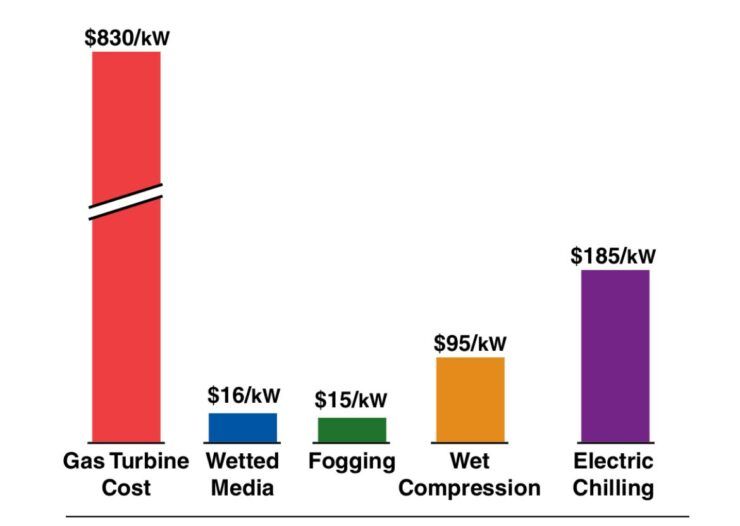
Ultimately, the optimum choice of technologies is largely determined by site weather conditions, but it also depends on what you want to accomplish and how much you have to spend.
Types of turbine inlet air cooling (TIAC or TIC)
Wetted media. Turbine inlet air cooling flow, through a continuously wetted honeycomb type fiber material (normally cellulose), evaporates water off surrounding surfaces of the wet medium thereby cooling itself. Wetted media can cool the inlet to within 85% to 95% of the difference between ambient dry bulb and wet bulb temperature. In low humidity areas, the evaporative cooling can boost power output by up to 15%, while in high humidity areas the increase is more likely to be under 10%, approaching zero at the point of saturation (100% relative humidity).
Fogging. Very fine droplets of water are sprayed into the warm inlet air stream where the droplets evaporate to cool the air (similar to wetted media systems). In this case, the fogging can be controlled to produce droplets of various sizes, depending on desired evaporation and inlet residence time under prevailing ambient air temperature and humidity conditions. Fogging can cool inlet air by 95% to 99% of the difference between ambient dry bulb and wet bulb temperatures which makes it a bit more effective than wetted media.
Wet compression. More finely atomized water than needed for turbine inlet air cooling alone, is sprayed into the intake as micro-sized droplets. Typically 3x to 4x more fogging is added than can be evaporated in the inlet (sometimes referred to as high fogging or overspray). The air stream carries over the excess water fog into the compressor section of the gas turbine where it further evaporates for compressor inter-cooling and mass flow enhancement. Combination of inlet and compressor cooling can boost power output by upwards of 25% independent of ambient temperature conditions.
Chilling. Refrigeration based system where the ambient intake air is cooled by chilled heat transfer fluid circulating through cooling coils placed inside the inlet ductwork. Electrically driven mechanical chillers or absorption chillers (steam or hot water) may be used to cool the heat transfer fluid. Chilling is not limited by humidity so it is possible to cool ambient air below its wet bulb temperature, typically down to around 45F to 55F, for upwards of a 25% increase in power output.

Gas turbine sensitivity to temperature
The power output of any gas turbine is very sensitive to ambient temperature. Maximum power typically drops by about 0.3% to 0.5% for each degree Fahrenheit increase in ambient temperature (0.5% to 0.9% for each degree Celsius rise).
Heavy frame machines are less sensitive than aeroderivative units. Typically, they operate at lower pressure ratios than aero units but with much higher mass flow so that temperature changes have proportionately less impact. For example, on a 95F day, the power output of an old heavy frame unit operating at a pressure ratio of around 10 to 1 will decline by 7 or 8% (off its standard 59F nameplate rating) as compared to a 15% drop for a new aeroderivative gas turbine operating at a 30 to 1 pressure ratio. In real life, each gas turbine model has a unique temperature-effect curve specific to its design parameters and component efficiencies with respect to change in power output, heat rate and exhaust flow.
How inlet cooling helps
High ambient temperatures usually coincide with peak demand periods and are especially detrimental during hot summer days when the reduction in power output is greatest. Turbine Inlet air cooling offers a low cost solution to offset power loss at high ambient temperatures. Cooling the inlet air below 59F allows gas turbines to exceed their rated output.
In addition, turbine inlet air cooling and particularly wet compression helps minimize the degradation in heat rate with increases in ambient temperature. Since gas turbine heat rate is inversely proportional to fuel efficiency, any increase in heat rate means higher fuel consumption – along with fuel related CO2 emissions and other pollutants.
Inlet cooling also has a positive effect on steam production and power output of combined cycle plants. Increased gas turbine mass flow entering the heat recovery boiler produces more steam which, in turn, helps increase steam turbine kW output.
Retrofitting a high efficiency combined cycle plant with inlet cooling is also an effective way of increasing peak power output and reducing the cost of electricity (COE) compared to an advanced simple cycle peaker (see chart below). Annualized $65/MWh cost of electricity for a 2×1 combined cycle 7F peaking plant with chilling added is over 40% less than the $115/MWh COE for a simple cycle LM6000PC Sprint peaker with hot selective catalytic reduction and inlet cooling.
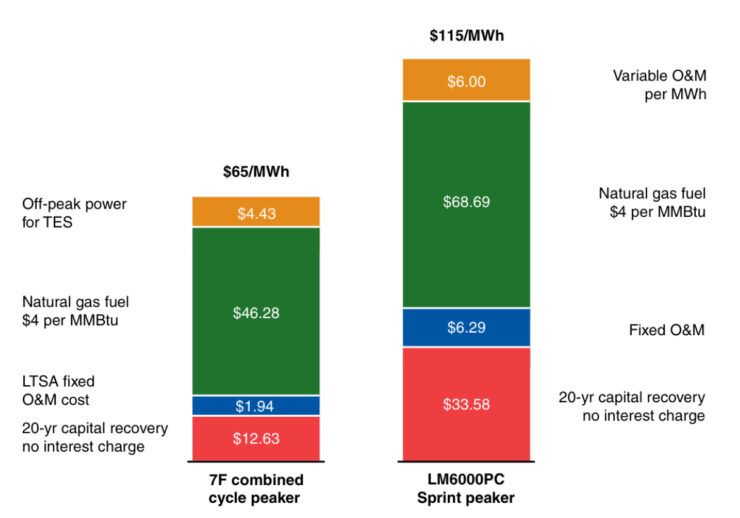
Combined cycle cost includes an annual fixed long term service fee of $20 per ton ($110,000) for the chiller plus an off-peak power cost of $40 per MWh (amortized over peak hours) to recharge thermal energy storage tanks. COE for simple cycle LM6000PC includes a fixed cost of $250,000 per year for scheduled overhaul and maintenance, $6 per MWh variable O&M cost, plus additional fuel cost.
Dispatch factors
The preferred order of dispatch for providing electric power from a combined cycle peaking plant incorporating turbine inlet air cooling and duct firing is to bring the most efficient combination of technologies online first (see below). This chart is based on a 2×1 Fr 7F combined cycle peaking plant ISO rated at 509,200 kW and 6150 Btu/kWh heat rate (55.5% efficiency) equipped with evap/fogging and inlet chilling plus supplementary duct firing to increase HRSG steam output.

Calculations show that plant performance falls off to around 452,200 kW output and 5640 Btu/kWh heat rate (53.6% efficiency) at 95F dry bulb and 78F wet bulb inlet air temperature conditions. Cooling the turbine inlet air flow by fogging to its dew point will add 36,860 kW and increase net plant output to 489,060 kW at 6800 Btu/kWh heat rate (50.2% efficiency). Chilling to further cool the air to 50F will add another 16,870 kW for a net plant increase to 505,930 kW and 7895 Btu/kWh heat rate (43.2% efficiency). Supplementary duct firing could boost steam turbine generation by 73,900 kW and increase total combined cycle plant output to 579,830 kW at 8440 Btu/kWh heat rate (40.4% efficiency). Total performance increase in this example would be 17.8% boost in power output compared to performance at ambient temperature.
CO2 reduction
One major environmental benefit of turbine inlet air cooling technology is that it enables simple cycle and combined cycle gas turbine plants to operate at higher than rated power output and efficiency, despite hot and humid air conditions.
The increase in capacity helps defer (and sometimes eliminate) the need to bring older and less efficient power plants on-line to meet grid demand, particularly for peaking power. Higher efficiency reduces fuel consumption and production of collateral CO2 emissions and other fuel-related pollutants.
Turbine inlet air cooling for already efficient combined cycle plants allows them to operate at significantly lower CO2 emissions per kWh of generation in comparison to highly efficient simple cycle gas turbines equipped with inlet cooling.
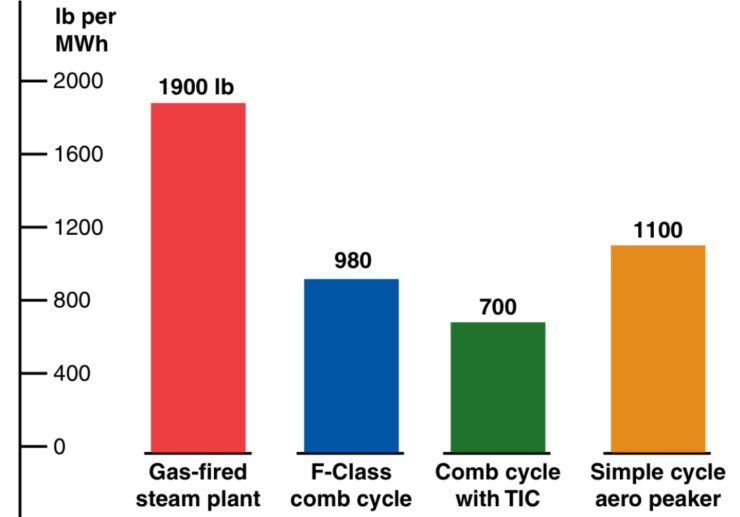
The 1×1 F-Class combined cycle plant shown in the chart is rated at 260MW and 57% to 58% efficiency. Under 95F dry bulb and 78F wet bulb temperature conditions, with turbine inlet air cooling, the combined cycle plant will generate about 700 lb of CO2 per MWh of generation compared to 980 lb for the same plant without using cooling.
That is less than the 1100lb of CO2 per MWh for a simple cycle LM6000 Sprint peaking plant equipped with inlet cooling – and significantly lower than the 1900 lb of CO2 produced by a natural gas-fired steam plant.
Regulated criteria pollutants
Additional benefits of gas turbine inlet cooling include a decrease in emissions of all kinds that accompany improvements in heat rate. The reduction in regulated criteria pollutants, notably hydrocarbons (HC), carbon monoxide (CO) and nitrogen oxide (NOx), is similar to that of carbon dioxide emissions for inlet cooled simple cycle and combined cycle plants.
Turbine inlet air cooling project benefits
Operational and economic benefits of turbine inlet air cooling apply to new gas turbine projects, both simple cycle and combined cycle plants, and to existing plants on a retrofit basis.
For new projects, the economic benefit of inlet cooling is that the $/kW cost for the increase in capacity is usually well below the $/kW capital cost of the plant on its own.
When retrofitted to existing plant installations, especially combined cycles, the added capacity can be enough to eliminate the need for new generating capacity.
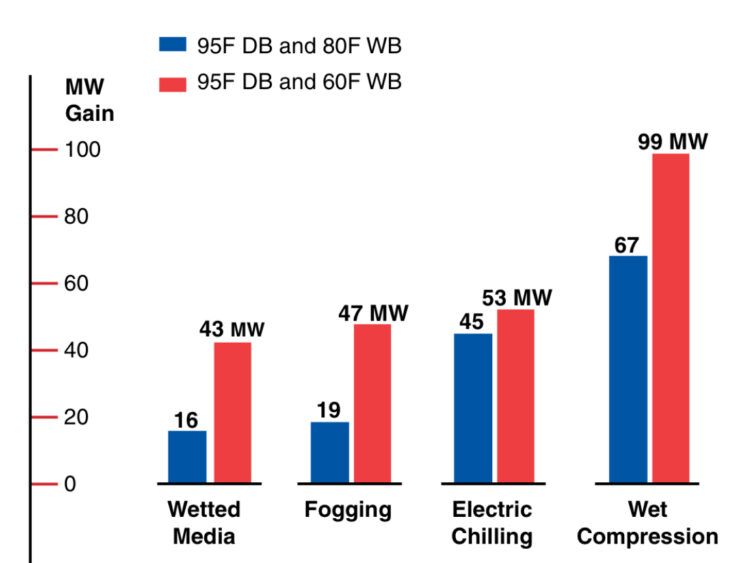
The relative potential of various cooling technologies to increase capacity (without burning more fuel) depends on ambient air conditions. Take for instance a 2×1 combined cycle plant ISO rated at 500 MW. As shown, wetted media and fog cooling are more effective adding capacity when the relative humidity of the ambient air is lower; chilling and wet compression are both much less dependent on humidity.
It is worth noting that many comparative charts are based on reasonable assumptions for each technology based on experience and in-depth design study of equipment capabilities and performance. They are intended to provide a generic grasp of commonly applied cooling technologies and should be treated accordingly rather than be accepted as gospel or case history.
For preliminary planning purposes or questions about performance, the major turbine inlet air cooling system suppliers are always the best source for information directly related to your project interests.
Evaluation factors
The power capacity enhancement potential of different turbine inlet air cooling technologies for a specific project application depends largely on geographic location of the plant (climate and weather) and gas turbine design performance characteristics.
The economic choice of technologies depends largely on the projected return on investment with respect to expected hours of operation during the year under comparable temperature and humidity conditions, amount and value of the incremental increase in power produced, and competitive cost of outside purchased power.
The same historical weather data that utility planners work with to analyze peak load demand during different seasons and hours of the day can also be used to evaluate and estimate the annual gas turbine inlet air cooling load and frequency of hot, cool and humid days of operation.
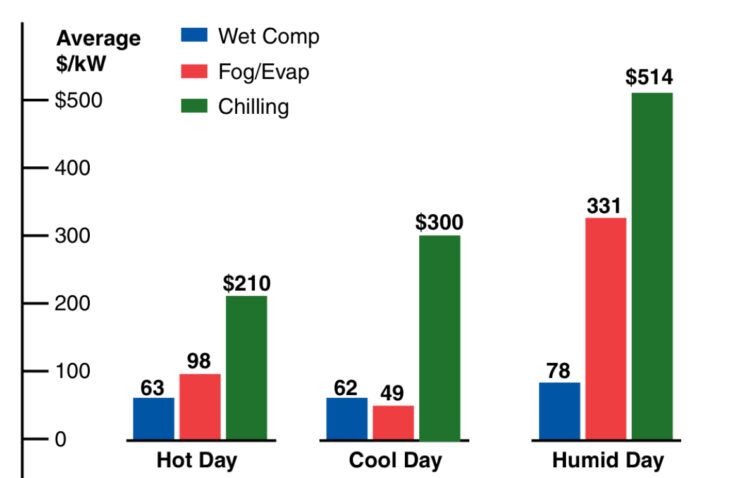
Hourly costs ($/kW) are averaged over the entire day that a system is used to approximate the relative cost of cooling technology options operating at hot day, cool day and humid day ambient air conditions.
For hot day operation, as the chart shows, the wet compression average cost is $63/kW; fog/evap cooling is $98/kW; and chilling $210/kW. The significant difference between these technologies, say cooling project engineers, is due to the varying spread between dry and wet bulb temperature throughout the day.
Similarly, energy gains (MWh) differ for each technology. For hot day operation, wet compression shows a gain of 854 MWh; fog/evap cooling 235 MWh; and chilling 301 MWh.

The cooling technology gains for hot day, cool day and humid day operation represent the increase in saleable energy over a 24-hour period.
Built-in cooling
Gas turbine builders also incorporate compressor intercooling to augment power output. GE Vernova Aero, for one, has been increasing the power output of its LM6000 series by at least 15% to 20% with its Sprint (spray intercooling) design upgrades.
The latest LM6000PF model is ISO rated at around 44 MW and 8188 Btu/kWh heat rate (41.5% simple cycle efficiency). By comparison, the LM6000PF Sprint version, with water intercooling, is rated at 49 MW.
GE Vernova’s LMS100 gas turbine design incorporates off-engine intercooling (heat exchanger) to give it a nominal rating of 109 MW and 7784 Btu/kWh heat rate (43.8% simple cycle efficiency).
Several LMS100 power plant peaking and base load installations have been equipped with evaporative inlet cooling systems for hot day performance enhancement.
Better performance, better planning
In addition to the increase in output, a major benefit of turbine inlet air chilling is a plant operator will know months in advance the exact power output and heat rate for the plant, regardless of any day’s temperature or special weather conditions (humid, dry, etc.). This provides for accurate planning of power production as well as better forecasting a plant’s need to add new capacity or purchase power from the market.
For further reading, see “Old Inlet Fogging Idea Gets New Life“.