The new combined cycle power plant at Flémalle has set a record for the world’s largest HRSG.
The new plant replaces the old Awirs power plant complex (originally coal, subsequently employing a range of fuels, including natural gas, oil and biomass). The new 875 MW plant will be able to participate in the Belgian capacity remuneration mechanism, introduced in 2021, to help ensure security of electricity supply.
The heat recovery steam generator is the biggest ever supplied by John Cockerill and the world’s largest HRSG, and will produce a third of the power plant energy. As well as the sheer scale, other challenges associated with this project included very low nitric oxide (NOx) limits (coupled with very tight ammonia slip controls), use of dissimilar welds – necessary to avoid sensitization of stainless steel – which have a major impact on the HRSG design.
Useful links:
- Looking for plant performance data of HRSGs combined with different gas turbines? See the following tables with plant configurations and HRSG performance specs, including information about the best selling models from GE Vernova, Siemens, Mitsubishi (and more). CLICK HERE.
Plant Efficiency of 63%
The new HRSG is installed downstream of a Siemens Energy SGT5 – 9000HL gas turbine (593 MWe), achieving a power plant efficiency of over 63%. The power plant features a one-on- one multi-shaft configuration, with steam from the HRSG driving an SST5 – 5000 steam turbine coupled to an SGen5 – 1200A generator and the HL gas turbine coupled to an SGen5 – 3000W generator.
A distinguishing feature of the HRSG is its four-module width, with a consequent increase in the number of tubes and heat exchange surface area.
The structural steelwork is enlarged to accommodate the four modules side by side. The casing inside-width is 18.7 m and casing height 26 m. This is the first HRSG of this width, and in terms of these dimensions, the largest HRSG ever. HRSGs for class F and H gas turbines typically employ a three-module width.
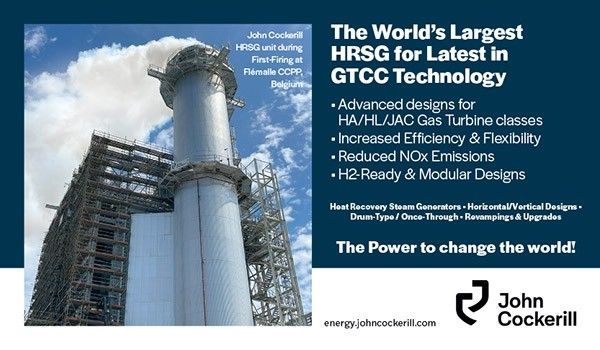
Basic data for the HRSG can be summarized as follows:
- Type: horizontal GT exhaust flow, three pressure levels plus reheat (with recovery of heat at the exit of the high-pressure ST stage reinjected at the medium pressure level). No duct burner
- Live steam operating conditions at HRSG outlet: HP steam at 602°C and 164 barA; reheat steam at 609°C and 40 barA
- Boiler dimensions: 73 m long and stack height 60 m
- Heat exchange surface area: more than 1 000 000 m2, which is a milestone in HRSG evolution
- Weight: 10 500 t
- Tube materials: hottest superheater and reheater tubes will employ austenitic stainless steel finned tubes, with Incoloy transitions to ferritic alloy steel outlet headers
- Integrated SCR achieving reduced NOx with low residual ammonia. Requirements (at the stack): less than 10 mg/Nm3 NOx; max NH3 slip 1.5mg/Nm3
- CFD modelling performed for the SGT5 – 9000HL has demonstrated that there is no need for an attenuation flow grid in the HRSG inlet duct thanks to the long transition duct between GT exhaust and HRSG inlet. This long straight duct is just a provision for the potential future addition of a bypass stack
Despite the high HP pressure, the HRSG is of the conventional drum type, and is perhaps at the limit for this technology, due to separation limitations of water and steam in the drum demisters. To achieve higher pressures, a once through boiler (OTB) configuration is required for the HP circuit, and indeed John Cockerill is currently supplying vertical-Once-through-Boilers for another Combined Cycle plant equipped with two (2) SGT5 – 9000HL, following the noted market shift in Europe towards OTB technology to accommodate the largest gas turbines. A vertical OTB, manufactured by Siemens/NEM, is employed at the Keadby 2 CCGT power plant in the UK.
Boiler Stress Evaluator software based on Euro-Norm codes (developed by John Cockerill), are uploaded onto the Flémalle power plant DCS and combined with dedicated temperature measurements on critical components such as the outlet headers and HP drum. This will enable boiler lifetime to be monitored and support predictive maintenance. Thermocouples will provide temperature profiles over the thick walls during transients, and induced thermal stresses will be calculated.
The order for the Flémalle HRSG was placed at the end of 2022 and the CCGT unit´s First-Firing took place in August 2025.
The new combined cycle plant will be highly flexible in operation. “Designed to facilitate frequent start-ups and changes of regime, it will also provide all the flexibility necessary to adapt to the significant production fluctuations required by the intermittent side of renewable energies”, says Eric Absil, president of John Cockerill Energy Solutions, noting that in the current context of the energy transition, combined cycle power plants are “a key element of national energy mixes.”
Gilian Deblauwe, Chief Operations & Engineering Officer at ENGIE Renewable & Flex Power, says his company has “made great efforts to develop a state-of-the-art project in Flémalle in order to reduce the impact on the environment and to integrate the plant into local communities”, and “decided to go beyond its obligations by further reducing NOx emissions. We are convinced that the Flémalle plant, which represents an investment of 500 million euros, will be one of the world’s best benchmarks in terms of efficiency and emissions control.”
ENGIE subsidiary Electrabel is acting as EPCM contractor for the Flémalle combined cycle plant and selected John Cockerill for the HRSG package, which included balance of plant portion and pipe rack to the steam turbine building, and HRSG erection activities. John Cockerill has worked several times with ENGIE, and among other contracts, on the supply of heat recovery steam generators for combined cycle power plants, at Amercoeur (Hainaut, Belgium) and Dunamenti (Hungary).
Useful link:
- Looking for plant performance data of HRSGs combined with different gas turbines? See the following tables with plant configurations and performance specs, including information about the best selling models from GE Vernova, Siemens, Mitsubishi (and more). CLICK HERE.
HRSG Case Studies:
- HRSG with 4 x GE Vernova 9F gas turbines for Besyama III Combined Cycle plant in Iraq, rated at 1500 MW capacity.
- HRSG with Mitsubishi M701JAC gas turbine for Keppel Sapra Cogeneration plant in Singapore, rated at 600 MW
- 3-pressure level + reheat HRSG with a CO catalyst for 600 MW hydrogen-ready power plant using MItsubishi M701JAC gas turbine.
About John Cockerill:
For over 200 years, John Cockerill has been a global leader in the design, supply, construction supervision and commissioning of Heat Recovery Steam Generators (HRSGs), Once-through Boilers (OTBs), and H2-ready HRSGs for combined cycle power plants, for cogeneration, and integrated solar combined cycles. Over 750 John Cockerill HRSGs are installed worldwide supporting gas turbines of all brands and power ratings. John Cockerill also provides renowned technical expertise for recovery boilers of all brands. To learn more, please visit us at: https://johncockerill.com/en/