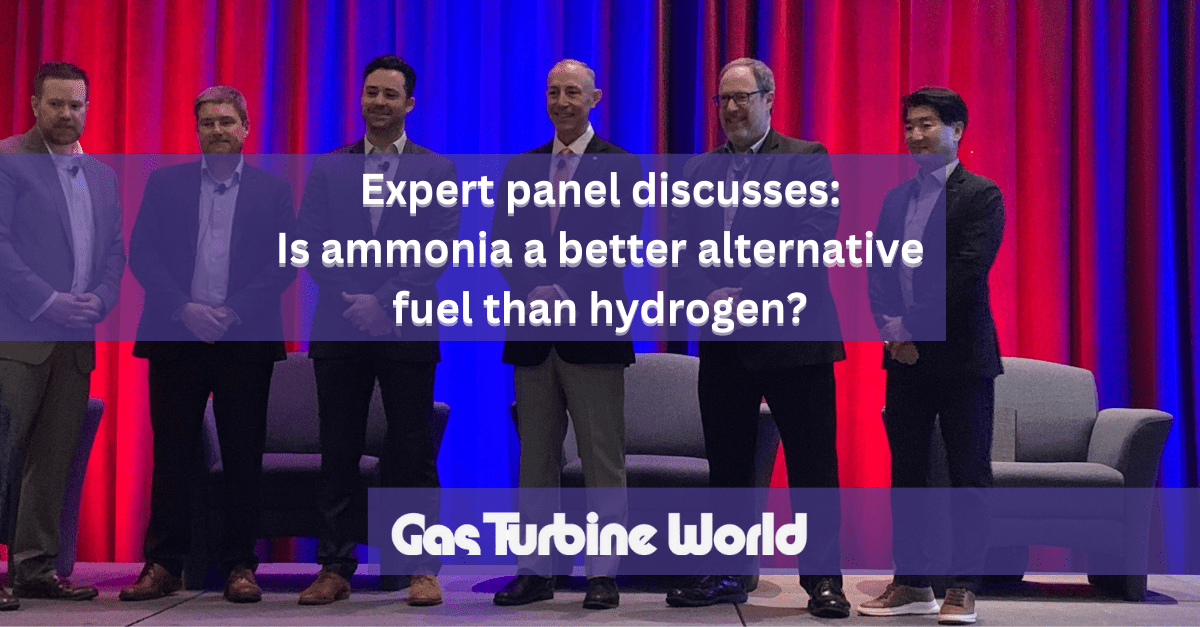
The challenges of hydrogen availability and transportability (due to relatively low density, even when liquefied) have led some to propose ammonia as an alternative decarbonization fuel source to hydrogen.
As a derivative of hydrogen, ammonia is expected to be utilized directly in power generation as a carbon-free fuel. Since it contains no carbon, it does not emit carbon dioxide when burned and may therefore enhance the power sector’s efforts in reducing carbon emissions.
At PowerGen International 2024, Jason Jermark, Vice President of Global Services Operations, Gas Services, Siemens Energy, said that his company has seen an uptick in interest in ammonia as a generation resource. Siemens Energy has several demonstration projects on the go. It is also partnering with Air Liquide to combine their experience in hydrogen and ammonia.
“Ammonia has a far higher energy density than hydrogen,” said Jermark.
Similarly, Benjamin Thomas, Senior Manager, Hydrogen Production Engineering, Mitsubishi Power Americas, listed memorandums of understanding it has for developing ammonia-fired power plants in Thailand, Singapore, and Europe.
Meanwhile, GE Vernova has partnered with IHI of Japan to develop a new gas turbine combustor capable of using ammonia for power generation compatible with GE Vernova’s 6F.03, 7F and 9F gas turbines. Combustion testing will take place in IHI’s facilities in Japan.
IHI has already successfully developed a 2 MW gas turbine using 100% liquid ammonia. Together, these two organizations are evaluating combustion technologies to determine their ability to meet operational requirements. The plan is to co-develop a two-stage combustor configured to burn up to 100% ammonia to comply with emission requirements.
Part of the excitement about ammonia comes from it being utilized today in industrial applications such as fertilizers and in the chemical industry. Hence, there is an abundance of existing infrastructure in place (which isn’t the case with hydrogen).
“Ammonia offers a new pathway for decarbonization and could become especially valuable in LNG-dependent markets in Asia,” said GE Vernova’s Jeffrey Goldmeer. “It is not economical to move liquid hydrogen over long distances. Ammonia is a far cheaper way to ship it and there are already up to 20 million tons a year of ammonia being transported around the world.”
What about moving ammonia from place to place and then converting it back to hydrogen? The energy requirements for the cracking of ammonia to provide hydrogen are high. And there are serious emissions challenges, too.
To resolve these issues Doosan is building a combined cycle gas turbine plant with integrated ammonia cracking to maximize energy efficiency. The goal is to take ammonia, break it down to nitrogen and hydrogen and use the hydrogen to run gas turbines. Heat recovery technology is being used to lower the energy requirements for ammonia cracking.
For more event coverage, please see the following articles:
PowerGen International 2024 Focuses on Decarbonization
Carbon Capture and Storage Interest Ramps Up
Unlocking Hydrogen’s Power Potential