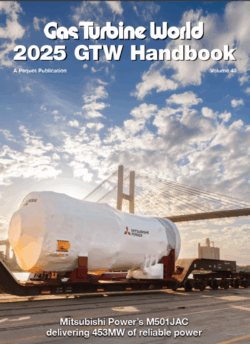
This article is part of our series on “Transition 2 Hydrogen”, covering suppliers whose technologies and solutions will contribute to the switch to burning 100% hydrogen in gas turbines, and to the rollout of hydrogen solutions in power generation, energy storage, electrolyzer technology, and pipeline/distribution. To register for monthly updates, CLICK HERE
Current capabilities of gas turbines burning high-hydrogen fuel mixtures
As a highly efficient well-established and versatile technology, today’s natural gas-fired turbine systems are contributing to a smooth transition towards a decarbonized future centered on their ability to also burn hydrogen fuel.
Already existing assets and infrastructure can be used with today’s gas turbine technology adapted for hydrogen operation to drastically reduce the carbon footprint of electric power generation and oil & gas sectors of industry.
Driven by this vision, considerable efforts have been launched by gas turbine OEMs to determine more clearly how much hydrogen can be tolerated by existing gas turbine designs. And to assess the adverse impact of hydrogen combustion on design (e.g., shortened lifetime of hot gas path components) and on performance (higher Nox emissions).
First order of business has been to qualify existing gas turbines for operation on a low blend of hydrogen and natural gas fuel mixtures while developing the engineering technologies needed to safely and reliably operate on 100% hydrogen fuel.
Historically, extensive operating (and design) experience with high hydrogen content fuels has been accumulated with gas turbines developed for the combustion of syngas derived from gasification of fossil fuels and biomass.
Depending upon feedstock and gasification technology used, their hydrogen concentration has ranged between 30 and 60% by volume hydrogen, with remaining fuel component being mainly carbon monoxide .
Most major gas turbine OEMs today offer specialized gas turbine products (originally developed for syngas applications) capable of running on blended natural gas and hydrogen fuel mixtures with high hydrogen content (about 60% by volume) and, sometimes, even up 100% hydrogen. But today’s high volume hydrogen mixes produce very high Nox emissions, which is more damaging than CO2: according to the US Environmental Protection Agency, “the impact of 1 pound of N2O on warming the atmosphere is almost 300 times that of 1 pound of carbon dioxide.”
Today’s designs combine simple diffusion burner combustion technology with dilution (steam, water or nitrogen) to cope with the challenging properties of highly reactive fuel mixtures. However, diffusion combustion cannot match low Nox emission values (25ppm) guaranteed by advanced gas turbine dry low emissions (DLE) premix combustion technology.
Long range hydrogen target
The goal of industry research and development is to match state-of-the-art dry low Nox emissions (below 25ppm) while operating on fuel gas mixtures containing increasing percentages of hydrogen up to 100% H2.
So far, new and modified combustion technologies in development are based on DLE combustion techniques (lean premixed combustion without dilution) as the main line of pursuit. Engineering changes for hydrogen combustion also require new materials and cooling technologies for hot gas path components.
Several OEMs have successfully tested hydrogen-enabled gas turbine models with adapted DLE combustion systems operating on fuel gas mixtures with up to 30% vol. H2 (or even 60% vol. H2). Some cases, however, require a power de-rating accomplished by lowering the firing temperature.
Combustor developments with novel combustion concepts (e.g. micro mixing concepts and constant pressure sequential combustion) are also being pursued and have shown promising results on gas turbine test bench installations.
Unlocking the potential of hydrogen
To unlock the potential of zero-emission hydrogen gas turbine technology in a future energy landscape, cooperation between manufacturers, end-users and academia will be essential to raise the gas turbine readiness level up to demonstration status.
Deploying new technology in a real world environment is another challenge to be overcome during the demonstration phase. Future gas turbines must deal with a wide range of variable hydrogen and natural gas mixtures while being operationally flexible to stabilize grid frequency fluctuations.
Demonstration projects are required in many locations to verify the feasibility of new system solutions faced with different local/regional boundary conditions. The retrofit scope of existing gas turbines must be evaluated case by case for given hydrogen levels in the public pipeline network, considering modifications in the fuel skid, and in the controls and combustion system.
Capital expenditures associated with retrofit solutions for gas turbines power plants will also require market conditions favorable for wide-spread introduction of the technology. Regulatory measures should ensure a level playing field for all technology providers.
Hydrogen gas turbine readiness
The immediate hydrogen research and development target for gas turbine OEMs is to match the state-of-art low Nox emissions (25 ppm and less) performance of today’s advanced gas-fired turbines, with natural gas fuel mixtures containing increasing amounts of green hydrogen.
Hydrogen Gas Turbine readiness: OEM REPORTS
- Ansaldo Energia predicts that by 2030 its entire portfolio of gas turbines will be 100% hydrogen capable. CLICK TO READ REPORT
- Mitsubishi Power: The development of 100% H2 firing combustor is slated for completion in 2025. CLICK TO READ REPORT
Register to receive the following OEM reports:
- GE: the newest combustion system, the DLN 2.6eAs technology was developed from a program intended for high hydrogen fuels, and has capability beyond 50% hydrogen; an internal roadmap has been developed, mapping out the steps to reach 100% hydrogen over the next decade. This combustion system is now in new units and can be applied as upgrades for existing gas turbines.
- MAN Energy: 100% hydrogen combustion systems for MAN Energy GTs will be available starting in 2025.
- Siemens: By 2030, Siemens Energy intends to have gas turbines capable of running on 100% hydrogen across its complete portfolio.
This article is part of our series on “Transition 2 Hydrogen”, covering suppliers whose technologies and solutions will contribute to the switch to burning 100% hydrogen in gas turbines, and to the rollout of hydrogen solutions in power generation, energy storage, electrolyzer technology, and pipeline/distribution. To register for monthly updates, CLICK HERE